

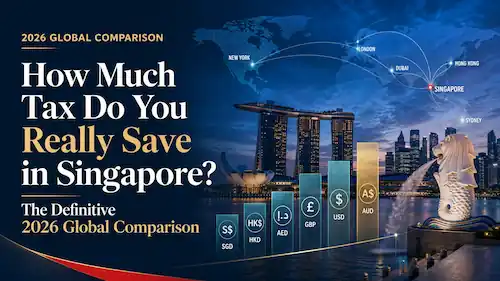
How much tax do you really save by incorporating in Singapore? For a scaling business generating S$300,000 in annual profit (Estimated Chargeable Income), Singapore’s Startup Tax Exemption (SUTE) caps the corporate tax bill at just S$29,750 (an effective rate of 9.91%). Compared to major global markets, this represents annual corporate tax savings ranging from S$30,250 to over S$49,000.
S$29,750 (Effective 9.91%)
0% (Tax-free extraction)
0% (Generally exempt)
Key Takeaways for Global Founders
- Progressive Tax Shield: SUTE actively rewards early growth, taxing the first S$100k of profit at an effective 4.25%, and the next S$100k at 8.5%.
- The Repatriation Advantage: Unlike many Asian neighbors that impose withholding taxes on outbound profits, Singapore charges 0% withholding tax on dividends paid to foreign shareholders.
- Strategic Regional Structuring: Sophisticated founders often deploy a "Singapore HQ + Regional Operations" model to optimize both operational costs and global tax efficiency.
- Economic Substance is Mandatory: To satisfy Controlled Foreign Corporation (CFC) rules in your home country, your Singapore entity must maintain genuine operational substance, not just a registered address.
Fast Facts — Global Corporate Tax Comparison (2026)
The Strategic Tax Advantage of Incorporating in Singapore
For global founders, choosing a jurisdiction is no longer just about finding the lowest headline corporate tax rate. It is about finding a stable, reputable ecosystem that offers legitimate, structured tax efficiency, access to global capital, and operational flexibility.
Singapore has engineered its tax system to reward growth, innovation, and regional expansion. Through mechanisms like the Startup Tax Exemption (SUTE), a territorial tax system, and an extensive network of Double Taxation Agreements (DTAs), Singapore consistently outperforms major global markets in total tax burden for early-stage and scaling companies.
This definitive guide compares Singapore’s tax framework against 9 major global markets, providing data-driven insights to help you structure your business for maximum efficiency in 2026 and beyond.
Table of Contents
The 9-Country Tax Savings Comparison
To see how this translates into real-world cash flow, consider a growing startup or SME generating S$300,000 in annual profit (Estimated Chargeable Income).
In most major economies, a profit of this size is taxed at standard headline rates—often between 20% and 27%. Yet, under Singapore’s Startup Tax Exemption (SUTE), the corporate tax liability on that exact same S$300,000 is reduced to just S$29,750.
The following breakdown illustrates the annual tax leakage a business faces in 9 other global markets compared to a Singapore-incorporated entity, demonstrating the immediate capital retention advantage of a Singapore holding structure:
| Jurisdiction | Standard Corporate Tax Rate | Tax on S$300k Profit | Annual Tax Leakage vs. Singapore |
|---|---|---|---|
| Singapore (with SUTE) | 17% (Effective: 9.91%) | S$29,750 | — |
| Thailand | 20% | S$60,000 | S$30,250 |
| Indonesia | 22% | S$66,000 | S$36,250 |
| Malaysia | 24% | S$72,000 | S$42,250 |
| Australia | 25% (SMEs) | S$75,000 | S$45,250 |
| China | 25% | S$75,000 | S$45,250 |
| United Kingdom | 25% (Marginal) | S$75,000 | S$45,250 |
| Canada | ~26.5% (General Rate)* | ~S$79,500 | ~S$49,750 |
| United States | ~26% (21% Fed + ~5% State) | ~S$78,000 | ~S$48,250 |
| Hong Kong | 8.25% (Two-Tier on first ~S$340k) | ~S$24,750 | See note below |
*Canada's small business deduction often does not apply to foreign-controlled private corporations, triggering the general combined federal/provincial rate.
**Note on HK: While Hong Kong's headline rate on this specific bracket is marginally lower, Singapore dominates on broader DTA coverage, stronger IP protection, and 0% capital gains tax on reinvested profits.
Country-by-Country Breakdown: Why Founders Choose Singapore
1. United States: Escaping C-Corp Double Taxation
US founders face a 21% federal corporate tax rate, plus state taxes, followed by personal dividend taxes upon distribution. By establishing a Singapore HQ, US entrepreneurs can leverage Singapore’s territorial tax system and extensive DTA network. Learn how US citizens can avoid double taxation by moving to Singapore.
2. United Kingdom: Mitigating Rising Corporate Rates
The UK’s corporate tax rate has risen to 25% for profits over £250,000, creating complexity for growing SMEs. UK founders increasingly use Singapore as a tax-efficient holding company for their APAC expansion. Explore the guide for UK founders incorporating in Singapore.
3. Australia: Optimizing APAC Holding Structures
While Australia offers a 25% rate for base rate entities, its complex compliance and higher personal tax rates make it less ideal for global scaling. Singapore offers a more streamlined, globally respected jurisdiction for APAC founders. Read our guide for Australian founders.
4. Canada: Bypassing the Foreign-Controlled Tax Trap
Foreign founders incorporating in Canada often do not qualify for the small business deduction, meaning they face the general combined corporate tax rate of approximately 26.5%. Singapore’s SUTE provides an immediate, massive cash-flow advantage for early-stage ventures, alongside easier access to Asian markets.
5. Malaysia: The "Singapore HQ + Regional Operations" Model
Malaysia’s standard corporate tax rate is 24%. However, the smart play isn't necessarily choosing one over the other. Many founders establish a Singapore HQ + Johor Operations dual-entity structure. This allows them to keep operational costs low in Malaysia while routing IP and profits through Singapore’s tax-efficient holding framework. See costs for Malaysian founders.
6. Indonesia: Attracting Global Venture Capital
Indonesia’s 22% corporate tax rate, combined with complex foreign ownership rules and repatriation hurdles, makes it challenging for startups seeking global funding. Indonesian founders frequently use Singapore as a holding company to attract VCs and streamline cross-border payments. Register a Singapore company from Indonesia, and leverage the Singapore-Indonesia Tax Treaty to reduce withholding taxes.
7. Thailand: Superior IP Protection and Capital Access
While Thailand offers a competitive 20% corporate tax rate, foreign founders face strict ownership limitations and less favorable holding company structures. Singapore provides superior intellectual property protection, a robust legal framework, and easier access to global capital. Compare Singapore incorporation vs. other Asian countries.
8. China: The "Going Global" (出海) Escape Hatch
Chinese founders expanding internationally face a 25% corporate income tax, strict capital controls, and complex profit repatriation rules. Singapore offers a 0% capital gains tax environment and a territorial tax system, making it the premier destination for Chinese businesses going global. View the Singapore incorporation guide for Chinese founders.
9. Hong Kong: Why Singapore Wins for Active Businesses
Hong Kong’s two-tier tax system (8.25% on the first ~S$340k) is competitive on headline rates. However, Hong Kong has recently tightened its Foreign-Sourced Income Exemption (FSIE) regime, introducing stricter economic substance requirements for foreign-sourced dividends and interest. Singapore’s framework remains more stable, predictable, and founder-friendly for active, scaling regional headquarters. Read the detailed Singapore vs. Hong Kong incorporation comparison.
Singapore’s 3 Hidden Tax Advantages
The headline corporate tax rate is only part of the story. Singapore’s true advantage lies in its structural design, which actively rewards business growth and reinvestment.
1. The Total Tax Burden is Lower
Corporate tax is only half the battle. Extracting profits via dividends in the UK, Australia, or the US triggers heavy personal taxes (often 30-40%). Singapore charges 0% tax on dividends, meaning the money you save stays in your pocket. Learn more about optimizing profit extraction.
2. 0% Dividend Withholding Tax
Unlike many Asian neighbors that impose withholding taxes (often 10-15%) when profits are repatriated overseas, Singapore imposes 0% withholding tax on dividends paid to foreign shareholders, allowing for frictionless, tax-free profit repatriation. Understand Singapore's withholding tax rules.
3. The FSIE Nuance & Tax Timing
Foreign-sourced income remitted to Singapore is tax-exempt under Section 13(12) of the Income Tax Act, provided the foreign income has been subjected to tax in the foreign country at a headline rate of at least 15%. Furthermore, Singapore collects tax later than most markets, keeping crucial working capital in your business when you need it most.
Strategic Structuring for Founders
Maximizing these savings requires proper corporate structuring from Day 1. Simply registering a company is not enough; you must align your operational reality with Singapore’s tax framework.
- Maintain Genuine Tax Residency: Simply registering a company in Singapore does not automatically grant you Singapore tax residency or SUTE benefits. IRAS requires that the "control and management" of the company (e.g., board meetings, strategic decision-making) physically occurs in Singapore. Failing this test can result in your company being taxed as a non-resident (flat 17% with no SUTE) and triggering CFC rules in your home country. Ensure your corporate compliance meets IRAS substance standards.
- Plan for the GST Horizon: As your revenue scales past S$300,000, you must proactively monitor the S$1 million mandatory GST registration threshold. Voluntary registration before hitting this mark can be highly advantageous if your business incurs significant GST on imports or local expenses, allowing you to claim input tax refunds. Review our comprehensive GST compliance guide.
- Arm’s Length Transfer Pricing: If your Singapore HQ provides management services, IP licensing, or charges fees to your regional subsidiaries (e.g., in Malaysia or Indonesia), these intercompany transactions must be priced at "arm’s length." While formal TP documentation is mandatory in Singapore for companies with gross revenue >S$10 million, establishing sound TP policies early prevents costly audits and double taxation disputes. Explore our cross-border taxation advisory.
- Align Immigration and Incorporation: If you plan to relocate to manage the business, your EP application must align with your company’s financial projections and paid-up capital. Read our guide for foreign founders seeking an Employment Pass.
⚠️ The CFC Reality Check
While Singapore’s taxes are low, founders must ensure their Singapore entity has real economic substance (local directors, physical office, genuine business activity) to satisfy Controlled Foreign Corporation (CFC) rules in their home country (e.g., Australia, US, UK) and avoid being taxed as a shell company back home. Our team ensures your structure meets both Singapore IRAS and international substance standards. Explore our cross-border taxation advisory.
Stop Overpaying Taxes in Inefficient Jurisdictions
Whether you are relocating from the US, expanding from Southeast Asia, or structuring a new global HQ, our team ensures your Singapore entity is optimized for maximum tax efficiency and full compliance.
Frequently Asked Questions
Incorporating or restructuring your business requires more than automated forms. We provide a highly personal, tailored approach—no generic packages, just dedicated expert guidance.
- • Your Peace of Mind Comes First: We don't just explain—we ensure you truly understand and are comfortable before proceeding.
- • Personalized & Honest Pricing: Once we understand your needs, we provide a clear, custom quote—no hidden fees or unnecessary extras.
- • Expert Immigration Support: Direct, one-on-one advisory from seasoned professionals with 14+ years of experience.
- • Cross-Border Expertise: Local advisory for smooth business expansion between Singapore and Malaysia.
Your vision, your pace, our expertise.
Note: Terra Advisory Services is a Registered Filing Agent under the ACRA Act. Under the Corporate Service Providers Act 2024, we are treated as a registered Corporate Service Provider (CSP) and meet all new compliance requirements.
Important Notice: While Terra Advisory Services Pte. Ltd. endeavours to keep the content accurate and current, Singapore government policies, regulations, fees, and procedures may change at any time without prior notice. For the most up-to-date and authoritative information, please refer directly to official government sources. For the latest compliance and advice tailored to your specific circumstances, please contact Terra Advisory Services.
Strategic Malaysia Affiliate — MIA Registered Firm
Official sources used in this 2026 update: