
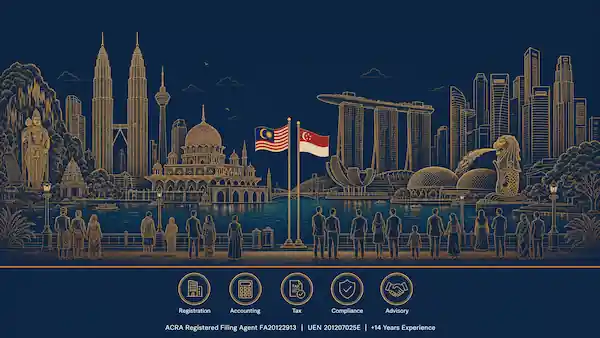
JS-SEZ Guide 2026 — Johor-Singapore Special Economic Zone Incentives
3,500 km². Nine zones. One integrated corridor. The Johor-Singapore SEZ launch timeline has been adjusted to strengthen its framework for cross-border business.
The Johor-Singapore Special Economic Zone (JS-SEZ) is a bilateral framework designed to create a seamless, highly competitive operating environment across the Causeway. It allows Singapore businesses to scale operations into Malaysia while accessing targeted fiscal incentives, streamlined customs, and improved talent mobility.
Up to 5% corporate rate for qualifying Global Services Hubs & new manufacturing
1 Jan 2025 – 31 Dec 2034
Targeted 5-minute journey time by end of 2026
Key Takeaways for Founders
- No single "JS-SEZ tax rate" — The 5% rate is reserved for specific qualifying activities under the Global Services Hub and selected new manufacturing routes.
- Nine flagship zones — The JS-SEZ spans over 3,500 km², but incentives are not uniform. PIPC and Forest City SFZ operate under separate, specialized frameworks.
- Strong SME interest — Singapore's JS-SEZ Project Office has received over 300 enquiries, with nearly half originating from Singapore SMEs, not just large MNCs.
- RTS Link changes the equation — With a targeted 5-minute journey time, the RTS Link makes cross-border management and talent movement highly practical. Read our full RTS Link impact analysis →
- Structure matters more than cost — Lower operating costs in Johor are attractive, but the right setup depends on whether your business needs Singapore for commercial credibility or Johor for operational scale.
Fast Facts
The bilateral JS-SEZ agreement was officially exchanged at the Malaysia-Singapore Leaders' Retreat in January 2025, followed by the establishment of a joint JS-SEZ Project Office through MTI, EDB, and Enterprise Singapore.
If you are still deciding whether to expand at all, start with our strategic guide on whether your business should set up in Singapore, Johor, or both before diving into specific JS-SEZ incentives.
What the JS-SEZ Is — and Why It Matters Now
For Singapore companies evaluating JS-SEZ eligibility criteria, the commercial appeal is not simply "cheap Johor." It is a coordinated, dual-jurisdiction operating model that maximizes the strengths of both countries.
Singapore as the Strategic Base
Use Singapore for regional headquarters, treasury, investor confidence, R&D, advanced functions, and international client relationships.
Johor as the Scale Platform
Use Johor for manufacturing, logistics, shared services, industrial expansion, and cost-sensitive execution within the JS-SEZ framework.
This gives firms a structured way to twin operations across the Causeway, improve supply-chain resilience, and scale into Southeast Asia without giving up Singapore's institutional advantages. For a complete framework on how to structure this dual model, see our guide on the Singapore HQ + Johor operations dual entity structure.
Core JS-SEZ Business Advantages & Eligibility
Rather than getting lost in complex tax codes, successful cross-border founders focus on three core commercial advantages the JS-SEZ provides:
Preferential Tax Frameworks
Qualifying Global Services Hubs and new manufacturing investments can access highly competitive 5% corporate tax rates for up to 15 years, alongside targeted Investment Tax Allowances (ITA) for logistics and tourism.
Seamless Talent Mobility
Eligible high-value knowledge workers can benefit from a 15% flat personal income tax rate for up to 10 years, making it easier to attract and retain regional leadership in Johor.
Unmatched Connectivity
With the RTS Link targeting a 5-minute journey time by the end of 2026, managing a dual-entity structure between Singapore and Johor has never been more operationally viable.
For SMEs and mid-market businesses: You do not need to hit these massive thresholds to benefit. We design custom Singapore HQ + Johor Operations structures that maximize standard MIDA tax breaks, operational cost savings, and seamless cross-border compliance.
For a comprehensive breakdown of entity structures, compliance requirements, and market entry strategies, visit our primary Malaysia Business Expansion Hub.
Not sure if your business qualifies for JS-SEZ incentives?
Our cross-border advisory team can assess your operational model and map out the most tax-efficient dual-entity structure for your specific needs.
Request a JS-SEZ Eligibility Assessment →Note on Advisory Fees: End-to-end JS-SEZ eligibility assessment, dual-entity structuring, and MIDA application support typically range from SGD 5,000 to 15,000+, depending on corporate complexity. We provide transparent, fixed-fee proposals before any work begins.
The Nine JS-SEZ Flagship Zones
The zone map is official, but the incentive framework is tailored to the specific economic strengths of each area.
Johor Bahru
Business services, city-centre activities, and high-value services
Iskandar Puteri
Education, healthcare, tourism, and mixed-use investment
Tanjung Pelepas & Bin
Logistics, port-linked activities, and supply-chain infrastructure
Pasir Gudang
Manufacturing, chemicals, energy, and industrial operations
Senai-Skudai
Manufacturing, aerospace-linked activity, and industrial projects
Sedenak (incl. Kulai)
Advanced industry, digital economy, and tech manufacturing
Desaru
Integrated tourism and hospitality-led development
PIPC
Pengerang Integrated Petroleum Complex (separate framework)
Forest City SFZ
Special Financial Zone (separate package for companies/individuals)
Why Cost Comparisons Matter — But Don't Decide Everything
Incentives are one part of the equation. Operating costs are another. For a full breakdown of the Singapore to Johor business expansion cost and what businesses actually pay for setup, talent, and space on both sides of the Causeway, see our detailed Singapore vs Johor business costs comparison for 2026.
Recent initiatives, such as major semiconductor supply-chain localization programs and cross-border supplier qualification frameworks, demonstrate that the JS-SEZ is rapidly moving beyond policy headlines into real, funded operating models.
The broader JS-SEZ is being promoted across 11 sectors. In practical tax-planning terms, however, the most clearly structured routes are currently around global services, selected manufacturing, smart logistics, and integrated tourism. For businesses in the digital economy, see our guide on using a Singapore Pte Ltd for global payments as part of your JS-SEZ strategy.
Why the RTS Link Still Matters Commercially
The Johor Bahru-Singapore RTS Link remains officially targeted to commence passenger service at the end of 2026. The Land Transport Authority (LTA) states a journey time of about five minutes, with co-located CIQ and capacity of up to 10,000 commuters per hour.
For firms using a Singapore-HQ-plus-Johor-operations structure, that is a meaningful reduction in friction for management and technical staff. For a deeper analysis, see our dedicated RTS Link impact guide.
How to Apply for JS-SEZ Tax Incentives: The Application Path
Typical Timeline: From initial eligibility assessment to final MIDA approval, the process typically takes 3 to 6 months, depending on corporate complexity and flagship zone requirements.
Confirm Zone & Route
Align your real business activity with the correct flagship location and incentive pathway (e.g., global services, manufacturing, logistics).
Structure the Entity
Terra Advisory structures your Malaysian entity to align perfectly with MIDA compliance guidelines and cross-border tax efficiency.
Secure Location
Obtain official confirmation of your development location within the relevant JS-SEZ flagship zone through IMFC-J.
Formal Submission
We manage the financial mapping and official application submission through the MIDA portal on your behalf.
Coordinate Approvals
IMFC-J helps coordinate across relevant agencies to reduce friction around land, facilitation, and implementation.
Maintain Compliance
Approved companies must continue to meet scheme conditions and submit annual compliance documentation.
Ready to explore whether JS-SEZ incentives fit your business?
Terra Advisory assesses the correct Malaysian route, prepares MIDA-facing applications, and coordinates with our strategic partners on the Singapore side for seamless cross-border structuring and tax planning.
Frequently Asked Questions
Incorporating or restructuring a business in Singapore or Malaysia is a major legal and financial decision. We provide dedicated, personal service from our first conversation to your ongoing annual filings.
If you do not fully understand any aspect of the process, we will pause and will not move forward until you are ready.
We quote and design only the specific services your business actually requires.
Licensed Malaysian Division — MIA Registered Firm
Official sources used in this 2026 update:
This page is a general guide and should not be treated as legal or tax advice. The right structure depends on your specific business activities, revenue, and long-term goals. For advice tailored to your situation, contact Terra Advisory Services.