

Understanding the Singapore Holding Company Structure for Malaysian Businesses
| Reading time: 9 minutes
Key Takeaways
- Malaysia generally does not impose withholding tax on dividends paid by a Malaysian company, but the Singapore tax treatment depends on the Singapore company’s tax residency, documentation, and applicable IRAS conditions.
- Singapore generally does not tax capital gains, but whether a gain is capital or revenue in nature depends on the facts. Section 13W may provide safe-harbour treatment for qualifying ordinary share disposals if statutory conditions are met.
- Foreign-sourced dividends received in Singapore may qualify for exemption under Singapore’s foreign-sourced income exemption rules if the relevant conditions are satisfied.
- Both IRAS and LHDN may review related-party transactions. Transfer pricing records should be prepared where Singapore and Malaysia entities transact with each other.
- Pure investment holding companies are generally excluded from Singapore's Start-Up Tax Exemption but may qualify for the Partial Tax Exemption where applicable.
- Share transfer or share swap restructuring can take several weeks depending on shareholder approvals, valuation, legal documents, stamping, SSM filings, ACRA filings, and professional review.
The Corporate Flip: How the Structure Works
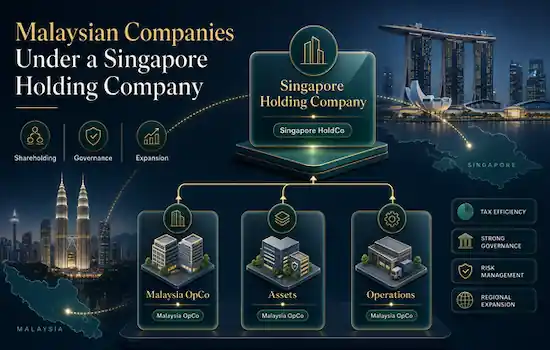
Restructuring a Malaysian business under a Singapore parent company is sometimes called a “corporate flip”. It should not be treated as a simple filing exercise. The correct method depends on the existing shareholders, valuation, tax position, stamp duty, legal documents, banking requirements, and any sector-specific approvals.
Incorporate a Singapore Pte Ltd
The first step is to incorporate a Singapore Pte Ltd with ACRA. Singapore permits 100% foreign ownership of a Singapore company, and at least one director must be ordinarily resident in Singapore. The Singapore resident director requirement may be met through a nominee director arrangement, subject to onboarding, due diligence, and approval. A qualified company secretary must be appointed within six months of incorporation. Refer to ACRA's official portal for official registration information.
Review the Share Transfer or Share Swap Arrangement
The shares in the Malaysian Sdn Bhd may be transferred to the new Singapore parent company through a share transfer, share swap, or other restructuring arrangement. The client should appoint legal and tax professionals to review the transfer terms, valuation, stamp duty, shareholder approvals, and Malaysia-side filings. Terra Advisory Services can assist with Singapore incorporation and Singapore-side corporate records, but does not provide legal advice or Malaysia tax opinions.
Establish the Parent-Subsidiary Relationship
After the transfer is properly completed and recorded, the Malaysian company may become a subsidiary of the Singapore holding company. The founder may remain the ultimate beneficial owner at the top of the structure, depending on the final shareholding arrangement. Day-to-day operations can continue in Malaysia, while selected holding, treasury, governance, or investor-facing functions are maintained in Singapore.
3 Strategic Reasons Malaysian Founders Move to an SGD Anchor
1. Currency Planning and Dividend Flow Management
Holding group-level funds in Singapore Dollars (SGD) may help reduce exposure to regional currency fluctuations and support international treasury planning. Malaysia generally does not impose withholding tax on dividends paid by a Malaysian company. However, the Singapore tax treatment of dividends received by a Singapore company depends on the tax residency of the Singapore company, the nature of the income, the foreign-sourced income exemption conditions, and the supporting records maintained.
Foreign-sourced dividends received in Singapore may qualify for exemption under Singapore’s foreign-sourced income exemption rules if the statutory conditions are satisfied. These conditions should not be assumed automatically. The company should maintain supporting documents on tax paid, source country tax treatment, beneficial ownership, board decisions, and the commercial reason for the structure. For more details, refer to IRAS guidance or seek specialist Singapore tax advice where required.
2. Capital Exit Planning and Global Funding Access
Singapore generally does not tax capital gains. However, whether a gain is treated as capital or revenue in nature depends on the facts and circumstances of the disposal. Section 13W of the Singapore Income Tax Act may provide safe-harbour treatment for gains from disposal of ordinary shares where the statutory conditions are met. For Singapore corporate tax filing support, Terra Advisory Services can assist with Singapore-side tax filing and supporting records, while specialist tax positions should be reviewed separately where needed.
Global investors often prefer Singapore’s legal and corporate framework because of its common-law system, English-language contracts, corporate transparency, and familiar due diligence process. A Singapore holding structure may help streamline investor review, provided the restructuring was properly documented and the group maintains accurate accounting, shareholder, and governance records.
3. Access to Singapore Financial Infrastructure
Some Malaysian digital companies, exporters, and e-commerce businesses consider a Singapore holding or commercial structure because Singapore offers access to a broad financial ecosystem, including corporate banking, multi-currency accounts, payment institutions, and trade finance providers.
However, access is not automatic. Corporate bank accounts, payment platforms, merchant accounts, and financing facilities remain subject to each provider’s onboarding, KYC, source-of-funds review, business model review, and internal risk assessment. Terra Advisory Services can guide clients on company documents commonly requested during onboarding, but final approval remains with the bank or payment institution.
Managing Cross-Border Compliance
Operating a dual-region structure means your Singapore parent entity and Malaysian subsidiary may engage in cross-border relationships through management support, intercompany services, licensing, technical support, funding, or dividend flows.
Key compliance requirements include:
- Transfer pricing documentation: Where Singapore and Malaysia related entities transact with each other, transfer pricing documentation may be required depending on revenue, transaction size, and local rules. Refer to IRAS transfer pricing guidance and LHDN transfer pricing guidance.
- Substance requirements: The Singapore company should maintain proper board records, commercial rationale, accounting records, and decision-making evidence if it expects to support a Singapore tax residency or treaty position.
- Annual filings: Singapore companies must file annual returns with ACRA and maintain company secretary compliance support. Malaysian subsidiaries must comply with SSM filings and LHDN tax obligations.
- Beneficial ownership registers: Both SSM Malaysia and ACRA have beneficial ownership or registrable controller requirements. Accurate disclosure should be maintained.
Poor documentation can create tax adjustments, double taxation exposure, bank onboarding issues, or regulatory questions. The client should appoint legal, Malaysia tax, Singapore tax, transfer pricing, valuation, or regulatory professionals where the structure requires specialist review.
Implementation Timeline and Requirements
| Phase | Key Activities | Typical Timeline |
|---|---|---|
| Pre-structuring review | Business structure review, shareholder review, tax questions, commercial rationale, and identification of legal, tax, or valuation support required | 1–2 weeks |
| Singapore company incorporation application | Name reservation, director appointment, company secretary appointment, registered address, ACRA filing, and statutory registers | 1–3 business days, subject to complete KYC and approval |
| Share transfer or share swap documentation | Legal documents, valuation support, stamp duty review, shareholder approvals, board resolutions, and Malaysia-side filing requirements | 2–3 weeks or longer depending on complexity |
| Post-restructuring compliance | Accounting records, intercompany records, board minutes, transfer pricing support, annual filing calendar, and ongoing statutory compliance | Ongoing |
| Total with professional support | Singapore incorporation plus restructuring coordination | Often 4–6 weeks, depending on documents, approvals, and professional review |
Note: Timelines assume complete documentation and no major regulatory, shareholder, bank, or tax queries. Complex structures involving multiple shareholders, foreign investors, regulated activities, valuation issues, stamp duty questions, or existing bank facilities may require additional review by legal, tax, banking, or valuation professionals.
How Terra Advisory Supports Your Restructuring
Practical Singapore Setup and Compliance Support
Moving a Malaysian business under a Singapore holding company is an important business and compliance decision. It may involve company incorporation, shareholder restructuring, board approvals, legal documents, stamp duty review, tax analysis, banking documents, and ongoing records in both jurisdictions.
Terra Advisory Services supports the Singapore-side incorporation, corporate secretarial, accounting, corporate tax filing, and compliance aspects of the structure. We do not provide legal advice, Malaysia tax opinions, Singapore tax legal opinions, MAS licensing advice, investment advice, certified valuation, or guaranteed bank approval. Where legal, tax, valuation, transfer pricing, or Malaysia-side advice is required, clients should appoint the appropriate professional advisors.
As an ACRA registered filing agent, we can support:
- Singapore incorporation support: We assist with Singapore company incorporation application, ACRA filing, director appointment, company secretary appointment, registered address, and statutory registers.
- Corporate secretarial records: We prepare Singapore-side board resolutions, minutes, registers, and selected corporate records required for the Singapore company’s internal approvals.
- Accounting and tax filing support: We assist with bookkeeping, accounting setup, financial reporting, and Singapore corporate tax filing support after the structure is implemented.
- Intercompany record support: We help maintain Singapore-side accounting records and supporting schedules for intercompany charges. Legal agreements and specialist transfer pricing documents should be prepared or reviewed by the client’s appointed advisors.
- Banking document guidance: We guide clients on common company documents requested by banks and payment institutions. Final account approval remains subject to each provider’s internal review.
- Malaysia-side coordination where appropriate: Where Malaysia-side support is needed, Terra may coordinate with the client’s appointed Malaysia advisors or affiliate contacts for selected matters. Malaysia legal, tax, valuation, and SSM filings should be handled by the relevant Malaysia professionals.
Why founders choose Terra: We help founders understand what Terra can handle directly, what must be handled by external professionals, and how to keep the Singapore company’s statutory, accounting, and compliance records properly maintained after setup.
Need help setting up the Singapore side of a Malaysia–Singapore structure?
Submit Your Singapore–Malaysia Setup RequirementsACRA registered filing agent | UEN: 201207025E | Singapore incorporation, accounting and compliance support
Frequently Asked Questions
Can a Malaysian Sdn Bhd be owned by a Singapore holding company?
Yes. A Singapore Pte Ltd can hold shares in a Malaysian Sdn Bhd, subject to the company documents, shareholder approvals, Malaysia-side filings, stamp duty requirements, and any sector-specific restrictions. The client should obtain legal and tax advice before completing a share transfer or share swap arrangement.
Are dividends from Malaysia to Singapore taxed under the DTA?
Malaysia generally does not impose withholding tax on dividends paid by a Malaysian company. In Singapore, foreign-sourced dividends may qualify for exemption if the relevant statutory conditions are satisfied. The company should review tax residency, source country tax treatment, beneficial ownership, documentation, and IRAS requirements before relying on exemption treatment.
Is there capital gains tax in Singapore on share disposals?
Singapore generally does not tax capital gains. However, whether a gain is capital or revenue in nature depends on the facts. Section 13W may provide safe-harbour treatment for qualifying ordinary share disposals if the statutory conditions are met. Specialist tax advice should be obtained where the disposal is material or complex.
Do holding companies qualify for Singapore's Start-Up Tax Exemption?
Pure investment holding companies are generally excluded from Singapore’s Start-Up Tax Exemption. They may still qualify for the Partial Tax Exemption where applicable. The final tax treatment depends on the company’s activities, income type, and IRAS rules.
Can a Singapore holding company also run operational business activities?
Yes. A Singapore company can hold shares and also carry on business activities, depending on how it is structured. Founders should consider accounting separation, commercial substance, tax residency, intercompany agreements, and compliance records before combining holding and operating functions in one entity.
What happens if the Malaysian subsidiary becomes insolvent?
A Malaysian subsidiary and Singapore holding company are generally separate legal entities. However, liability protection depends on proper corporate governance, guarantees, financing documents, director conduct, and the specific facts. Legal advice should be obtained where insolvency, creditor exposure, or group guarantees are involved.
What documents are required for a share swap restructuring?
Common documents may include board resolutions, shareholder approvals, share transfer instruments, valuation support, stamp duty records, updated registers, SSM filings, ACRA records, and intercompany documents. The exact documents depend on the transaction structure and should be confirmed by the client’s legal, tax, and Malaysia-side advisors.
Can Terra Advisory Services prepare the share swap agreement?
No. Terra Advisory Services does not provide legal advice or draft legal share swap agreements. The client should appoint legal counsel to prepare or review share transfer, share swap, shareholder, or restructuring documents. Terra can support the Singapore company setup, Singapore-side corporate records, accounting setup, and tax filing support.
Can Terra Advisory Services provide Malaysia tax or transfer pricing opinions?
No. Terra Advisory Services does not provide Malaysia tax opinions or specialist transfer pricing opinions. Clients should appoint the appropriate Malaysia tax or transfer pricing professional where required. Terra can assist with Singapore-side accounting records and coordinate with the client’s appointed advisors where appropriate.
Need Help Setting Up a Singapore Holding Company?
Terra Advisory Services can support the Singapore incorporation, company secretary, accounting, corporate tax filing, and compliance aspects of a Malaysia–Singapore structure. Legal documents, share transfer advice, valuation, Malaysia tax matters, transfer pricing opinions, and bank approvals should be handled by the appropriate professionals where required.
Submit Your Singapore–Malaysia Setup Requirements Chat on WhatsAppIncorporating or restructuring a business in Singapore is an important business and compliance decision. We provide practical support from company setup to ongoing annual filings.
If you do not fully understand any aspect of the process, we will explain the relevant filing and compliance steps before proceeding.
We quote and recommend only the services that are relevant to your company’s actual requirements.
Malaysia Affiliate for Selected Malaysia-Side Support