

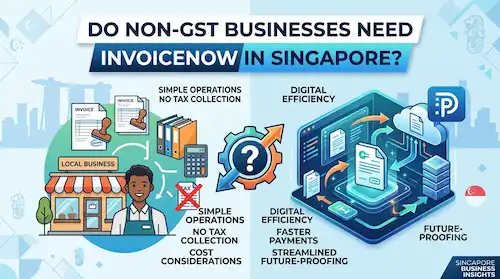
Do non-GST registered businesses need to use InvoiceNow? No, non-GST registered businesses are not required to use InvoiceNow. The IRAS GST InvoiceNow Requirement applies only to GST-registered businesses.
No requirement
Continue current invoicing
From 1 April 2026
Mandatory before approval
From 1 April 2028
Phased by revenue
Key Takeaways — InvoiceNow for Non-GST Businesses
- Non-GST registered businesses have no InvoiceNow requirement — you can continue using your current invoicing method.
- Voluntary GST registration from 1 April 2026 — InvoiceNow compliance becomes mandatory before your application is approved.
- Compulsory GST registration — phased in from 2028 to 2031 based on your annual taxable supplies.
- Excluded groups — Overseas Vendor Registration (OVR) and Reverse Charge businesses are exempt.
- Implementation takes time — typically 2-8 weeks, so plan ahead if you are considering GST registration.
- InvoiceNow is a compliance issue — treat it as part of your GST planning, not just a software upgrade.
Fast Facts — GST InvoiceNow 2026
- Who Must Comply With InvoiceNow?
- The One Trigger You Cannot Ignore: Voluntary GST Registration
- Phased Implementation Timeline (2025-2031)
- What Does "InvoiceNow-Ready" Mean?
- Businesses Excluded from the Requirement
- Three Scenarios Every Non-GST Business Should Review
- Decision Framework: What Should You Do?
- Frequently Asked Questions
Who Must Comply With InvoiceNow?
The Inland Revenue Authority of Singapore (IRAS) introduced the GST InvoiceNow Requirement to streamline tax reporting and reduce compliance errors. Under this mandate, GST-registered businesses must transmit invoice data directly to IRAS through the national Peppol network.
If your business is not registered for GST, this mandate does not apply to you. You are not required to send invoice data to IRAS, and you may continue using your existing invoicing methods. Non-GST registered businesses cannot issue tax invoices or charge GST; they issue standard commercial invoices.
For a complete understanding of GST registration thresholds, input tax claims, and compliance obligations, read our Ultimate GST Compliance Guide for Singapore Businesses.
The One Trigger You Cannot Ignore: Voluntary GST Registration
From 1 April 2026, the rules change for non-GST businesses that want to register voluntarily. If you apply for voluntary GST registration on or after this date, you must be InvoiceNow-compliant at the time of your application. This is not optional. IRAS will not approve your registration until you demonstrate that you can transmit invoice data through the InvoiceNow network.
Key Fact: "From 1 April 2026, any business that applies for voluntary GST registration must be InvoiceNow-compliant at the time of application. IRAS will not approve applications submitted on or after this date without compliance." — IRAS
Many small and medium businesses register for GST voluntarily even when their turnover is below the compulsory S$1 million threshold. Businesses considering voluntary GST registration should also review our Singapore tax compliance checklist to understand broader reporting obligations beyond InvoiceNow. They do this to claim input tax credits on purchases such as rental expenses, equipment, professional services fees, and marketing costs.
If this applies to you, plan ahead. Implementing an InvoiceNow-ready solution typically takes two to eight weeks. For full implementation steps, deadlines, and business preparation guidance, read our complete GST InvoiceNow compliance guide.
Phased Implementation Timeline (2025-2031)
IRAS is implementing the GST InvoiceNow requirement in phases. Your compliance date depends on your GST registration status and total annual supplies.
| Implementation Date | Who Must Comply | Total Annual Supplies |
|---|---|---|
| 1 November 2025 | New companies voluntarily registering for GST within 6 months of incorporation | Any |
| 1 April 2026 | All new voluntary GST registrants (including existing non-GST businesses applying on or after this date) | Any |
| 1 April 2028 | New compulsory GST registrants and existing GST-registered businesses | Up to S$200,000 |
| 1 April 2029 | Existing GST-registered businesses | Up to S$1 million |
| 1 April 2030 | Existing GST-registered businesses | Up to S$4 million |
| 1 April 2031 | Remaining GST-registered businesses | Above S$4 million |
Source: IRAS GST InvoiceNow Guidance
For the full phased rollout timeline affecting GST-registered businesses, see our InvoiceNow compliance deadlines guide (2026–2031).
Key Takeaway: Voluntary GST registration can trigger immediate compliance obligations. If you are considering voluntary registration, start your InvoiceNow implementation now—not when you are ready to apply. Implement first, then register.
What Does "InvoiceNow-Ready" Mean?
Being InvoiceNow-ready means your business can send and receive invoices through the Peppol network, the technical framework behind Singapore's national e-invoicing system. For GST purposes, it also means you can transmit invoice data directly to IRAS.
To become InvoiceNow-ready, you need:
- A Peppol ID linked to your Unique Entity Number (UEN).
- An InvoiceNow-ready solution – accounting software or a service provider accredited by the Infocomm Media Development Authority (IMDA).
- The ability to transmit data to IRAS if you are GST-registered.
Many popular accounting platforms in Singapore, including Xero and QuickBooks, now offer InvoiceNow integration. Some IMDA-accredited providers also offer free solutions for GST-registered businesses.
If you are considering GST registration, you may also want to read our step-by-step Peppol ID registration guide.
Businesses Excluded from the Requirement
IRAS has explicitly excluded certain groups from the GST InvoiceNow Requirement, even if they are GST-registered:
- Overseas entities registered under the Overseas Vendor Registration (OVR) Pay-only regime or the full OVR regime.
- Businesses registered solely due to the Reverse Charge regime (imported services or low-value goods).
If your non-GST business falls into either of these categories, you remain excluded even if you later register for GST.
Three Scenarios Every Non-GST Business Should Review
1. You are approaching the S$1 million threshold
If your taxable turnover exceeds S$1 million at the end of a calendar year, or you reasonably expect it to exceed S$1 million in the next 12 months, you must register for GST compulsorily. Your InvoiceNow compliance date will be phased in between 2028 and 2031 depending on your revenue. What to do now: Monitor your turnover and begin researching InvoiceNow-ready solutions early.
2. You are considering voluntary registration
This is the highest-risk scenario for non-GST businesses. If you apply for voluntary registration on or after 1 April 2026, you must be InvoiceNow-ready before you submit your application. What to do now: Start your InvoiceNow implementation now. Do not wait until you are ready to apply. Implement first, then register.
3. You have no plans to register for GST
If your turnover is stable and you have no intention of registering for GST, you have no obligation under the GST InvoiceNow Requirement. However, adopting InvoiceNow voluntarily can improve B2B relationships and speed up payment cycles with GST-registered customers. This is a commercial decision, not a compliance one.
Why consider voluntary InvoiceNow adoption? Even without GST registration, joining the Peppol network can:
- Speed up payments: GST-registered clients often prioritize vendors who send invoices via InvoiceNow, as it simplifies their GST reporting and input tax claims.
- Improve vendor standing: Large corporates and government agencies increasingly prefer suppliers who use e-invoicing. Being InvoiceNow-ready can give you a competitive edge.
- Reduce manual work: Automation reduces data entry errors, reconciliation time, and follow-up calls on unpaid invoices.
- Future-proof your business: If your turnover grows and you later register for GST, you will already be compliant. This removes the pressure of last-minute implementation.
For e-commerce businesses processing high volumes, see our InvoiceNow for E-commerce guide. For traditional service businesses, see our InvoiceNow for Non-E-commerce Businesses guide.
Decision Framework: What Should You Do?
Choosing what to do about InvoiceNow depends on your GST status and business plans. Here is a simple framework to help you decide:
Decision Framework
- If you are not GST-registered and have no plans to register: Do nothing. You have no obligation under the GST InvoiceNow Requirement. Continue using your current invoicing method.
- If you are considering voluntary GST registration: Start your InvoiceNow implementation immediately. Do not wait until you are ready to apply. Implement first, then register. Your application will be rejected without it.
- If you are approaching the S$1 million threshold: Monitor your turnover closely. Begin researching InvoiceNow-ready solutions early. Your compliance date will be phased in between 2028 and 2031.
- If you are already GST-registered: Check your revenue bracket against the phased timeline. Start implementation at least 3-6 months before your compliance date.
- If you are a high-volume e-commerce seller: Consider automation earlier. Manual processing does not scale, and implementation takes 4-8 weeks.
Unsure If InvoiceNow Applies to Your Business?
Get a clear answer based on your GST status, business model, and registration plans — practical guidance, no generic advice.
Frequently Asked Questions
Navigating GST compliance in Singapore requires precision and proactive planning. We provide dedicated, personal service from our first conversation to your ongoing annual filings.
If you do not fully understand any aspect of the process, we will pause and will not move forward until you are ready.
We quote and design only the specific services your business actually requires, prioritising transparent, human-led guidance over fully automated platforms.
Note: Terra Advisory Services is a Registered Filing Agent under the ACRA Act. Under the Corporate Service Providers Act 2024, we are treated as a registered Corporate Service Provider (CSP) and meet all new compliance requirements.
Important Notice: While Terra Advisory Services Pte. Ltd. endeavours to keep the content accurate and current, Singapore government policies, regulations, fees, and procedures may change at any time without prior notice. For the most up-to-date and authoritative information, please refer directly to official government sources. For the latest compliance and advice tailored to your specific circumstances, please contact Terra Advisory Services.
Licensed Malaysian Division — MIA Registered Firm