

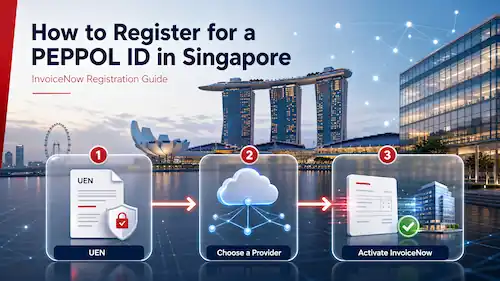
You need a Peppol ID — but getting it is only the first step. From 1 April 2026, IRAS requires a valid Peppol ID for all new voluntary GST registrations. However, the Peppol ID must be issued by an IMDA-accredited InvoiceNow Ready Solution Provider (IRSP). Terra Advisory does not issue Peppol IDs directly; instead, we ensure your corporate structure, accounting framework, and GST data are fully aligned so that when your IRSP activates your connection, your business remains compliant and audit-ready.
1 April 2026 (new voluntary GST registrants)
IMDA-Accredited IRSPs only
Compliance & Accounting Alignment
Key Takeaways
- Peppol ID is mandatory from 1 April 2026 — All new voluntary GST registrants must have a valid Peppol ID before IRAS approves their registration.
- Only accredited IRSPs can issue IDs — Terra Advisory is a Corporate Service Provider and Accounting Firm, not an IRSP. We guide you in selecting the right accredited provider for your business needs.
- Compliance goes beyond the ID — Your Chart of Accounts, GST coding, and financial reporting must be structured to handle real-time data transmission to IRAS without triggering discrepancy flags.
- Directors bear compliance risk — Transaction mismatches between Peppol data and GST returns trigger automated IRAS audits. Directors face personal liability for compliance failures.
- Government grants are available — Eligible SMEs can access the S$1,000 GST InvoiceNow Transition Grant to offset IRSP subscription costs.
Fast Facts — Peppol ID & GST InvoiceNow 2026
What Is a Peppol ID and Why Do You Need One?
Peppol (Pan-European Public Procurement Online) is the international e-invoicing standard adopted by Singapore's Infocomm Media Development Authority (IMDA) for the InvoiceNow network. A Peppol ID is your business's unique identifier on this network — similar to an email address but specifically for sending and receiving structured e-invoices.
Your Peppol ID is linked to your Unique Entity Number (UEN). When you send an invoice via InvoiceNow, the network uses your Peppol ID and your customer's Peppol ID to route structured invoice data directly between accounting systems and to IRAS in real time.
For the GST InvoiceNow requirement, having a valid Peppol ID is mandatory for new voluntary GST registrants from 1 April 2026. Without one, IRAS will not approve your GST registration application. For a full overview of the framework, see our GST InvoiceNow guide.
Who Needs a Peppol ID and When?
| Implementation Date | Who It Applies To |
|---|---|
| 1 April 2026 | All new voluntary GST registrants (regardless of business structure or incorporation date) |
| 1 April 2028 | New compulsory GST registrants + Existing businesses with total annual supplies ≤ S$200,000 |
| 1 April 2029 | Existing GST-registered businesses with total annual supplies ≤ S$1 million |
| 1 April 2030 | Existing GST-registered businesses with total annual supplies ≤ S$4 million |
| 1 April 2031 | Existing GST-registered businesses with total annual supplies > S$4 million |
What Happens If You Don't Comply?
IRAS Will Refuse Your GST Application
From 1 April 2026, IRAS will reject any voluntary GST registration application that doesn't have a valid Peppol ID. This is a precondition that must be satisfied before you apply.
Automated Audit Flags
Because InvoiceNow routes live invoicing data directly to IRAS, any mismatch between your declared Form F5 GST returns and your Peppol invoice data will trigger an immediate, automated discrepancy flag. This is where most businesses face real danger — not from lacking the ID, but from having misaligned accounting data flowing through it.
Directors Face Personal Liability
Transaction mismatches flagged by IRAS are tied to director accountability. Directors face personal liability for compliance failures under the Companies Act. Late GST filing penalties start at S$200 and can reach S$10,000 for repeat offences. In cases of wilful default, directors may face criminal prosecution with fines up to S$20,000 and imprisonment.
The Hidden Financial Danger of Misconfigured Peppol Infrastructures
Acquiring a Peppol ID via an IRSP is straightforward, but the structural transaction reconciliation that follows is highly complex. Many founders treat Peppol registration as a simple IT task. They get the ID from an IRSP but fail to update their accounting structures, Chart of Accounts, or GST coding.
When IRAS receives real-time data via Peppol that doesn't match your Form F5 or your internal unaudited financial statements, the discrepancy flag is immediate. Real operational security requires unifying your digital Peppol endpoints with specialized, professional accounting services right from day one.
How to Get a Peppol ID — Step-by-Step
Step 1: Select an IMDA-Accredited IRSP
To obtain a Peppol ID, you must engage an IMDA-accredited InvoiceNow Ready Solution Provider (IRSP). These are the only entities authorized to connect businesses to the Peppol network and issue Peppol IDs. Options include cloud accounting platforms (Xero, QuickBooks Online) or specialized Access Point Providers.
Step 2: Register Your Business with Your Chosen IRSP
Your selected IRSP will register your business using your UEN and Corppass credentials, and assign your Peppol ID (format: 0195:SGUEN).
Step 3: Align Your Accounting Framework
Before activating the GST InvoiceNow submission feature, your Chart of Accounts, GST codes, and financial reporting structure must be audited for compatibility with real-time IRAS data transmission. This is the critical step where Terra Advisory provides value — ensuring your books are structured to prevent automated discrepancy flags.
Step 4: Apply for GST Registration on myTax Portal
Only after the Peppol ID has been obtained and your accounting alignment is confirmed should you submit your GST F1 application via myTax Portal.
Government Support: The S$1,000 Transition Grant
SMEs onboarding early can tap into the government's S$1,000 GST InvoiceNow Transition Grant to help defray IRSP implementation and subscription costs. Free-of-charge solution packages are also available for eligible GST-registered businesses, and the Productivity Solutions Grant covers up to 50% of eligible software subscription costs.
Ready to Speak to an InvoiceNow Ready Solution Provider?
Terra Advisory helps founders navigate the compliance landscape, select the right accredited IRSP, and ensure their accounting framework is fully aligned before activation. Don't let real-time reporting catch you off guard.
Frequently Asked Questions
InvoiceNow compliance and GST alignment are major obligations with real-time tax reporting implications. We provide dedicated, personal service from our first conversation to your ongoing annual filings.
If you do not fully understand any aspect of your obligations, we will pause and will not move forward until you are ready.
We quote and design only the specific services your business actually requires.
📌 Pin Terra Advisory Services as your Preferred Source on Google →
Important Notice: While Terra Advisory Services Pte. Ltd. endeavours to keep the content accurate and current, Singapore government policies, regulations, fees, and procedures may change at any time without prior notice. For the most up-to-date and authoritative information, please refer directly to official government sources, including IMDA and IRAS. For advice tailored to your specific circumstances, please contact Terra Advisory Services.
Licensed Malaysian Division — MIA Registered Firm (NF3281)
Official sources used in this 2026 update: