

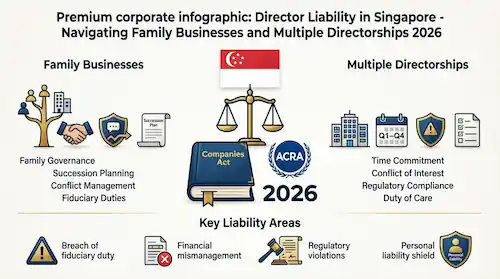
What is the personal liability of a director in Singapore? Under the Corporate and Accounting Laws (Amendment) Act 2025, directors face fines up to S$20,000 and potential imprisonment of up to 12 months for breaches of duty. The "ignorance defense" is no longer viable. The landmark case of Public Prosecutor v Zheng Jia established that a director who fails to exercise supervision can face a custodial sentence, with a specific sentencing framework now in place. Directors of three or more companies struck off by ACRA within five years face an automatic five-year disqualification.
S$20,000 per offence
Up to 12 months
5-year ban for 3+ offences
The True Legal Risks of Managing Family Firms and Multiple Corporate Boards in Singapore
Recent high-profile corporate governance discussions in The Business Times and The Straits Times have made one thing crystal clear: ACRA is aggressively tightening its grip on corporate governance.
Whether you are managing a generational family business or juggling a portfolio of multiple directorships across various corporate boards, the era of treating compliance as a passive administrative task is officially over. Under the latest Singapore regulatory frameworks, the "ignorance defense" is completely dead—and the personal liabilities are higher than ever.
A recent Straits Times forum letter (July 2026) put the spotlight on a growing problem: local nominee directors who are effectively trapped—responsible for a company's legal compliance but unable to fulfill their duties because foreign owners have become uncontactable. ACRA responded by confirming it is "committed to a regulatory regime that balances strong corporate governance with the ease of doing business."
According to The Business Times, smaller firms often struggle to match governance standards due to limited resources, lean management teams, and a focus on survival rather than compliance. However, improving governance among small companies is critical, both for their own long-term sustainability and for the health of Singapore's broader capital market ecosystem.
Key Takeaways
- Director penalties have quadrupled — Under the Corporate and Accounting Laws (Amendment) Act 2025, fines increased from S$5,000 to S$20,000 for breaching duties under Section 157 of the Companies Act.
- The "ignorance defense" is dead — The High Court's landmark judgment in Public Prosecutor v Zheng Jia established a specific sentencing framework for negligent directors and confirmed that a corporate service provider could be sentenced to 10 months in prison for abetting nominee directors in their dereliction of duty.
- Nominee directors carry the same liability — They have the same legal duties and face the same personal penalties as any other director. A recent Straits Times case highlighted a former HR executive left "jobless and stuck in limbo" over multiple directorships she could not quit.
- The disqualification domino effect — A director of three or more companies struck off by ACRA within five years faces an automatic five-year disqualification from acting as a director or managing any company.
- Shadow and de facto directors are also liable — Under Section 4 of the Companies Act, a person who directs or influences the board without a formal appointment can still be held personally liable.
Fast Facts — Director Liability 2026
Table of Contents
- The Overlapping Liability Trap
- The Shadow Director Risk in Family Businesses
- The Governance Blindspot
- The Disqualification Domino Effect
- The New Penalty Framework (2026)
- The Zheng Jia Sentencing Framework for Director Negligence
- The Business Judgment Rule: Protection for Honest Business Decisions
- The Nominee Director Trap
- Protecting Yourself — A 4-Step Shield
- A Balanced View: Penalties Are Real, But Honest Mistakes Are Protected
- Frequently Asked Questions
The Overlapping Liability Trap
Many Singaporean entrepreneurs fall into both risk categories simultaneously. They might be directing their core family enterprise while also holding board seats on two or three secondary investment holding firms, property entities, or partner ventures.
What they often fail to realize is that under Singapore law, these entities are not isolated. They are legally linked to you as an individual.
If any single one of your entities — whether it's a small family venture or a side holding company — accumulates 3 late filings within a 5-year period, ACRA will automatically disqualify you from all other directorships for up to 5 years. A single mistake in a minor entity can legally lock you out of running your main business legacy.
A complete breakdown of how late filings trigger penalties and disqualification is covered in our ACRA late filing penalties guide.
The Shadow Director Risk in Family Businesses
In many family businesses, the formal board structure does not reflect where real power lies. A patriarch or matriarch may formally resign from the board—yet continue giving commands, approving expenditures, and making strategic decisions behind the scenes. Under Singapore law, these individuals remain liable as shadow directors.
What is a shadow director? Under Section 4 of the Companies Act, a shadow director is a person who is not formally appointed but whose instructions or directions the directors are accustomed to follow. The law treats them as having the same legal duties and liabilities as a formally appointed director—including fiduciary duties, the duty to act honestly, and the duty of reasonable diligence.
De Facto and Shadow Directors — The Law
Under Section 4(1) of the Companies Act, the definition of a "director" extends beyond formally appointed individuals to include:
- De facto directors — persons who occupy the position of director "by whatever name called" and act as directors in practice.
- Shadow directors — persons in accordance with whose "directions or instructions the directors are accustomed to act".
Both de facto and shadow directors are generally subject to the same fiduciary duties and potential liabilities as formally appointed directors. This means a patriarch who steps down from the board but whose directions are still followed could be treated as a shadow director and held personally liable for breaches of duty.
A person who provides advice in a professional capacity—such as a lawyer or accountant—is not automatically treated as a shadow director. However, the risk is real for family members or major shareholders who continue to exert control behind the scenes.
Why this matters for family businesses: In a family business, the founding generation may step down from the board but retain de facto control. They approve budgets, make hiring decisions, or dictate strategy—without holding a formal director title. If the company faces financial difficulty, insolvency, or litigation, a shadow director can be held personally liable for decisions they influenced.
In practice, shadow directors in family businesses are particularly vulnerable because their influence is often documented in emails, WhatsApp messages, or board meeting minutes—creating a clear paper trail of their involvement.
How to protect yourself: If you are a family patriarch or matriarch who has stepped down from the board, ensure you are no longer giving operational instructions. If you remain involved, formalize your role as an advisor or consultant with a clearly defined scope that does not constitute "directing" the company. Better yet, stay on the board and take formal responsibility for your decisions.
For guidance on formalizing family business governance structures, we offer corporate secretarial services.
The Governance Blindspot
As The Business Times recently reported, smaller firms often have fewer independent voices at the board level. Instead, their boards tend to be dominated by founders, family members, or close associates, resulting in limited oversight and accountability.
This table shows how different risk groups commonly make mistakes that expose them to ACRA penalties:
| The Risk Group | The Common Mistake | The ACRA Legal Reality |
|---|---|---|
| Family Businesses | Treating the board like a family dinner table. Relatives make decisions based on emotion rather than formal director duties. (Straits Times, July 2026) | Under Singapore law, a director's fiduciary duty is to the company itself, not to pleasing family members. |
| Multi-Firm Directors | Treating extra board seats like passive titles. Assuming a partner or external vendor is handling the compliance. | You can delegate the paperwork, but you never delegate the liability. Fines now top S$20,000, plus potential jail time. |
Understanding how to separate family governance from corporate governance is essential — director's fees vs salary structuring is a key part of that separation.
The Disqualification Domino Effect
A director convicted of three or more filing offences within a five-year period faces an automatic five-year disqualification from acting as a director or managing any company.
Similarly, a director of three or more companies struck off by ACRA within five years faces a three-year disqualification, with repeat offenders facing a five-year ban.
This is the domino effect: A single late filing in a side investment holding company can trigger a chain reaction that disqualifies you from your main family business.
Directors convicted of money laundering offences under the Corruption, Drug Trafficking and Other Serious Crimes (Confiscation of Benefits) Act also face disqualification.
If your company is already facing strike-off, the ACRA strike-off timeline gives you a limited window to act.
The New Penalty Framework (2026)
Under the Corporate and Accounting Laws (Amendment) Act 2025, which took effect on 6 May 2026, the penalties for directors have been significantly increased.
| Offence | Previous Penalty | New Penalty (2026) |
|---|---|---|
| Breach of reasonable diligence (Section 157) | S$5,000 fine | S$20,000 fine + up to 12 months imprisonment |
| Late filing (ACRA Annual Return) | S$300 (under 3 months late) | S$300 (under 3 months) / S$600 (over 3 months) |
| Disqualification | Up to 3 years | 5 years for 3+ offences |
As The Straits Times reported in a recent case, a former HR executive was left "jobless and stuck in limbo" due to multiple directorships she could not resign from. This illustrates the real human cost of the nominee director trap.
For a full breakdown of ACRA filing requirements and how to stay compliant, our Singapore corporate compliance 2026 guide covers everything you need to know.
The Zheng Jia Sentencing Framework for Director Negligence
In the landmark case of Public Prosecutor v Zheng Jia, the High Court established a three-step sentencing framework for directors who breach their duty of reasonable diligence under Section 157 of the Companies Act. This framework is now the guiding precedent for such cases.
The Three-Step Approach:
- Identify offence-specific factors — including the extent of due diligence undertaken, efforts to monitor bank transactions, knowledge that negligence could enable abuse, duration of the breach, and whether it was profit-driven.
- Determine the sentencing band based on the number of factors present:
| Offence-Specific Factors | Sentencing Band | Indicative Sentence |
|---|---|---|
| 1 to 3 factors | Band 1 | Up to 4 months' imprisonment |
| 4 to 5 factors | Band 2 | 5 to 8 months' imprisonment |
| 6 or more factors | Band 3 | 9 to 12 months' imprisonment |
- Calibrate for offender-specific factors — such as remorse, plea of guilt, cooperation with authorities, and restitution.
In Zheng Jia, the accused received 3 months' imprisonment for the First Charge and 7 months' imprisonment for the Second Charge, to run consecutively. The court rejected the "hands-off" business model for nominee directors, emphasising that all directors are subject to a "minimum objective standard of care" requiring them to monitor and supervise the company's affairs.
This framework is a critical tool for understanding the real-world consequences of director negligence.
The Business Judgment Rule: Protection for Honest Business Decisions
While the penalties for director misconduct have increased significantly, it is equally important to understand the protections available to directors who make honest business decisions that later turn out poorly. Singapore courts apply the Business Judgment Rule, which shields directors from personal liability for commercial decisions that were:
- Made in good faith (not for personal gain or to harm the company)
- Made without any conflict of interest
- Made with proper advice (e.g., consulting legal, tax, or financial advisors)
- Made with reasonable diligence (i.e., the director was not negligent in their decision-making)
What this means in practice: If you are a director who makes a commercial decision—such as expanding into a new market, investing in new equipment, or approving a major contract—that decision later turns out to be a bad one, you will not be held personally liable provided you acted in good faith, sought proper advice, and did not have a personal conflict of interest.
Where the protection ends: The Business Judgment Rule does not protect directors who:
- Act dishonestly or fraudulently
- Fail to seek proper advice before making decisions
- Act with a conflict of interest
- Are negligent in their duties—such as failing to review financial statements, missing board meetings, or delegating without supervision
- Breach their duty of reasonable diligence, which now carries penalties up to S$20,000
The bottom line: The Business Judgment Rule encourages directors to take calculated risks without fear of personal liability. However, it does not protect directors who fail to exercise proper oversight. The key is to document your decision-making process: board minutes should show that you sought advice, considered alternatives, and acted in the company's best interests.
Limits of the Rule: The Business Judgment Rule primarily protects decisions made honestly and without conflict. It is less likely to apply to decisions made in a conflict of interest or to claims of negligence stemming from omissions (failing to act) rather than commissions (active decisions). In practice, a court will still review whether a decision was made in good faith, with due care, and in the company's best interests.
For a balanced approach to director liability and corporate governance, our Singapore corporate compliance 2026 guide provides a full framework.
The Nominee Director Trap
A nominee director has the same legal duties and personal liabilities as any other director under Singapore law.
This reality was starkly illustrated in a recent Straits Times case where a former HR executive was left "jobless and stuck in limbo" due to multiple directorships she could not resign from. The article highlighted how a single resignation could "trigger a chain reaction and cause her existing companies to be struck off by ACRA."
This is the nominee director trap: you accept a directorship as a favour, a formality, or a service—and suddenly you cannot leave without triggering legal consequences. Under Singapore law, resignation from a directorship is not effective until ACRA's records are updated, which requires the company's compliance.
If you are a nominee director or considering becoming one, ensure you are protected with nominee director services that provide a managed, compliant arrangement.
Protecting Yourself — A 4-Step Shield
You cannot rely on "good intentions." You need a formal governance shield. Here is the exact process to protect yourself from ACRA penalties and family conflict.
Step 1: Professionalize Your Board
- Appoint a qualified Corporate Secretary to manage compliance and statutory filings.
- Ensure you have an independent director (non-family) to provide oversight and objective judgment.
- For professional support, we offer corporate secretarial services.
Step 2: Formalize Roles and Rules (The "Family Constitution")
- Action: Write a formal document that defines the specific duties of Shareholders, Directors, and Executives.
- The Rule: A shareholder must not behave like an executive. A director must not become an unofficial manager. An executive must never hide behind ownership or family seniority.
- For guidance on structuring director remuneration, our guide to director's fees vs salary structuring covers the tax and CPF implications.
Step 3: Document Your Decision-Making Process
Under the Business Judgment Rule, your defense is only as strong as your documentation. If IRAS or ACRA investigates a decision that went wrong, the first thing they will look for is board minutes showing that you:
- Sought proper advice from legal, tax, or financial advisors
- Considered alternatives and weighed risks
- Acted in the company's best interests
- Did not have a personal conflict of interest
Practical tip: Ensure your board minutes are detailed, accurate, and contemporaneous. A meeting held six months later to "record" a decision does not carry the same weight.
For a complete framework on corporate governance documentation, see our corporate secretarial services.
Step 4: Understand the True Cost of a Nominee Director
- The Misconception: Many foreign founders think a nominee director is just a "paper requirement."
- The Reality: They carry the same legal duties as any other director and face the same penalties. Ensure your arrangement complies with the Corporate Service Providers Act 2024, which requires mandatory KYC and AML checks. Fines for non-compliance can reach S$100,000 for CSPs and S$10,000 for Registered Qualified Individuals.
- For a safe, compliant arrangement, we offer nominee director services.
Step 5: Plan for Succession Now (Not Later)
- Don't wait until a crisis to decide who takes over.
- Expert Insight: The late Nippon Paint tycoon Goh Cheng Liang strategically transferred ownership of his S$10 billion empire to his grandchildren while his son retained control—avoiding a costly future transfer.
- For accurate financial records essential to succession planning, we offer accounting services and a guide to unaudited financial statements.
A Balanced View: Penalties Are Real, But Honest Mistakes Are Protected
The increased penalties under the Corporate and Accounting Laws (Amendment) Act 2025 are significant—but they are not designed to punish honest directors who make commercial decisions that later turn out poorly. Singapore's legal framework distinguishes between:
- Honest commercial mistakes
- Risky but well-advised decisions
- Decisions made in good faith
- Decisions documented in board minutes
- Fraud or dishonesty
- Failure to seek advice
- Personal conflict of interest
- Negligence (lack of supervision)
- Repeated late filings
The bottom line: You should not be afraid to make decisions. You should, however, be afraid to make decisions without proper documentation, without seeking advice, or without acting in the company's best interests. The new framework is designed to catch the negligent, the dishonest, and the willfully ignorant—not directors who are trying their best and documenting their process.
For a detailed breakdown of director duties and protections, our Singapore corporate compliance 2026 guide covers all the essentials.
Protect yourself from liability—without being afraid to lead.
Good governance is not about fear. It is about clarity, documentation, and professional support. At Terra Advisory Services, we help family businesses and multi-directors build governance structures that protect you from ACRA penalties and director disqualification—while still allowing you to make bold business decisions with confidence. We don't just tell you the rules—we help you document your decisions and build the shields that honest directors deserve.
Frequently Asked Questions
Incorporating or restructuring a business in Singapore is a major legal and financial decision. We provide dedicated, personal service from our first conversation to your ongoing annual filings.
If you do not fully understand any aspect of the process, we will pause and will not move forward until you are ready.
We quote and design only the specific services your business actually requires.
📌 Pin Terra Advisory Services as your Preferred Source on Google (Click link and check the box) →
Note: Terra Advisory Services is a Registered Filing Agent under the ACRA Act. Under the Corporate Service Providers Act 2024, we are treated as a registered Corporate Service Provider (CSP) and meet all new compliance requirements. Our next certificate will be re-issued as a Registered Corporate Service Provider.
Important Notice: While Terra Advisory Services Pte. Ltd. endeavours to keep the content accurate and current, Singapore government policies, regulations, fees, and procedures may change at any time without prior notice. For the most up-to-date and authoritative information, please refer directly to official government sources, including ACRA and other relevant agencies. For the latest compliance and advice tailored to your specific circumstances, please contact Terra Advisory Services.
Strategic Malaysia Affiliate — MIA Registered Firm
Official sources used in this 2026 update:
- Straits Times — Forum: Balancing director accountability with sound corporate governance (July 2026)
- Straits Times — Jobless and stuck in limbo over multiple directorships she cannot quit yet
- Business Times — Raising governance standards of smaller firms for retail investors
- ACRA — Corporate and Accounting Laws (Amendment) Act 2025 commencement
- Singapore Courts — Public Prosecutor v Zheng Jia [2025] SGHC 76
- Singapore Companies Act 1967 (Section 157)