

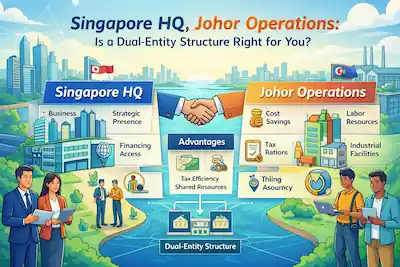
Why more businesses are keeping a Singapore headquarters while building execution capacity through Johor operations
Quick Answer — Dual-Entity Structure for Singapore HQ + Johor Operations
A dual-entity structure keeps your Singapore company as the headquarters for contracts, management, and investor confidence, while a Malaysia/Johor entity handles operations — staffing, warehousing, fulfilment, and local delivery. This model works best when each side has a clear role. The Johor-Singapore Special Economic Zone (JS-SEZ) and RTS Link (targeted end of 2026) make this corridor more viable than ever.
Key Takeaways — Singapore HQ + Johor Operations
- Singapore HQ is best for: Management, contracts, investor confidence, regional coordination
- Johor operations are best for: Staffing, warehousing, fulfilment, local delivery, physical expansion
- Dual-entity works when: Each side has a real job and the second entity removes friction
- Too early when: Business is still testing the market or the second entity exists only for optics
- 2026 catalyst: JS-SEZ incentives and RTS Link (5-minute travel) make cross-border operations more practical
Table of Contents
- What a dual-entity structure actually means
- Why Singapore still works as the headquarters side
- Why Johor is increasingly the operations side
- When the dual-entity model is likely right for you
- When it may still be too early
- Why this matters more in 2026
- The real decision is not complexity — it is fit
- Frequently asked questions
For many businesses in 2026, the real expansion question is no longer whether Singapore or Johor is "better." It is whether each side should do a different job. Singapore may remain the stronger platform for headquarters, contracts, management, investor confidence and regional positioning, while Johor becomes the more practical side for operations, staffing, warehousing, fulfilment or execution. That is why the dual-entity structure has become a serious commercial question rather than a niche structuring exercise, especially as more firms explore how to benefit from the Johor-Singapore Special Economic Zone.
The logic behind this model is increasingly clear. The Johor-Singapore Special Economic Zone is officially positioned as a way for businesses to combine Singapore's strengths in business, finance, technology, R&D and regional connectivity with Johor's land, labour and operating capacity. Singapore's Ministry of Trade and Industry has also noted that the JS-SEZ Project Office has already received more than 300 enquiries from Singapore companies and foreign multinationals, with SMEs accounting for nearly half.
What a dual-entity structure actually means
A dual-entity structure does not mean creating a second company for appearance. It means giving each jurisdiction the right vehicle for the role it is actually playing. In practical terms, that often means the Singapore company handles headquarters functions, regional contracts, management, strategic planning and outward-facing business activity, while the Johor or Malaysia entity handles local hiring, operational delivery, warehousing, service execution or domestic commercial activity. That is also how Terra's own Singapore–Malaysia dual-entity structure guide frames the issue: not as added complexity for its own sake, but as a way to make the legal structure match the way the business really runs.
Why Singapore still works as the headquarters side
Singapore continues to make sense as the headquarters side because it is fast, credible and highly structured. The official ACRA company setup guide shows why: most straightforward registrations are approved soon after payment, the registration framework is clear, and the registered office does not need to be the same location where physical operations occur. That flexibility matters because it allows businesses to maintain a strong Singapore commercial base even when operations are distributed elsewhere. For founders or growth businesses building from scratch, this is one reason Singapore incorporation remains a practical starting point for many internationally oriented businesses.
Why Johor is increasingly the operations side
Johor becomes more attractive once the business needs more than a front-end presence. If the company needs a support team, logistics layer, project execution base, warehousing footprint or broader operating capacity, Johor offers an increasingly credible platform. The official MIDA JS-SEZ framework makes clear that Malaysia is actively structuring the Johor side to support qualifying investment. This matters because Johor is no longer only a lower-cost alternative. It is being shaped into a more investable operating corridor.
Singapore HQ is usually best for
Management, contracts, regional oversight, investor-facing activity, client confidence and group coordination.
Johor operations are usually best for
Operational delivery, local staffing, warehousing, fulfilment, service execution and physical expansion.
The dual-entity structure works best when
Each side has a real job and the second entity removes friction instead of creating dead weight.
The structure is premature when
The business is still testing the market and the second entity exists only for optics or vague future plans.
When the dual-entity model is likely right for you
A dual-entity structure usually becomes more compelling when Malaysia is no longer just a market you sell into, but a place where you actually operate. That can happen when you need local staff, local contracts, local fulfilment, inventory, premises, project delivery or a more permanent operating presence. Terra's cross-border planning guide, Navigating Cross-border Business, is particularly useful here because it forces the right questions early: which entity signs the contracts, which entity employs staff, where inventory sits, who invoices the end customer, and where licences, goods and operational risk actually belong.
When it may still be too early
Not every business needs two entities immediately. If the company is still at the stage of testing demand, selling across borders without a local operating footprint, or managing everything from Singapore without local hires or facilities, creating a second company too early can simply add admin before it adds value.
Why this matters more in 2026 than it did before
The underlying economics of the corridor are becoming easier to act on. The RTS Link project confirms that the line will connect Woodlands North to Bukit Chagar, with a journey time of about five minutes and a targeted passenger-service start at the end of 2026. That matters because better movement reduces one of the hidden costs of a cross-border operating model: management friction.
This commercial logic also fits the broader message in Should Your Business Set Up in Singapore, Johor, or Both?, alongside Can You Live in Johor and Run a Singapore Business? and Singapore vs Johor Business Costs 2026.
The real decision is not complexity — it is fit
The best way to think about a dual-entity structure is not to ask whether it is more complicated. Two companies mean two sets of filings, two compliance tracks and more coordination. The real question is whether that complexity is justified by the commercial reality of the business.
| Structure | Best for | Less suitable when |
|---|---|---|
| Singapore company only | Early-stage cross-border sales, regional planning, founder-led expansion with limited on-the-ground Malaysia activity | Johor or Malaysia now needs local staff, facilities, inventory, fulfilment or operational delivery |
| Malaysia company only | Businesses that are genuinely Malaysia-led with limited need for a Singapore headquarters role | Singapore still matters for commercial positioning, investor relationships or regional management |
| Singapore HQ + Johor operations | Businesses with a real need for a Singapore commercial base and a separate Johor operating layer | The second entity has no clear role or is being added before the operating model is ready |
Bottom line
A dual-entity structure is right when Singapore and Johor are no longer doing the same job for your business. If Singapore is where the company should be seen, led and coordinated, and Johor is where the company should operate, deliver and scale, then the dual-entity model often becomes the cleaner answer. If that split is not real yet, then two entities may still be too early. The point is not to sound sophisticated. The point is to structure the business in a way that reflects how it actually works and how it is likely to grow next.
Let's Map Out a Right-Sized Cross-Border Structure Together
Balancing a Singapore headquarters with Johor operations can be a game-changer, but it should never create unnecessary corporate noise. We believe in complete honesty from our very first conversation. If a dual-entity structure is premature for your current stage, we will tell you openly. We refuse to move forward or file a single document until you completely understand how both entities interact and feel entirely comfortable with the workflow.
Our advisors evaluate your physical footprint, local hiring needs, and long-term goals face-to-face to design and quote only the specific corporate layers your business model genuinely requires today.
Frequently Asked Questions
What is a dual-entity structure between Singapore and Johor?
It is a setup where a Singapore company and a Malaysia company each handle different parts of the business. Singapore usually stays as the headquarters or commercial base, while Johor handles operations or local execution.
When does a Singapore business usually need a Malaysia entity?
Usually when business activity in Malaysia has become operational rather than incidental — for example, when the company needs local staff, local contracts, premises, inventory or ongoing service delivery there.
Does every business expanding into Johor need two entities?
No. Some businesses should stay with one company longer. A second entity makes sense only when it solves a real commercial or operational problem.
Why keep the headquarters in Singapore?
Singapore often remains the stronger headquarters base for management, contracts, investor confidence, commercial credibility and regional coordination.
Why put operations in Johor?
Johor becomes attractive when the business needs more room for staffing, warehousing, fulfilment, operational delivery or physical expansion.
Incorporating or restructuring a business in Singapore is a major legal and financial decision. At Terra Advisory Services, we provide dedicated, personal service from our first conversation to your ongoing annual filings.
We believe in absolute clarity — if you have questions, we take the time to answer them completely. If you do not fully understand any aspect of the process, we will pause and will not move forward until you are ready.
Our experienced advisors evaluate your unique operational needs to quote and design only the specific corporate services your business actually requires.
UEN: 201207025E | Established 2012
Malaysia Company Registration and Cross-Border Compliance
Verify Malaysia Status on MIA →
Important Notice: The information on this page is for general informational purposes only and does not constitute legal, tax, immigration, or professional advice. Always verify current requirements directly with the relevant government authority.