

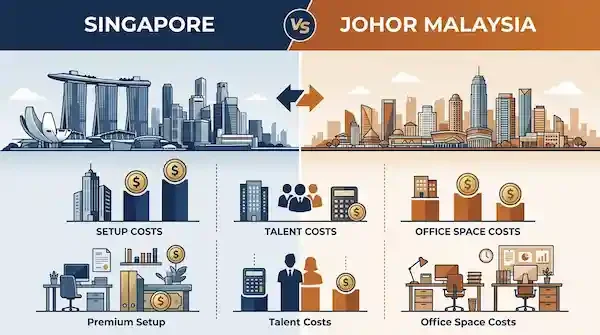
Why the cheapest setup is not always the cheapest operating model
Quick Answer — Singapore vs Johor Business Costs 2026
Singapore usually costs more for talent, office space and general overheads, but may still be the better-value base when your business needs commercial credibility, contracts, governance and regional positioning. Johor often becomes more attractive when your business is increasingly operational, execution-led or space-dependent. For many growth-stage businesses, the strongest answer is no longer Singapore or Johor alone, but a dual-entity structure that uses each side for a different job.
Key Takeaways — Singapore vs Johor Business Costs
- Setup cost is misleading: Singapore ACRA fee is S$300; Johor setup starts from RM2,000–3,500. The real difference comes after setup.
- Talent cost matters more: Singapore excels for leadership and client-facing roles; Johor is attractive for support teams and operational scaling.
- Space changes the equation: Office and industrial space in Johor is significantly lower, benefiting space-dependent businesses.
- Commercial positioning: Singapore remains stronger for contracts, banking, and investor confidence.
- 2026 catalysts: The RTS Link (5-minute travel) and JS-SEZ make cross-border operations more practical than ever.
Table of Contents
- Why headline setup costs can be misleading
- What businesses really end up paying for
- Singapore vs Johor cost comparison
- Why talent costs matter more than setup fees
- Why space and overheads change the equation
- Why this matters more in 2026
- When Singapore is still worth paying more for
- When Johor changes the business case
- Why businesses compare structures, not places
- Frequently asked questions
The cheapest setup on paper is not always the cheapest operating model in practice. If your business is comparing Singapore and Johor in 2026, the real cost question is not only incorporation fees. It is what you will actually pay over time for setup, staffing, office or industrial space, management friction and the structure needed to support growth.
This is why a good cost comparison should not stop at incorporation fees. It should ask what the business is really trying to buy. If you are paying more for Singapore, are you paying for a stronger commercial anchor? If you are moving toward Johor, are you doing it because the business genuinely needs lower operating costs, more physical capacity or a deeper execution footprint?
That is also why this article works best alongside Terra's broader decision guide on whether your business should set up in Singapore, Johor, or both. Cost matters, but it makes more sense when viewed inside the right structure decision.
Why headline setup costs can be misleading
Singapore can look relatively straightforward at the point of incorporation. The official ACRA company registration fee is S$300, and most standard registrations are approved soon after payment. On paper, that makes the Singapore setup process look clean and efficient.
Johor can also look attractive at the entry stage. Terra's Expand Singapore to Malaysia guide notes that Malaysia setup costs can start from around RM2,000 to RM3,500, depending on the structure and service scope. Terra's Malaysia guide also notes that a Sdn Bhd usually takes around 2 to 4 weeks end-to-end, with 100% foreign ownership available in most sectors.
But the real difference emerges after setup. Once the business starts paying for people, office or industrial space, support functions, logistics and ongoing execution, Singapore and Johor stop looking like a simple registration comparison and start looking like two very different operating environments.
What businesses really end up paying for
In practice, most businesses are paying for five things:
- setup and compliance
- talent and payroll intensity
- office, industrial or operating space
- management and coordination friction
- the cost of using the wrong structure for the next stage of growth
That last point is often underestimated. A company may save money by keeping everything in one place at the start, only to create more friction later when the business clearly needs a stronger Malaysia operating side or a stronger Singapore commercial base.
Singapore vs. Johor cost comparison at a practical level
| Cost area | Singapore | Johor | What it usually means |
|---|---|---|---|
| Initial setup | Official ACRA registration fee is S$300, with fast processing for standard cases. | Setup can start from around RM2,000 to RM3,500 depending on structure and service scope. | Neither side is usually expensive enough at incorporation stage to decide the whole strategy on its own. |
| Talent | Stronger for regional, managerial and outward-facing roles, but usually at a higher payroll cost. | Often more attractive for cost-sensitive hiring, support teams, operations and scaling headcount. | The talent cost gap often matters more than the setup gap. |
| Space | Office and operating space usually cost more, especially if the business needs room to scale physically. | Office space, staff-related overheads and operating footprint are generally lower. | Space-dependent businesses often feel the Johor advantage much faster. |
| Commercial positioning | Often stronger for contracts, banking familiarity, governance and regional credibility. | May be more operationally attractive, but not always the preferred outward-facing base. | Higher Singapore costs may still be justified if the business needs a stronger commercial anchor. |
| Cross-border operating model | Can remain the strategic or client-facing side. | Can become the operating, staffing, warehousing or fulfilment side. | For many businesses, the best answer is not one side alone but a coordinated structure across both. |
Why talent costs usually matter more than setup fees
Many founders initially fixate on incorporation cost because it is easy to compare. But setup cost is often a small part of the actual business equation. Once the company starts hiring, talent cost becomes more decisive. Singapore may still make sense for leadership, client-facing, strategic or investor-facing roles. But businesses that want to build support teams, operating teams or more cost-sensitive functions often find Johor much harder to ignore.
This is also why Terra's Can You Live in Johor and Run a Singapore Business? article matters in the wider cluster. It reflects a bigger trend: once the corridor becomes more workable, businesses stop thinking only about where to incorporate and start thinking about how to distribute people, management and functions across both sides.
Why space and overheads change the equation quickly
The difference in office, industrial and general overhead cost can change the economics of the business much faster than the difference in registration fees. Terra's Malaysia guidance explicitly notes that office space, staff and overheads in Malaysia run significantly below Singapore levels. That is one reason companies needing to scale headcount or physical capacity often start looking at Johor as more than just a nearby alternative.
That said, lower space cost does not automatically mean Johor should replace Singapore. If the business still needs Singapore as the commercial base, the better solution may be to let Singapore remain outward-facing while Johor handles the more space-sensitive operating side.
Why this cost discussion matters more in 2026
The commercial logic is changing because the corridor is changing. The RTS Link is officially targeted to commence passenger service at the end of 2026, with a journey time of about five minutes between Woodlands North and Bukit Chagar and capacity of up to 10,000 commuters per hour in each direction. That does not reduce your salary bill directly, but it can reduce management friction and make cross-border supervision feel much more workable.
The wider Johor-Singapore Special Economic Zone also changes how businesses think about cost. EDB describes the zone as spanning more than 3,500 square kilometres across nine flagship zones, designed to support complementary operations across both jurisdictions. It also notes that streamlined customs processes now require only a single transshipment permit instead of two, cutting processing time by half and saving S$40 per permit application. That is a small figure on its own, but it reflects a wider pattern: the corridor is being designed to reduce friction, not just to advertise lower rent.
When Singapore is still worth paying more for
Singapore may still be the better-value choice when the business needs a recognised base for contracts, regional management, investor confidence, banking familiarity and outward-facing credibility. In those cases, the higher ongoing cost is not necessarily waste. It may be the cost of buying a cleaner commercial platform.
If that is the main need, Terra's Singapore incorporation guide remains the most relevant next step.
When Johor changes the business case
Johor becomes much more attractive once the business is no longer just selling, but actually operating. That usually means staffing, support functions, logistics, warehousing, fulfilment, project work, service delivery or a larger physical footprint. At that point, the question is no longer just whether Johor is cheaper. It is whether the business has reached the stage where Singapore-only costs are no longer the most logical fit for how the company actually runs.
If that shift is already underway, Terra's Expand Singapore to Malaysia page and Malaysia Hub are the natural operational follow-ups.
Why many businesses eventually compare structures, not places
For many companies, the most useful question is not "Singapore or Johor?" but "Which functions should live where?" That is the point where the cost conversation becomes more strategic. Singapore may still hold the contracts, management, treasury, branding and commercial relationships. Johor may take on the operating footprint, team growth, support functions or fulfilment side.
That is why Terra's Singapore-Malaysia dual-entity structure guide becomes important once the business has clearly outgrown a one-country mindset. The goal is not adding complexity for show. The goal is making sure each cost base supports the right function.
Singapore usually makes more sense if…
You need stronger commercial credibility, contracts, governance, management visibility and a recognised regional base.
Johor usually makes more sense if…
You need lower operating costs, more room for staff, support teams, warehousing, fulfilment or execution-heavy functions.
Both often make more sense if…
You want Singapore to remain the outward-facing anchor while Johor takes on a clearer operating role.
Best strategic question
Not "where is cheaper?" but "which cost base belongs to which function?"
The practical answer
If you compare only incorporation fees, you may miss the real cost story. If you compare only salaries or office rent, you may miss why Singapore still matters. The better answer is to compare total operating logic: where commercial value is created, where execution happens, and whether the structure still fits the way the business is growing.
For some businesses, Singapore remains worth the premium. For others, Johor changes the economics quickly. And for many, the smartest answer is not choosing one side over the other, but assigning each side a clearer commercial role.
Let's Build a Transparent, Right-Sized Budget For Your Expansion
Comparing cross-border operational costs involves much more than lookups on rent tables and salary averages. We believe in absolute clarity from our very first conversation. We don't use rigid, pre-packaged corporate bundles or padded estimates. If your current business scale only requires a single-entity structure, we will tell you openly. We refuse to move forward or file a single registration until you are completely comfortable with your long-term cost projections and understand exactly where every dollar is allocated.
Our experienced advisors look at your targeted headcounts, office needs, and transaction structures face-to-face to quote and design only the specific corporate services your business genuinely requires to grow safely.
Frequently Asked Questions
Is Singapore or Johor cheaper for business setup?
At incorporation stage, the difference may not decide the strategy on its own. The more important cost gap usually appears later in talent, office or industrial space, and general operating overheads.
What costs more in Singapore than Johor?
For many businesses, the bigger differences are in staffing, office space, physical operating footprint and general overheads rather than the basic act of incorporation.
Does lower Johor cost mean every business should move there?
No. If the business still needs Singapore as a stronger commercial anchor, paying more may still make strategic sense. Lower cost only helps when the structure still fits the business model.
Should I compare Singapore and Johor as alternatives or as a combined model?
That depends on the business. For many growth-stage companies, the better comparison is no longer one place versus the other, but which functions should sit in Singapore and which should sit in Johor.
When does a Singapore-plus-Johor structure start making sense?
It usually starts making more sense when the business wants Singapore for commercial positioning and Johor for operating depth, staffing or space-sensitive execution.
Incorporating or restructuring a business in Singapore is a major legal and financial decision. At Terra Advisory Services, we provide dedicated, personal service from our first conversation to your ongoing annual filings.
We believe in absolute clarity — if you have questions, we take the time to answer them completely. If you do not fully understand any aspect of the process, we will pause and will not move forward until you are ready.
Our experienced advisors evaluate your unique operational needs to quote and design only the specific corporate services your business actually requires.
UEN: 201207025E | Established 2012
Malaysia Company Registration and Cross-Border Compliance
Verify Malaysia Status on MIA →
Important Notice: The information on this page is for general informational purposes only and does not constitute legal, tax, immigration, or professional advice. Always verify current requirements directly with the relevant government authority.