

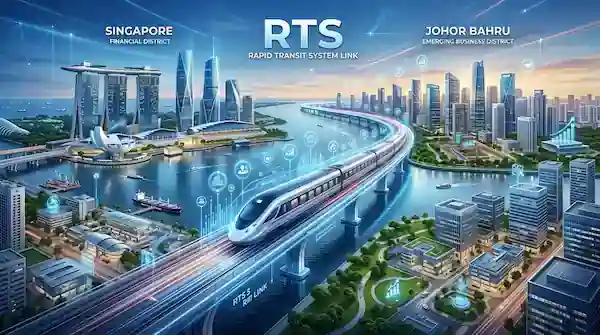
How will the RTS Link and JS-SEZ change Singapore-Johor business setup in 2026? The RTS Link, targeted to commence service by January 2027, will connect Woodlands North to Bukit Chagar in just 5 minutes with a peak capacity of 10,000 passengers per hour per direction. This transforms the Singapore-Johor corridor from a logistical challenge into a practical, integrated business region.
Singapore remains the optimal commercial anchor for incorporation, contracts, banking, and investor confidence. Johor becomes increasingly viable for operations, staffing, warehousing, and fulfilment, supported by the JS-SEZ's goal of 50 high-value projects and 20,000 skilled jobs within five years. For many businesses, the most strategic approach is no longer choosing one side over the other, but structuring a coordinated presence that uses each side for a different role.
Key Takeaways — RTS Link & Business Setup
- RTS Link: 5-minute journey, 10,000 passengers/hour/direction, January 2027 launch
- Co-located CIQ: Passengers clear both departure and arrival immigration at the point of departure — no further clearance on arrival
- JS-SEZ targets: 50 high-value projects, 20,000 skilled jobs within five years; 100 projects within 10 years across 3,505 km²
- Special tax rates: 5% corporate tax for up to 15 years (qualifying sectors), 15% personal income tax for knowledge workers for 10 years
- MRA Grant: Up to 70% co-funding for Singapore SMEs expanding into Johor, capped at S$100,000 per market
- Key question: Not "Will the RTS Link save me time?" but "Will it change how I should structure my business?"
Fast Facts — RTS Link & JS-SEZ 2026
- Why founders should pay attention now
- The RTS Link: a game-changer for business
- Why Singapore remains the natural starting point
- Why Johor becomes more realistic much earlier
- The JS-SEZ opportunity
- What the strongest founders may do differently
- Why this matters even more for new businesses
- What founders should ask next
- Frequently asked questions
Why founders should pay attention now
Entrepreneurs rarely wait for infrastructure to become familiar before responding to it. They move when it starts to shift the economics and manageability of growth. Better connectivity between Singapore and Johor makes the corridor feel less like a compromise and more like a practical operating option.
That matters whether the founder is launching a service business, building an e-commerce brand, structuring a regional base, or thinking about how to separate commercial functions from operating functions more intelligently.
From the Singapore Ministry of Home Affairs:
"The Johor Bahru-Singapore Rapid Transit System Link, or RTS Link, is targeted to commence service this December. With a peak capacity of up to 10,000 passengers per hour per direction, the RTS Link will help relieve congestion on the Causeway."
— Edwin Tong, Minister for Law & Second Minister for Home Affairs, 5 May 2026
The wider policy direction reinforces that shift. The Johor-Singapore Special Economic Zone is being positioned as a more integrated platform for businesses that want to combine Singapore's commercial strengths with Johor's operating capacity, space and cost advantages.
If you are still deciding on the best Singapore entity type, read our guide on best Singapore business structure for startups in 2026.
The RTS Link: a game-changer for business
The RTS Link matters because it changes more than travel time. It changes how manageable the Singapore–Johor corridor feels. Once cross-border movement becomes faster and more predictable, founders stop thinking about the two sides as separate decisions. They start thinking in terms of one commercial corridor.
According to Singapore's Land Transport Authority, the line will connect Woodlands North directly to Bukit Chagar, with a journey time of about five minutes, capacity of up to 10,000 commuters per hour in each direction, and passenger service targeted for January 2027.
Key Fact: The RTS Link features co-located CIQ clearance — passengers clear both departure and arrival immigration at the point of departure, with no further clearance required upon arrival. This is supported by a passport-free QR code system and 100 AI-enabled e-gates, enabling clearance in as little as 7 seconds.
Malaysia's Transport Minister Anthony Loke confirmed in April 2026 that the project has reached 90% completion and is now focused on system installation, with field readiness testing scheduled for September 2026.
From Malaysia's Transport Minister:
"Right now, it is the system installation phase. So it does not involve much in terms of fuel costs and so on. So I am confident that it will not affect this project."
— Anthony Loke, Malaysia Transport Minister, April 2026
Why Singapore remains the natural starting point for many businesses
For many new ventures, Singapore will remain the right place to begin. It offers speed, credibility and a business environment that is widely understood by clients, banks, partners and investors. The official ACRA guide to setting up a local company still reflects what founders value most: a clear registration framework, a S$300 incorporation fee, and fast approval for straightforward cases.
In that sense, the RTS Link does not weaken Singapore's role. It can strengthen it. A Singapore base becomes even more useful when founders feel more confident about placing selected operating functions across the border without losing commercial coherence.
Once you've decided on a Singapore company as your commercial anchor, your next step is choosing a name that ACRA will approve. Read our guide on The Perfect Company Name For Your Singapore Business.
For a deeper breakdown of the foreign-founder angle, see can a foreigner own 100% of a Singapore company.
If you are ready to set up your Singapore company, Singapore company incorporation is your next step.
Why Johor becomes more realistic much earlier
Johor changes meaning once it becomes easier to access and supervise. Entrepreneurs who may once have viewed it as operationally awkward can begin to see it as a serious extension of the business model. That does not mean every founder should build in Johor immediately. It means Johor becomes more realistic much earlier for businesses thinking about support teams, service operations, warehousing, fulfilment, project execution or a broader operating footprint.
This is where Terra's Malaysia Hub becomes strategically relevant. The corridor no longer works in only one direction. Some businesses will still start in Singapore and extend into Johor later. Others may build meaningful operating substance in Johor while keeping a strong Singapore-facing company as the commercial front.
For a complete guide to registering the Malaysia side, see How to Register a Company in Malaysia.
The JS-SEZ opportunity
The Johor-Singapore Special Economic Zone (JS-SEZ) is designed to deepen economic activity between Singapore and Johor, with Malaysia announcing a robust incentive package for qualifying activities and qualifying investments in designated areas. The zone covers 3,505 km² across six cities and townships: Johor Baru, Iskandar Puteri, Pasir Gudang, Kulai, Pontian, and Pengerang.
From Malaysia's Economy Minister:
"JS-SEZ is not merely about geography, nor is it only about moving people and goods more efficiently across borders. It is about bringing together Malaysia's industrial scale and Singapore's global connectivity into one competitive platform for investors."
— Akmal Nasrullah Mohd Nasir, Economy Minister, July 2026
Key Fact: The JS-SEZ targets 50 high-value projects and 20,000 skilled jobs within five years, with 100 projects within 10 years. ANZ Research projects Johor's GDP will reach RM250 billion by 2030, positioning the state for "high-income" status with a 6.5% compounded annual growth rate.
JS-SEZ Incentives
Effective from January 1, 2025, companies undertaking new investment in qualifying sectors within the JS-SEZ are eligible for:
- Special corporate tax rate of 5% for up to 15 years for qualifying activities in:
- Flagship F (Kulai–Sedenak): Artificial Intelligence, Quantum Computing Supply Chain, Medical Devices, Pharmaceuticals
- Flagship E (Senai–Kulai): Aerospace Manufacturing, Maintenance Repair and Overhaul (MRO) Services
- Flagship A & B (Johor Bahru Waterfront, Iskandar Puteri): Global Service Hubs (regional P&L, strategic business planning, corporate development, regional/global treasury and fund management)
- 15% personal income tax rate for 10 years for qualifying knowledge workers
- 100% Investment Tax Allowance for eligible capital expenditure in Flagship C (Smart Logistics Complex), Flagship D (Downstream Specialty Chemicals), and Flagship G (Integrated Tourism Development)
For a deeper understanding of how Double Tax Agreements can benefit your cross-border structure, see our Singapore Double Tax Agreements guide.
For detailed guidance on dividend repatriation and Singapore tax exemption, see JS-SEZ Dividends and Singapore Tax Exemption Guide 2026.
What the strongest founders may do differently
Some founders who benefit most from the RTS Link may not be those who wait until it is fully operational before adjusting their strategy. Instead, they are the ones who begin planning early. Improved Singapore–Johor connectivity changes how entrepreneurs approach management access, team deployment, and business design.
For businesses expecting meaningful activity on both sides, a more deliberate Singapore–Malaysia dual-entity structure may become increasingly relevant.
For some businesses, the right answer will still be Singapore only. For others, Johor will become part of the operating model sooner than expected. For a growing number, the strongest answer may be a coordinated structure in which Singapore remains the commercial anchor while Johor supports execution, capacity and expansion.
If founders are already thinking in those terms, it also makes sense to connect this discussion to Should Your Business Set Up in Singapore, Johor, or Both? and Singapore vs Johor Business Costs 2026.
Why this matters even more for new businesses
Established companies can often absorb some inefficiency. New businesses usually cannot. Founders making setup decisions in 2026 and beyond are often balancing speed, credibility, cost and flexibility at the same time. The RTS Link strengthens the case for thinking beyond a single-jurisdiction mindset.
This does not mean infrastructure replaces judgement. It means infrastructure improves the quality of the choices available. Founders still need to decide where to incorporate, where to hire, where to build capacity and whether the business needs one entity or a more coordinated structure across both sides.
MRA Grant: Government Funding for Your Expansion
For Singapore SMEs expanding into Malaysia, the Market Readiness Assistance (MRA) Grant by Enterprise Singapore offers significant funding support. From 1 April 2026 to 31 March 2029, eligible companies can receive up to 70% co-funding for overseas market promotion, business development, and market setup activities.
The support is capped at S$100,000 per company per new market, covering overseas market promotion (capped at S$20,000), overseas business development (capped at S$50,000), and overseas market setup (capped at S$30,000).
Key Fact: To be eligible for the MRA Grant, your company must be registered and operating in Singapore, at least 30% locally owned, and have group annual sales turnover not exceeding S$100 million or a group employment size not exceeding 200 employees.
This grant is particularly relevant for businesses establishing their Malaysia operations, covering setup costs including legal fees, documentation, and professional services for business incorporation and regulatory compliance.
What founders should ask next
A founder should not stop at asking, "Will the RTS Link save me time?" The more useful question is, "Will it change how I should set up the business?" That shift in thinking matters. It moves the conversation away from convenience and toward structure, expansion and commercial design.
If the business may eventually need Singapore for contracts, management and commercial credibility, while using Johor for operating scale, then it makes sense to think about the business as a corridor strategy from the beginning.
For detailed cross-border taxation guidance, see Singapore-Malaysia Cross-Border Taxation Guide.
Ready to Align Your Corporate Structure with the Shifting Corridor?
As the RTS Link and JS-SEZ make cross-border operations more practical than ever, we'll help you design a dual-entity structure that works for your business — not a generic template. We'll also guide you through available funding like the MRA Grant to make your expansion more affordable.
Frequently Asked Questions
Incorporating or restructuring a business in Singapore is a major legal and financial decision. We provide dedicated, personal service from our first conversation to your ongoing annual filings.
If you do not fully understand any aspect of the process, we will pause and will not move forward until you are ready.
We quote and design only the specific services your business actually requires.
📌 Pin Terra Advisory Services as your Preferred Source on Google (Click link and check the box) →
Note: Terra Advisory Services is a Registered Filing Agent under the ACRA Act. Under the Corporate Service Providers Act 2024, we are treated as a registered Corporate Service Provider (CSP) and meet all new compliance requirements.
Important Notice: While Terra Advisory Services Pte. Ltd. endeavours to keep the content accurate and current, Singapore government policies, regulations, fees, and procedures may change at any time without prior notice. For the most up-to-date and authoritative information, please refer directly to official government sources. For the latest compliance and advice tailored to your specific circumstances, please contact Terra Advisory Services.
Strategic Malaysia Affiliate — MIA Registered Firm
Official sources used in this 2026 guide:
- MHA — Cross-Border Railways (Border Control Co-location) Bill, 5 May 2026
- The Star — JS-SEZ targets 50 high-value projects, 7 January 2025
- JS-SEZ Tax Incentive Package Details
- EY — Market Readiness Assistance Grant
- OnCourse — RTS Link Enters Final Phase, 7 April 2026
- The Edge Malaysia — JS-SEZ to lift Johor's GDP to RM250b by 2030