

How to Incorporate a Company in Singapore in 2026: Complete Foreign Founder Guide
Quick Answer — Singapore Company Incorporation 2026
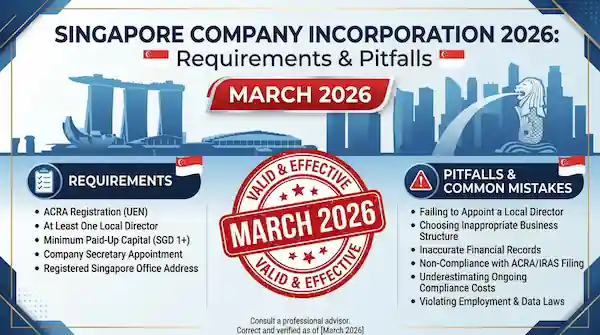
Government fees: S$315 total (S$15 name reservation + S$300 registration). Timeline: 1–3 business days for standard applications. Requirements: At least one resident director (citizen/PR/EP holder), one shareholder (100% foreign ownership allowed), minimum S$1 paid‑up capital, registered Singapore address, and company secretary within 6 months. Critical 2026 updates: Register of Registrable Controllers (RORC) must be filed within 2 business days of incorporation; nominee director status is now publicly disclosed on BizFile; maximum director penalties increased to S$20,000 for breach of duties.
Key Takeaways for Foreign Founders
- 100% Foreign Ownership: No local shareholder or equity partner required. You retain full control.
- Resident Director Mandatory: At least one director must be ordinarily resident in Singapore from day one. Foreign founders typically use a professional nominee director service until they secure their own Employment Pass.
- Bank Account is the Real Bottleneck: ACRA approval takes 1–3 days, but opening a corporate bank account takes 2–6 weeks. Banks reject applications with vague SSIC codes, no business plan, or unclear source of funds.
- RORC Filing is Now Day-One Critical: The Register of Registrable Controllers must be filed within 2 business days of incorporation. Non-compliance carries penalties up to S$5,000.
- Director Penalties Increased: Maximum penalty for breach of director duties rose to S$20,000 in 2026. Professional compliance support is no longer optional.
Fast Facts — Singapore Incorporation 2026
Why should foreign founders incorporate a company in Singapore in 2026?
Singapore remains one of the world's most business‑friendly jurisdictions, with a 2% increase in company formations from 2025 to 2026 despite global uncertainty. It offers a transparent legal system, competitive 17% corporate tax, and access to ASEAN's 650+ million consumers.
Key reasons businesses choose Singapore include:
- Transparent legal system based on English common law
- Competitive corporate tax rates capped at 17%, with effective rates of 4–8% for qualifying startups under the Start-Up Tax Exemption (SUTE)
- Strong international reputation with 90+ Double Taxation Agreements
- Gateway to ASEAN with 650+ million consumers
- 100% foreign ownership permitted in most sectors
- No capital gains tax on investment returns
Which business structure is right for foreign founders in Singapore?
For 90% of foreign entrepreneurs, the Private Limited Company (Pte. Ltd.) is the correct choice. It offers limited liability, tax efficiency, and the ability to raise investment capital.
| Structure | Best For | Liability | Key Notes |
|---|---|---|---|
| Private Limited (Pte. Ltd.) | 90% of foreign entrepreneurs | Limited to share capital | Most common; scalable; tax-efficient |
| Branch Office | Foreign companies testing market | Parent company fully liable | Extension of foreign entity; not separate |
| Subsidiary Company | Foreign parent seeking risk isolation | Limited to subsidiary | Locally incorporated; separate legal entity |
| Representative Office | Market research only | Parent company liable | No revenue generation allowed; 3-year max |
| Sole Proprietorship | Local freelancers only | Unlimited personal liability | Not available to foreigners |
If you are an overseas company expanding into Singapore, you may also need to navigate foreign business registration options specific to your industry and home jurisdiction.
What are the exact statutory requirements to incorporate a company in Singapore?
You must meet six statutory requirements from day one of incorporation. Missing any of these will result in automatic rejection by ACRA.
1. Resident Director (Mandatory from Day One)
At least one director must be "ordinarily resident" in Singapore — meaning a Singapore citizen, Permanent Resident, or Employment Pass/EntrePass holder. For foreign entrepreneurs living overseas, a professional nominee director service fulfills this requirement until you secure your own work pass.
2. Shareholder (Minimum 1, Maximum 50)
At least one shareholder is required. 100% foreign ownership is permitted — no local equity partner required. Shareholders may be individuals or corporate entities anywhere in the world.
3. Paid-Up Capital (Minimum S$1)
The legal minimum is S$1. However, banks typically expect to see S$1,000–S$50,000 depending on your business model and risk profile. Higher capital improves bank account approval odds.
4. Registered Address (Physical Singapore Address)
A physical Singapore address is required. P.O. Boxes are not permitted. Many entrepreneurs use a registered address service as part of their Singapore incorporation package.
5. Company Secretary (Within 6 Months)
A qualified company secretary must be appointed within 6 months of incorporation. A sole director cannot act as company secretary. Non-compliance carries fines up to S$1,000. Explore corporate secretarial services for ongoing compliance support.
6. Auditor (Within 3 Months, Unless Exempt)
Appoint an auditor within 3 months unless your company qualifies as a "small company" (revenue under S$10M, assets under S$10M, fewer than 50 employees).
How does the step-by-step incorporation process work?
The incorporation process takes 1–3 business days and costs S$315 in government fees. Here is the exact sequence:
Step 1: Choose Your Business Structure
Refer to Section 2 above. For most foreign entrepreneurs, a Private Limited Company is the correct choice.
Step 2: Reserve Your Company Name
Submit your proposed company name to ACRA via BizFile+. Cost: S$15. Valid for 120 days. Avoid sensitive words like "Bank," "Law," or "University" without prior approval. See our guide on how to select your ideal company name.
Step 3: Choose Your SSIC Code
Banks use your SSIC (Singapore Standard Industrial Classification) code for risk assessment. Avoid vague codes like "Trading" or "Consulting" — these trigger enhanced due diligence and delays. From 9 May 2026, all new incorporations must use SSIC 2025 codes. See our SSIC 2025 Guide and Code Directory for the full updated list.
Step 4: Prepare Required Documents
You will need:
- Passport copies for all directors and shareholders
- Proof of residential address (utility bill, bank statement)
- CV or professional profile for directors
- Company constitution (we provide templates)
- Details of nominee director (if applicable)
For a complete walkthrough including document templates, see how to register a company in Singapore.
Step 5: File Incorporation via BizFile+
Cost: S$300. Processing: 15 minutes to 3 business days. ACRA issues your Certificate of Incorporation and Unique Entity Number (UEN).
Step 6: Post-Registration Steps (Critical)
Immediately after receiving your UEN:
- File RORC within 2 business days (see Section 6)
- Open a corporate bank account (2–6 weeks)
- Register for CorpPass (digital identity for government services)
- Appoint company secretary (within 6 months)
- Plan your compliance calendar
Why is the corporate bank account the real bottleneck for foreign founders?
ACRA approval takes 1–3 days, but opening a corporate bank account takes 2–6 weeks. This is where most foreign founders get stuck.
Why Banks Reject Foreign Founder Applications
Banks conduct enhanced due diligence on foreign-owned companies. The most common rejection reasons include:
- Vague business description: "We do trading" or "We provide consulting" is not specific enough
- Opaque ownership structure: Banks need to understand who ultimately controls the company
- Unclear source of funds: Where did the initial capital come from?
- No business plan: Banks want to see projected revenue, expenses, and transaction flows
- Links to high-risk jurisdictions: Certain countries trigger additional scrutiny
- Nominee director cannot explain the business: Banks interview nominee directors; if they cannot articulate the business model, the application is rejected
How to Pre-Clear Bank Compliance
We prepare a comprehensive bank application package including:
- Detailed business plan with 3-year financial projections
- Clear organizational chart showing ownership and control
- Evidence of source of funds (bank statements, investment agreements)
- Expected transaction flows and counterparties
- SSIC code justification aligned with business activities
- Nominee director briefing document (so they can articulate the business model)
This preparation reduces bank account opening time from 6 weeks to 2–3 weeks and increases approval odds from 40% to 90%.
What changed in 2026 that foreign founders cannot ignore?
Key 2026 regulatory changes include mandatory RORC filing within 2 business days, increased director penalties, public disclosure of nominee directors, and AI-driven audit surveillance by ACRA.
1. Enhanced Beneficial Ownership Disclosure (RORC)
The Register of Registrable Controllers (RORC) must be filed within 2 business days of incorporation. This identifies individuals or entities with significant control (>25% shares or voting rights). The electronic registry is now live and accessible to law enforcement.
2. Director Penalties Increased to S$20,000
The Corporate and Accounting Laws Amendment Act 2025 raised the maximum penalty for breach of director duties from S$5,000 to S$20,000. This includes failures related to financial reporting, related party transactions, and insolvent trading.
3. Public Disclosure of Nominee Directors
From 16 June 2025, companies must file nominee director details with ACRA's Central Register of Nominee Directors (ROND). Nominee status is now publicly visible on BizFile company profiles. This increases transparency but also means banks and partners can see you are using a nominee director.
4. AI-Driven Audit Surveillance
ACRA now uses artificial intelligence to analyze XBRL financial statements for inconsistencies, related party transactions, and unusual patterns. This means automated flagging of potential compliance issues before human auditors even review your filings.
5. BEPS 2.0 and Global Minimum Tax
Multinational groups with €750M+ revenue are affected by the global minimum tax rate of 15%. While this does not directly impact most SMEs, it signals Singapore's commitment to international tax transparency.
6. ESG Reporting Requirements
Sustainability reporting is now mandatory for listed companies and encouraged for SMEs. While not yet required for private companies, investors and banks increasingly expect ESG disclosures.
What does Singapore company incorporation actually cost in 2026?
Government fees total S$315. However, your actual first-year cost depends on whether you need professional services for nominee director, company secretary, registered address, and accounting.
| Item | Cost (SGD) | Notes |
|---|---|---|
| Name reservation | S$15 | One-time fee |
| Incorporation filing | S$300 | One-time fee |
| Total government fees | S$315 | Mandatory |
| Company secretary (annual) | S$1,200–2,500/year | Mandatory within 6 months |
| Registered address service | S$300–800/year | Optional if you have physical office |
| Nominee director service | S$2,000–4,000/year | Required for foreign founders |
| Accounting & bookkeeping | S$200–800/month | Ongoing compliance |
| Corporate tax filing | S$500–1,500/year | Annual filing with IRAS |
- Without nominee director: S$2,500–S$5,000
- With nominee director: S$4,500–S$9,000
Terra Advisory Services provides integrated support covering corporate secretarial services and Singapore corporate compliance 2026 to ensure you meet all deadlines and avoid penalties.
What common mistakes do foreign businesses make when incorporating in Singapore?
The most common mistakes include treating the nominee director as a rubber stamp, using vague business descriptions, ignoring RORC filing, and assuming ACRA approval guarantees bank approval.
Mistake 1: Choosing the Wrong Business Structure
Defaulting to a structure without understanding the liability, tax, and operational implications. A Branch Office exposes your foreign parent to full liability. A Representative Office cannot generate revenue. For most foreign founders, a Pte Ltd is the correct choice.
Mistake 2: Treating Nominee Director as a Rubber Stamp
Foreign founders often assume the nominee director is just a name on paper. In reality, nominee directors have legal duties and can be held liable for company actions. You must brief them thoroughly on your business model, and they must understand it well enough to explain it to banks and regulators.
Mistake 3: Using Vague Business Descriptions
Descriptions like "We do trading" or "We provide consulting" trigger enhanced due diligence from banks and may result in rejection. Be specific: "We import electronic components from China and distribute to manufacturers in Southeast Asia" is much better.
Mistake 4: Ignoring RORC Filing
The Register of Registrable Controllers must be filed within 2 business days of incorporation. Many founders assume this can be done later. It cannot. Non-compliance carries fines up to S$5,000.
Mistake 5: Assuming ACRA Approval = Bank Approval
ACRA approval means your company is legally registered. It does not mean banks will open an account for you. Banks conduct independent due diligence and reject applications with vague business models, unclear ownership, or links to high-risk jurisdictions.
Mistake 6: Misalignment with Immigration Planning
Founders often incorporate first and then think about work passes later. This creates delays. Incorporation and work pass planning should happen together. See our guide on Singapore immigration and visa services to align your timeline.
What happens after ACRA approval? Post-incorporation compliance obligations
After incorporation, companies must file annual returns with ACRA, file ECI and corporate tax returns with IRAS, and maintain statutory registers. Missing deadlines results in automatic penalties, director disqualification risk, or strike-off.
Annual Filings with ACRA
- Annual Return: File within 7 months of financial year end
- Financial Statements: Prepare in XBRL format (unless exempt)
- Statutory Registers: Maintain and update throughout the year
Tax Compliance with IRAS
- Estimated Chargeable Income (ECI): File within 3 months of financial year end
- Corporate Tax Return (Form C/C-S): File by 30 November annually
- GST Registration: Mandatory if turnover exceeds S$1 million
For a complete compliance roadmap including deadlines, penalties, and filing procedures, see our guide on post-incorporation compliance and annual filings.
How does company incorporation align with work pass planning?
If you plan to relocate to Singapore to manage your company, your work pass strategy should be planned alongside — but separately from — incorporation.
Most foreign founders incorporate first using a nominee director, then apply for a work pass through their newly registered company. The most common pathways include:
- Employment Pass: For professionals, managers, and executives earning at least S$5,600/month. See our Singapore Employment Pass guide.
- EntrePass: For foreign entrepreneurs with innovative business ideas or venture capital backing. See our Singapore EntrePass guide.
- S Pass: For mid-skilled staff earning at least S$3,300/month. Subject to quota and levy. See our Singapore S Pass guide.
- Dependant's Pass: For spouse and children of EP/S Pass holders earning at least S$6,000/month. See our Singapore Dependant Pass guide.
For long-term planning, explore Singapore Permanent Residence pathways after holding an Employment Pass for 2–3 years.
Ready to incorporate your Singapore company?
We handle ACRA filing, nominee director arrangement, bank account preparation, and post-incorporation compliance — so you can focus on building your business.
Frequently asked questions about Singapore company incorporation
Incorporating or restructuring your business requires more than automated forms. We provide a highly personal, tailored approach—no generic packages, just dedicated expert guidance.
- • Your Peace of Mind Comes First: We don't just explain—we ensure you truly understand and are comfortable before proceeding.
- • Personalized & Honest Pricing: Once we understand your needs, we provide a clear, custom quote—no hidden fees or unnecessary extras.
- • Expert Immigration Support: Direct, one-on-one advisory from seasoned professionals with 20+ years of experience.
- • Cross-Border Expertise: Local advisory for smooth business expansion between Singapore and Malaysia.
Your vision, your pace, our expertise.
Important Disclaimer: The information provided on this website is for general informational purposes only and does not constitute formal legal, tax, financial, or corporate advisory advice. While Terra Advisory Services Pte. Ltd. endeavors to keep the content accurate and current, Singapore and Malaysian government policies, regulations, fees, and procedures change frequently and without prior notice. Readers should verify details directly with official government authorities (such as ACRA, MOM, SSM, and LHDN) before taking action. For advice tailored to your specific business circumstances, please contact Terra Advisory Services.
Licensed Malaysian Division — MIA Registered Firm (NF3281)
Official Sources & Latest Updates (August 2026):