

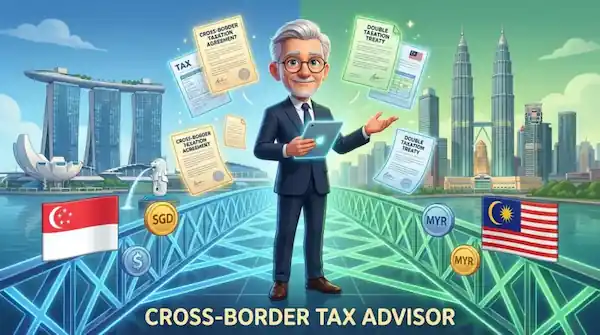
What is the main tax issue in a Singapore–Malaysia structure? The main issue is usually not the headline tax rate. It is whether the chosen entity structure correctly reflects where contracts are signed, where decisions are made, where staff work, which payments trigger withholding tax, and how profits are allocated between related entities.
17% flat
24% standard / 15-17% SME
50% up to S$40,000
Key Takeaways
- Tax residence is about control, not incorporation — IRAS says a company's tax residence depends on where control and management are exercised, not just where it is incorporated. Board meetings and strategic decision-making location matter most.
- DTA relief is conditional, not automatic — The Singapore–Malaysia DTA may reduce or eliminate double taxation if the relevant treaty provision applies and supporting documents like a Certificate of Residence are in place.
- YA 2026 CIT rebate enhanced to 50% — The enhanced rebate gives companies 50% of corporate tax payable (capped at S$40,000 total benefit) and S$2,000 cash grant for active companies with local employees.
- TPG8 introduces significant changes from 2026 — IRAS issued the 8th Edition of Transfer Pricing Guidelines on 19 November 2025, introducing the Simplified and Streamlined Approach (SSA) for qualifying distributions from 1 Jan 2026 to 31 Dec 2028.
- Malaysia LLP distributions taxed from YA 2026 — Profit distributions from LLPs to individual partners exceeding RM100,000 per year will be subject to 2% tax from YA 2026.
- JS-SEZ incentives are not automatic — The 5% corporate tax rate applies only to new investment in qualifying manufacturing and services activities, subject to specific criteria and MIDA approval.
Fast Facts — Singapore-Malaysia Cross-Border Taxation 2026
Table of Contents
- What cross-border taxation means in practice
- Singapore vs Malaysia tax and structuring comparison
- What Singapore tax rules matter most in 2026
- How DTA relief works and why it is not automatic
- What matters on the Malaysia side
- Does JS-SEZ automatically reduce your tax rate?
- When a dual-entity structure makes sense
- Common cross-border tax mistakes
- Frequently asked questions
What cross-border taxation means in practice
Cross-border taxation is the tax treatment that arises when a business earns income, pays service fees, licenses IP, employs people, invoices customers, or moves goods across more than one jurisdiction. For Singapore–Malaysia businesses, the real question is usually not "Which country has the lower headline rate?" but whether your business should set up in Singapore, Johor, or a coordinated structure across both. The RTS Link's 5-minute travel time changes what feels commercially workable from the start.
That is why a good cross-border tax structure should answer five questions clearly:
- Which entity signs customer contracts?
- Which entity employs staff and bears operating risk?
- Where are strategic decisions made?
- Which payments may trigger withholding tax?
- Can the chosen structure support treaty relief and transfer pricing documentation?
Best 2026 framing: cross-border taxation is about aligning the legal structure, tax treatment and real operating model. If those three do not match, the structure is weak no matter how attractive the tax rate looks on paper.
If you are still planning the commercial side of the structure, it helps to first understand the broader Singapore–Malaysia dual-entity structure and the Singapore company incorporation requirements for 2026.
Singapore vs Malaysia tax and structuring comparison
| Issue | Singapore | Malaysia | Practical takeaway |
|---|---|---|---|
| Headline corporate tax | 17% flat | 24% standard / 15-17% SME bands | Do not compare only the headline number. What you actually pay for talent, office space and general overheads often matters more than the registration fee or the headline CIT rate. |
| YA 2026 CIT rebate | 50% up to S$40,000; S$2,000 cash grant | N/A | Significantly reduces effective tax rate for 2026 |
| Tax residence | Based on control and management, not incorporation | Local tax analysis depends on Malaysian rules | Board meetings, strategic control and key personnel location matter |
| Withholding tax | Applies to specified payments to non-residents, subject to treaty relief | Malaysia-side treatment depends on local rules | Cross-border payment characterisation should be reviewed before invoicing begins |
| Transfer pricing | Arm's-length principle applies; TPG8 from Nov 2025 | Cross-border intercompany pricing also needs local support | Intercompany charges should be designed before the entities start transacting |
| Entity setup | Singapore private limited company remains a common regional vehicle | Private company requires at least one director ordinarily resident in Malaysia | Cross-border tax planning often starts with getting the entity map right |
| Incentive claims | Singapore tax benefits depend on specific schemes | JS-SEZ incentives are not automatic | Avoid building the structure around guaranteed-sounding tax claims |
What Singapore tax rules matter most in 2026
1) Corporate income tax and rebate
Singapore's corporate income tax rate remains a flat 17%. For YA 2026, the CIT rebate was enhanced on 7 April 2026 to 50% of corporate tax payable, with a combined maximum benefit of S$40,000. Active companies that employed at least one local employee in the 2025 calendar year may receive a minimum benefit of S$2,000 in the form of a CIT Rebate Cash Grant.
2) New start-up tax exemption vs partial tax exemption
The tax exemption scheme for new start-up companies gives qualifying companies a 75% exemption on the first S$100,000 of normal chargeable income and a further 50% exemption on the next S$100,000 for the first three YAs. The partial tax exemption gives 75% exemption on the first S$10,000 and 50% on the next S$190,000.
3) Tax residence is about control and management
IRAS is clear that a company is tax resident in Singapore when its control and management are exercised in Singapore. Place of incorporation alone is not enough. Usually, the location of board meetings and where strategic decisions are made matter most.
4) Withholding tax can apply to specified payments to non-residents
Singapore withholding tax can apply when a payer makes specified payments to a non-resident company or person. IRAS lists examples such as interest, royalties, management fees, rent for movable property, and certain technical or knowledge-related payments. The filing and payment deadline is generally the 15th of the second month from the date of payment.
5) Transfer pricing follows the arm's-length principle
IRAS requires related-party transactions to follow the arm's-length principle. Broadly, profits should be taxed where the real economic activities are performed and where value is created. Transfer pricing documentation is required where statutory conditions are met, including cases where gross revenue exceeds S$10 million or where documentation was required for the preceding basis period.
6) TPG8 — Significant changes from 19 November 2025
IRAS issued the 8th Edition of the Transfer Pricing Guidelines (TPG8) on 19 November 2025. Key updates include:
- Simplified and Streamlined Approach (SSA) / Amount B: From 1 Jan 2026 to 31 Dec 2028, qualifying marketing and distribution transactions can use simplified pricing. This reduces compliance burden for Singapore-Malaysia structures with distribution activities.
- Domestic loans relief: Related-party domestic loans entered on or after 1 Jan 2025 are no longer subject to TP adjustments if neither party is in the borrowing/lending business. This eases compliance for groups with intragroup financing.
- Protective MAP: Taxpayers can now file a "protective" MAP application while pursuing domestic remedies, preserving treaty rights without forfeiting local appeals.
Important: if the Singapore entity invoices customers, owns IP, or recharges the Malaysia entity, those flows should be supported by real functions, contracts and pricing logic. A "regional HQ" label by itself does not create tax substance.
If you are still deciding how to build the Singapore side properly, see whether a foreigner can own 100% of a Singapore company and post-incorporation compliance and annual filing obligations.
How DTA relief works and why it is not automatic
Singapore publishes an official list of its DTAs and related arrangements, and businesses can verify whether a specific agreement is in force on IRAS. A DTA is meant to reduce double taxation and improve tax certainty for cross-border transactions. But DTA relief is not something a business simply assumes into existence.
IRAS explains that treaty benefits depend on the actual provisions of the relevant treaty and on meeting the applicable conditions. For withholding tax relief, the payer generally needs to check eligibility and obtain supporting evidence such as a Certificate of Residence. IRAS also notes that treaty benefits can be denied in abusive cases under anti-avoidance provisions such as the Principal Purpose Test.
| DTA point | What to remember |
|---|---|
| Purpose of a DTA | Reduce double taxation and improve certainty for cross-border transactions |
| Automatic benefit? | No. Relief depends on the treaty article, eligibility and supporting documents |
| Proof often needed | Certificate of Residence and other relevant records |
| Business profits and PE | If a business has a permanent establishment in the other state, profits attributable to that PE may be taxed there |
In simple terms, the right way to describe treaty relief is: the DTA may reduce or exempt tax if the facts, treaty article and documentation support that result.
Before you apply treaty relief in a cross-border context, you need to understand the full range of Singapore's DTAs — including which countries are covered, the domestic withholding tax rates, and the conditions for claiming treaty benefits through a Certificate of Residence. The cross-border application is built on that foundation.
What matters on the Malaysia side
Malaysia should not be treated as just a lower-cost extension of Singapore. If the Malaysia entity employs people, signs local contracts, performs services, runs operations, or holds inventory, that usually strengthens the case for a separate Malaysia company with its own tax and compliance footprint.
1) Corporate tax rates
Malaysia's standard corporate tax rate is 24%. Qualifying SMEs pay 15% on the first RM150,000 and 17% on the next RM450,000 of chargeable income.
2) Resident director requirement
SSM requires every private company to have at least one director who ordinarily resides in Malaysia. This is a statutory requirement, not optional.
3) LLP distribution tax from YA 2026
From YA 2026, profit distributions from an LLP to its partners (resident or non-resident individuals) exceeding RM100,000 per year will be subject to 2% tax. This is a significant change that may make Sdn Bhd more attractive for some business setups.
4) Company secretary requirement
Under the Companies Act 2016, every Sdn Bhd must appoint a qualified company secretary within 30 days of incorporation.
If you need the broader entity-planning side, the most natural next read is the Singapore–Malaysia dual-entity guide.
Does JS-SEZ automatically reduce your tax rate?
No. That is one of the biggest areas where cross-border articles often overstate the position.
Malaysia's Ministry of Finance says the JS-SEZ incentive package includes a special corporate tax rate of 5% for up to 15 years for companies undertaking new investment in qualifying manufacturing and services activities. But the 5% rate is not available to every applicant — it applies to the Global Services Hub route (RM50m annual operating spend) and selected new manufacturing investments (RM500m–RM1bn capital). Logistics and tourism projects qualify through different structures entirely.
Qualifying sectors include:
- Manufacturing (aerospace, medical devices, electronics, precision engineering)
- Digital economy (data centres, AI, fintech, software development)
- Logistics, healthcare, energy, financial services, education, tourism
Key conditions:
- Minimum annual operating expenditure: RM50 million for new companies
- Capital investment (excluding land) of at least RM500 million for alternative tier
- Application submitted to MIDA between 1 Jan 2025 and 31 Dec 2034
For timing and implementation details, read our update on the JS-SEZ launch postponement and the revised implementation timeline.
2026 best practice: treat JS-SEZ as a potential strategic upside, not as the foundation of the tax advice unless the eligibility path is already clear.
When a dual-entity structure makes sense
A dual-entity structure with Singapore HQ and Johor operations works best where the two sides have genuinely different functions — Singapore for commercial coordination and investor confidence, Johor for staffing, warehousing and operational delivery.
That model tends to make more sense when:
- the Singapore side genuinely performs HQ, group or commercial coordination functions
- the Malaysia side genuinely performs delivery, staffing or local operating functions
- the intercompany flows can be documented clearly
- the pricing can be defended on an arm's-length basis
- the group wants a cleaner separation between commercial credibility and local operating cost base
It makes less sense when the business is still too small, when one entity is effectively dormant, or when the founders are trying to create a tax outcome without enough substance behind it.
If you are comparing Singapore's broader strategic value against other jurisdictions, you can naturally link readers to Singapore company incorporation vs other Asia countries.
PE Risk Checklist — Singapore-Malaysia Structures
PE Risk Checklist — Singapore-Malaysia Structures:
- Does the Singapore entity have employees working in Malaysia?
- Does the Singapore entity have a fixed place of business in Malaysia (office, warehouse, factory)?
- Is the Singapore entity concluding contracts in Malaysia through dependent agents?
- Is the Singapore entity providing services in Malaysia exceeding the 183-day threshold under the DTA?
If any answer is "yes," the Malaysia entity may face corporate tax exposure on profits attributable to the PE.
Common cross-border tax mistakes
- Confusing tax residence with incorporation. A company incorporated in Singapore is not automatically Singapore tax resident just because of where it is registered.
- Assuming the DTA applies automatically. Treaty relief depends on the treaty article, the facts and the documentation.
- Using "regional HQ" as a substitute for substance. If the real functions sit elsewhere, tax risk follows the facts.
- Ignoring withholding tax until invoices are issued. By that stage, the tax exposure may already have arisen.
- Adding a Malaysia entity without designing intercompany pricing. Transfer pricing should be built before the flow of charges begins.
- Presenting JS-SEZ as guaranteed. Incentives should be discussed as conditional, not automatic.
- Overlooking the LLP distribution tax from YA 2026. If you are setting up an LLP for professional services, this new tax affects after-tax returns for individual partners.
- Missing the TPG8 changes. The SSA, domestic loans relief, and protective MAP can benefit your structure — but only if you know they exist.
Ready to optimize your cross-border tax structure?
Terra Advisory Services helps businesses navigate Singapore-Malaysia cross-border taxation. We assist with tax structuring, transfer pricing documentation, Certificate of Residence applications, and treaty benefit claims. Our team ensures you pay the right tax — not double tax.
Frequently asked questions
Incorporating or restructuring a business in Singapore is a major legal and financial decision. We provide dedicated, personal service from our first conversation to your ongoing annual filings.
If you do not fully understand any aspect of the process, we will pause and will not move forward until you are ready.
We quote and design only the specific services your business actually requires.
📌 Pin Terra Advisory Services as your Preferred Source on Google (Click link and check the box) →
Note: Terra Advisory Services is a Registered Filing Agent under the ACRA Act. Under the Corporate Service Providers Act 2024, we are treated as a registered Corporate Service Provider (CSP) and meet all new compliance requirements. Our next certificate will be re-issued as a Registered Corporate Service Provider.
Important Notice: While Terra Advisory Services Pte. Ltd. endeavours to keep the content accurate and current, Singapore government policies, regulations, fees, and procedures may change at any time without prior notice. For the most up-to-date and authoritative information, please refer directly to official government sources, including ACRA and other relevant agencies. For the latest compliance and advice tailored to your specific circumstances, please contact Terra Advisory Services.
Strategic Malaysia Affiliate — MIA Registered Firm
Official sources used in this 2026 update: