

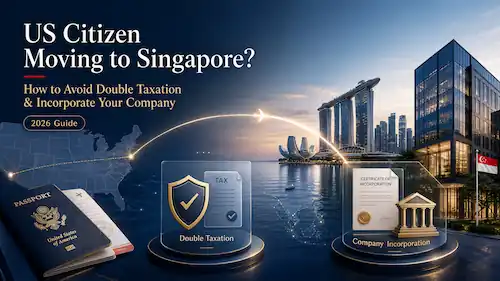
US citizens moving to Singapore must rely on unilateral relief mechanisms like the Foreign Earned Income Exclusion (FEIE) and Foreign Tax Credit (FTC), as there is no comprehensive US-Singapore tax treaty. The standard route involves incorporating a Singapore private limited company (Pte. Ltd.) with a nominee director, then applying for an Employment Pass (EP). Annual US compliance is strict, requiring FBAR, FATCA (Form 8938), and Form 5471 filings if you own 10% or more of the foreign company.
Key Takeaways
- No US-Singapore income tax treaty — US citizens rely strictly on FEIE, FTC, and housing exclusion to avoid double taxation.
- The GILTI & CFC trap — US shareholders collectively owning >50% trigger annual US taxation on active corporate profits, destroying the tax benefit of Singapore's 17% corporate rate.
- FATCA banking friction — Singapore banks require extensive documentation for US beneficial owners. Onboarding typically takes 2-4 weeks longer than for non-US applicants.
- Dependant's Pass work rights — Spouses cannot work automatically. A Letter of Consent (LOC) requires specific directorship and shareholding criteria under MOM rules.
- FEIE limits — Applies only to earned salary income. Dividends and corporate distributions are taxed by the IRS from dollar one.
Fast Facts — US Citizen Moving to Singapore
Table of Contents
- 1. US-Singapore Double Taxation: What US Citizens Need to Know
- 2. US Expat Tax Relief in Singapore: FEIE vs. Foreign Tax Credit (FTC)
- 3. Singapore Company Incorporation for US Citizens: Step-by-Step
- 4. Avoiding the GILTI & CFC Trap for US Founders in Singapore
- 5. Opening a Singapore Bank Account as a US Citizen (FATCA Guide)
- 6. Form 5471 Filing Requirements for Singapore Pte Ltd Owners
- 7. Singapore Work Passes for US Citizens: EP, EntrePass & ONE Pass
- 8. Singapore Dependant Pass (DP) & Family Relocation for US Expats
- 9. Singapore Personal Income Tax Rates for US Expats (2026 Guide)
- 10. Mandatory US Tax Compliance in Singapore: FBAR, FATCA & Form 5471
- 11. Quick Comparison: US vs. Singapore Tax & Visa Rules
- 12. Step-by-Step US to Singapore Relocation Checklist (2026)
- 13. Top 5 Tax & Compliance Mistakes US Citizens Make Moving to Singapore
- Frequently Asked Questions
1. US-Singapore Double Taxation: What US Citizens Need to Know
US citizens moving to Singapore rely on FEIE and FTC — not a tax treaty — to prevent double taxation. Contrary to popular belief, the United States and Singapore do NOT have a comprehensive income tax treaty. The only bilateral agreements are:
- 1983 Agreement – covers shipping and aircraft income.
- FATCA Intergovernmental Agreement (IGA) – facilitates automatic exchange of financial account information.
Consequence: US citizens living in Singapore cannot rely on treaty provisions to exempt Singapore-source income from US tax. Instead, they must depend on domestic US tax law provisions to prevent double taxation.
1.2 US Citizenship-Based Taxation (CBT): Why You Still Owe the IRS
The US taxes its citizens on worldwide income regardless of where they live. This is known as Citizenship-Based Taxation (CBT). While no comprehensive tax treaty exists, US citizens must rely on unilateral relief mechanisms to avoid double taxation:
- Foreign Earned Income Exclusion (FEIE) – Form 2555 – excludes up to $130,000 (2025) / $132,900 (2026) of foreign earned income from US taxation.
- Foreign Tax Credit (FTC) – Form 1116 – provides a dollar-for-dollar credit for income taxes paid to Singapore.
- Foreign Housing Exclusion – Excludes qualified housing expenses above a base amount.
FATCA (Foreign Account Tax Compliance Act) also requires Singapore banks to report US account holders to the IRS, making compliance transparency unavoidable.
1.3 How Double Taxation Occurs
As a US citizen, you are taxed on your worldwide income regardless of where you live. Singapore, meanwhile, taxes income derived from or remitted to Singapore (for tax residents). Without relief, the same income could be taxed twice.
Thankfully, the US Internal Revenue Service (IRS) provides two powerful mechanisms to neutralise double taxation:
| Mechanism | How It Works | Best For |
|---|---|---|
| Foreign Earned Income Exclusion (FEIE) | Excludes up to $130,000 (2025) / $132,900 (2026) of foreign-earned income from US taxation. | Salary earners who meet the physical presence or bona fide residence test. |
| Foreign Tax Credit (FTC) | Provides a dollar-for-dollar credit against US tax for income taxes paid to Singapore. | High-income individuals, business owners, or those whose Singapore tax exceeds the FEIE limit. |
| Foreign Housing Exclusion | Excludes qualified housing expenses above a base amount. | Expats with substantial rent or utilities. |
Example: If you earn S$200,000 (≈US$148,000) as a Singapore-based employee, you could exclude up to US$130,000 using FEIE. For the remaining US$18,000, apply the Foreign Tax Credit using the Singapore tax you paid.
2. US Expat Tax Relief in Singapore: FEIE vs. Foreign Tax Credit (FTC)
To claim FEIE, you must pass either the Physical Presence Test (330 full days in a foreign country during any 12-month period) or the Bona Fide Residence Test (uninterrupted residency in a foreign country that includes an entire tax year).
2.1 Foreign Earned Income Exclusion (FEIE)
- Physical Presence Test – Be physically present in a foreign country for 330 full days during any consecutive 12-month period.
- Bona Fide Residence Test – Establish residency in a foreign country for an uninterrupted period that includes an entire tax year.
Important: FEIE applies only to earned income – salaries, wages, commissions, and self-employment earnings. Passive income (dividends, capital gains, interest) cannot be excluded.
2.2 Foreign Tax Credit (FTC)
When you cannot exclude all of your income, or when Singapore's tax rate is higher than the US rate, the FTC becomes essential.
- Form 1116 is used to compute the credit.
- The credit is generally limited to the US tax liability on the foreign-sourced income. Unused credits can be carried back one year and forward ten years.
Strategic combination: Many expats use FEIE for salary up to the exclusion limit and FTC for any remaining salary, plus passive income.
2.3 Housing Exclusion
Qualified housing expenses (rent, utilities, repairs, parking, etc.) beyond a base amount (usually around 16% of the FEIE cap) can be excluded. The exclusion must be applied alongside FEIE.
3. Singapore Company Incorporation for US Citizens: Step-by-Step
The private limited company (Pte. Ltd.) is the preferred vehicle for US entrepreneurs in Singapore, offering limited liability, tax efficiency, and credibility. US founders can register a Singapore company remotely from overseas without visiting Singapore.
For a complete overview of the process, see our ACRA Registered Corporate Service Provider guide.
3.1 Why Choose a Private Limited Company (Pte. Ltd.)?
- 100% foreign ownership — Foreigners can own 100% of a Singapore company with no local partner required.
- Separate legal entity – limits shareholder liability to their investment.
- Tax efficiency – corporate tax rate of 17% with generous exemptions for startups.
- Credibility – preferred by banks, investors, and government agencies.
- Perpetual succession – exists independently of its owners.
3.2 Key Requirements
Before you begin the incorporation process, ensure you understand the ACRA KYC requirements for foreigners. All foreign founders must complete mandatory identity verification and customer due diligence checks before their company can be incorporated.
| Requirement | Details |
|---|---|
| Minimum Paid-up Capital | S$1 (though S$5,000+ is common for banking). |
| Shareholders | At least one; can be 100% foreign-owned (individuals or corporations). |
| Directors | At least one ordinarily resident director (Singapore citizen, PR, or holder of an Employment Pass / EntrePass). |
| Company Secretary | Must be appointed within six months of incorporation. See our corporate secretarial services. |
| Registered Address | A physical address in Singapore (PO boxes not allowed). |
3.3 Singapore Local Director Requirement for US Founders
Every Singapore company must have at least one director who is ordinarily resident in Singapore. This is a statutory requirement under the Companies Act. For a detailed explanation, see why foreigners need an ACRA-registered filing agent.
US founders who serve as directors of their Singapore company should be aware that directors face personal liability for compliance failures, including fines up to S$20,000 and potential imprisonment. This applies equally to nominee directors and executive directors.
- Nominee Director Service – Engage a professional firm (such as Terra Advisory) to provide a nominee director until you obtain your own Employment Pass and can serve as resident director.
- Self-Employed Employment Pass Route – Incorporate the company with a nominee director, then immediately apply for an Employment Pass to manage the company. Once approved, you can replace the nominee director with yourself.
4. Avoiding the GILTI & CFC Trap for US Founders in Singapore
This is the single biggest tax trap for US citizens incorporating a Singapore company. If US shareholders (each holding 10% or more of voting power or value) collectively own more than 50% of your Singapore Pte Ltd, the IRS classifies it as a Controlled Foreign Corporation (CFC).
How to avoid the GILTI trap:
- Structure your shareholding to stay below the 50% CFC threshold if possible.
- Consider a Section 962 election to reduce the tax burden.
- Plan your corporate distributions carefully — bonus payments, dividends, and director's fees are treated differently under US tax rules.
Our accounting services help US founders structure their Singapore companies correctly from day one — avoiding the GILTI trap and ensuring full US compliance.
5. Opening a Singapore Bank Account as a US Citizen (FATCA Guide)
Opening a corporate bank account as a US citizen is more complex than for other nationalities. Because of FATCA (Foreign Account Tax Compliance Act), Singapore banks like DBS, OCBC, and UOB have strict compliance requirements for US beneficial owners and directors.
Why DIY applications often fail:
- Banks flag US beneficial owners for enhanced due diligence.
- Incomplete or incorrect FATCA forms cause rejections.
- Banks prefer applicants with established banking relationships or professional introductions.
Terra Advisory provides corporate banking introduction services to streamline FATCA compliance and reduce onboarding friction.
6. Form 5471 Filing Requirements for Singapore Pte Ltd Owners
US founders must file Form 5471 with the IRS annually. Form 5471 is mandatory if you own 10% or more of a foreign corporation (your Singapore Pte Ltd). This is an information return — not a payment — but failing to file it carries severe penalties.
Terra Advisory sets up Singapore Financial Reporting Standards (SFRS) books that map cleanly to US GAAP requirements. This alignment simplifies Form 5471 preparation and reduces cross-border reporting penalties. Our accounting services handle both Singapore and US compliance obligations.
7. Singapore Work Passes for US Citizens: EP, EntrePass & ONE Pass
For US entrepreneurs, the Employment Pass (EP) is the primary work pass. It requires a minimum salary of S$5,600 per month in 2026 (increasing to S$6,000 from 1 January 2027) and at least 40 COMPASS points; the EntrePass is an alternative for innovative startups.
For the latest MOM requirements, see the Ministry of Manpower (MOM) official website.
4.1 Employment Pass (EP) – The Primary Route
| Criteria | Requirement |
|---|---|
| Minimum Salary (2026) | S$5,600 per month (higher for older applicants; up to S$10,500 for those in their 40s). |
| Minimum Salary (2027) | Increases to S$6,000 from 1 January 2027. |
| COMPASS Points | New EP applications must score at least 40 points under the Complementarity Assessment Framework (COMPASS). |
| Educational Qualifications | Degrees from reputable institutions add points; otherwise, experience may compensate. |
| Company Operational Readiness | The company must have a physical office, a corporate bank account, and demonstrate ability to pay the salary. |
4.2 EntrePass – For Innovative Entrepreneurs
If your business is in a technology-based or high-growth sector, the EntrePass may be an alternative. It does not require a minimum salary but does require demonstrated innovation and business viability.
4.3 S Pass – For Mid-Level Skilled Workers
If your business employs mid-level skilled staff, the S Pass applies. Minimum salary S$3,300 in 2026, increasing to S$3,600 from 1 January 2027. Subject to quota and monthly levy.
4.4 Singapore ONE Pass for US Tech Founders (2026/2027 Update)
From January 2027, a new "AI and Tech track" will be introduced for the ONE Pass, allowing applicants to meet salary criteria through a combination of cash and non-cash components.
8. Singapore Dependant Pass (DP) & Family Relocation for US Expats
Your spouse and unmarried children under 21 can obtain Dependant's Passes if your EP salary is at least S$6,000; parents need a Long-Term Visit Pass with a salary threshold of S$12,000.
5.1 Dependant's Pass (DP)
| Family Member | Pass Type | Work Rights |
|---|---|---|
| Spouse | Dependant's Pass (DP) | No automatic work rights. Must obtain an EP, S Pass, or Letter of Consent (LOC) if starting a business with specific MOM criteria. |
| Unmarried children under 21 | Dependant's Pass (DP) | Not eligible to work; can study in local schools. |
| Parents (or grandparents) | Long-Term Visit Pass (LTVP) | Requires EP salary of S$12,000/month. Cannot work. |
5.2 Letter of Consent (LOC) for DP Holders
A DP holder cannot simply start working without approval. To qualify for a Letter of Consent (LOC) under MOM rules, the DP holder must be appointed as a Sole Proprietor, Partner, or Company Director, hold at least 30% shares in a Singapore company, and the company must employ at least one local employee earning S$1,400/month with CPF contributions for at least three months.
5.3 Education & Housing
- Education: Public schools (MOE) admit DP holders subject to vacancies; international schools are also an option (tuition S$20,000–S$40,000/year).
- Housing: Expats typically rent condominiums (S$3,000–S$8,000/month for 2-3 bedroom) or HDB flats if eligible. Private condo purchase is restricted with Additional Buyer's Stamp Duty (ABSD) of 60% for non-residents.
9. Singapore Personal Income Tax Rates for US Expats (2026 Guide)
Singapore taxes residents on a territorial basis at progressive rates from 0% to 24% (YA 2026), while non-residents pay a flat 15% on employment income or 24% on director's fees. Tax residency is determined by physical presence (≥183 days) or continuous employment across two years. For more details, visit the Inland Revenue Authority of Singapore (IRAS) official website.
6.1 Determining Tax Residency
| Resident Status | Criteria | Tax Rate |
|---|---|---|
| Tax Resident | – Physically present in Singapore for 183 days or more in a calendar year; OR – Continuous employment straddling two years totalling 183 days; OR – Resident for three consecutive years. | Progressive rates: 0% – 24% (YA 2026, income earned 2025). |
| Non-Resident | Fails the above tests. | Employment income: higher of 15% flat or resident progressive rates. Director's fees, consultation fees: 24%. |
Tax Rebate for YA 2026: All tax residents receive a 60% rebate on tax payable, capped at S$200.
6.2 Personal Income Tax Rates (YA 2026)
| Chargeable Income (SGD) | Tax Rate |
|---|---|
| First 20,000 | 0% |
| Next 10,000 | 2% |
| Next 10,000 | 3.5% |
| Next 40,000 | 7% |
| Next 40,000 | 11.5% |
| Next 40,000 | 15% |
| Next 40,000 | 18% |
| Next 40,000 | 19% |
| Next 40,000 | 19.5% |
| Next 40,000 | 20% |
| Next 180,000 | 22% |
| Next 500,000 | 23% |
| Above 1,000,000 | 24% |
6.3 Corporate Tax & Exemptions
Singapore's corporate tax rate is 17%, with start-up exemptions:
- Tax Exemption Scheme for New Companies (first three years): 75% exemption on first S$10,000; 50% exemption on next S$190,000.
- Partial Tax Exemption (after three years): 75% exemption on first S$10,000; 50% exemption on next S$190,000.
Additionally, no capital gains tax, no withholding tax on dividends, and no estate duty.
10. Mandatory US Tax Compliance in Singapore: FBAR, FATCA & Form 5471
US citizens must file FBAR, FATCA Form 8938, and Form 5471 if they own 10% or more of a foreign corporation. Ignoring these can result in severe penalties.
7.1 FBAR Filing for US Citizens in Singapore (FinCEN Form 114)
- Threshold: Aggregate value of foreign financial accounts exceeds $10,000 at any time during the calendar year.
- Deadline: April 15 (automatic extension to October 15).
- Penalties: Non-willful violations up to $12,921; willful violations up to the greater of $129,210 or 50% of account balance.
- More info: FinCEN FBAR page
7.2 FATCA – Form 8938
- Threshold (for US taxpayers living outside the US): Single or married filing separately: total foreign assets > $200,000 on last day OR > $300,000 anytime; married jointly: > $400,000 on last day OR > $600,000 anytime.
- Attaches to Form 1040.
7.3 Form 5471 – Foreign Corporation Ownership
If you own 10% or more of a foreign corporation (your Singapore Pte. Ltd.), you must file Form 5471 annually. If US shareholders collectively own more than 50%, GILTI (Global Intangible Low-Taxed Income) may apply. A Section 962 election can reduce the tax burden.
11. Quick Comparison: US vs. Singapore Tax & Visa Rules
8.1 Tax Relief Strategies
| Strategy | What It Excludes / Credits | Limitations | Best Scenario |
|---|---|---|---|
| FEIE | Up to $130,000 (2025) / $132,900 (2026) of earned income | Physical presence or residency test; does not cover passive income. | Employee with moderate salary. |
| FTC | Dollar-for-credit on foreign taxes paid | Must compute per country; unused credits carried forward. | High earner; business owner. |
| Housing Exclusion | Qualifying rent/utilities above base amount | Must be used with FEIE. | Expats with high housing costs. |
8.2 Work Pass Comparison
| Pass Type | Minimum Salary | COMPASS Required | Quota / Levy | Family Sponsorship |
|---|---|---|---|---|
| Employment Pass (EP) | S$5,600+ (2026) / S$6,000+ (2027) | Yes (40 points) | No quota, no levy | Yes, if salary meets prevailing baseline |
| EntrePass | None | No (innovation criteria) | No quota, no levy | Yes, after meeting business milestones |
| S Pass | S$3,300 (2026) / S$3,600 (2027) | No | Yes (quota + levy) | No (DP possible if salary meets baseline) |
8.3 Family Pass Salary Thresholds
| Pass | Min. EP Salary | Eligibility | Work Rights for Holder |
|---|---|---|---|
| Dependant's Pass (DP) | S$6,000 (tied to prevailing EP statutory baseline) | Spouse & unmarried children under 21 | No automatic; LOC only if business meets strict MOM criteria. |
| Long-Term Visit Pass (LTVP) | S$12,000 | Parents, common-law spouse, handicapped children | No work rights. |
12. Step-by-Step US to Singapore Relocation Checklist (2026)
- Consult with tax & immigration professionals – Terra Advisory offers integrated cross-border planning.
- Incorporate Singapore company – Choose company name, appoint nominee director, file with ACRA.
- Open corporate bank account – Needed for EP application.
- Apply for Employment Pass – Submit via MOM with business plan, salary details.
- Receive In-Principle Approval (IPA) – Valid for 6 months; you can enter Singapore.
- Secure housing – Sign lease (typically 2 years).
- Relocate family – Apply for DP/LTVP after your EP is issued.
- Complete formalities – Register address, obtain FIN cards, enrol children in school.
- File US taxes annually – Meet FBAR, FATCA, Form 5471 deadlines.
13. Top 5 Tax & Compliance Mistakes US Citizens Make Moving to Singapore
| Pitfall | Consequence | Prevention |
|---|---|---|
| Assuming a tax treaty exists | Under-estimating US tax liability. | Plan using FEIE, FTC, and housing exclusion. |
| Failing to file FBAR/FATCA | Penalties can reach $100,000+ per violation. | Set calendar reminders; use professional tax preparer. |
| Ignoring local director requirement | Company incorporation rejected. | Engage nominee director service from day one. |
| Spouse working without LOC | Breach of immigration rules; can lead to revocation of passes. | Apply for LOC or separate work pass before starting any work. |
| Under-capitalising the company | EP application may be rejected due to lack of funds. | Show sufficient paid-up capital and operational readiness. |
Ready to make the move to Singapore?
Terra Advisory Services helps US citizens navigate company incorporation, tax planning, work passes, and family relocation — all under one roof. Our integrated team of tax specialists, immigration experts, and corporate advisors guides you through every step.
Frequently Asked Questions
Incorporating or restructuring your business requires more than automated forms. We provide a highly personal, tailored approach—no generic packages, just dedicated expert guidance.
- • Your Peace of Mind Comes First: We don't just explain—we ensure you truly understand and are comfortable before proceeding.
- • Personalized & Honest Pricing: Once we understand your needs, we provide a clear, custom quote—no hidden fees or unnecessary extras.
- • Expert Immigration Support: Direct, one-on-one advisory from seasoned professionals with 20+ years of experience.
- • Cross-Border Expertise: Local advisory for smooth business expansion between Singapore and Malaysia.
Your vision, your pace, our expertise.
Important Notice: While Terra Advisory Services Pte. Ltd. endeavours to keep the content accurate and current, Singapore government policies, regulations, fees, and procedures may change at any time without prior notice. For the most up-to-date and authoritative information, please refer directly to official government sources. For advice tailored to your specific circumstances, please contact Terra Advisory Services.