

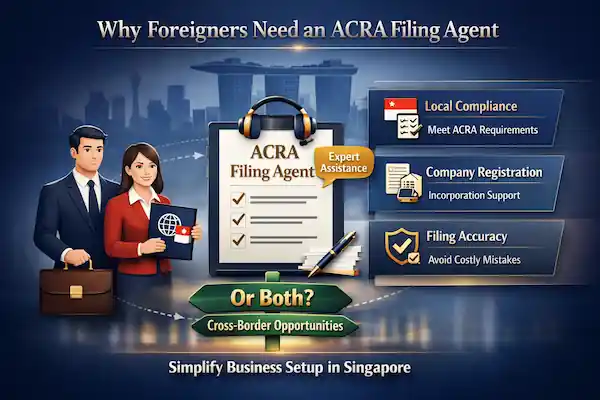
Can a foreigner incorporate a Singapore company without a Singpass? No — ACRA requires foreigners to engage an ACRA Registered Corporate Service Provider (CSP). You cannot file directly on BizFile without Singpass. The CSP handles name reservation, incorporation, KYC checks, nominee director arrangements, and ongoing compliance. This is a legal requirement under the Corporate Service Providers Act 2024.
ACRA CSP Act 2024
All foreign founders
ACRA filing, KYC, compliance
Key Takeaways — Foreign Founder Guide
- ACRA CSP is mandatory for foreigners — You cannot incorporate a Singapore company without one.
- No Singpass? No direct filing — Foreigners cannot file directly on BizFile without Singpass. A CSP does it for you.
- CSPs handle more than filing — KYC checks, nominee director, and ongoing compliance are included.
- Registered CSPs are regulated — They must be licensed and comply with the CSP Act 2024.
- Penalties for non-compliance — Late or incorrect filings trigger ACRA penalties starting at S$300.
- Not all providers are equal — Choose a CSP that understands foreign founders and offers full post-incorporation support.
Fast Facts — ACRA CSP for Foreigners
Our Approach to Pricing
We know one size doesn't fit all. A SaaS startup with 50 employees has very different needs than a solo consultant. We start with a discovery call to understand your business model, transaction volume, and growth plans. From there, we tailor a service scope that fits you—no cookie-cutter packages here.
You only pay for what you actually need. If your business has low transaction volume and no employees, we won't charge you for full-service payroll or CFO advisory. We focus on what keeps you compliant, nothing more.
🔒 Mandatory KYC & Compliance Checks: All ACRA-registered Corporate Service Providers (CSPs) must complete identity verification and customer due diligence checks before incorporating a company. This is a strict statutory requirement under Singapore's Corporate Service Providers Act 2024, not just a provider policy. You can verify this directly with ACRA.
Pricing is personalized after we review your specific needs. We quote only the services you require—no hidden fees, no surprises.
Why Foreigners Cannot File Directly on BizFile
ACRA's BizFile system is Singapore's online filing portal for company registration and corporate updates. Direct filing needs the right Singapore digital access. Local users rely on Singpass, while corporate service providers use the channel available to them.
For many non-resident founders, that access is not in place. More than that, ACRA's rule is clear: Foreigners must engage a Corporate Service Provider to reserve a name and register a business structure. This rule applies before the company is live, not after.
A CSP also helps with the core items that ACRA expects during registration. These include the company name, registered office, director and shareholder data, share capital, constitution, contact details, and, where relevant, nominee director or nominee shareholder details. ACRA's official guide on registering a local company through BizFile explains the filing information that must be prepared.
Foreign founders can own 100% of a Singapore company. For a complete breakdown, see our guide on whether a foreigner can own 100% of a Singapore company.
All foreign founders must also complete mandatory KYC checks before their company can be incorporated. See our ACRA KYC requirements guide for the full document checklist.
For a complete overview of the process, see our Singapore incorporation guide.
Table of Contents
- Why Foreigners Cannot File Directly on BizFile
- What Does an ACRA Registered Corporate Service Provider Do?
- CSP vs Corporate Secretary
- Do Foreigners Need an ACRA Registered Corporate Service Provider?
- How to Choose the Right ACRA CSP as a Foreigner
- Risks of Using an Unregistered Provider
- Penalties for Late ACRA Filing
- Frequently Asked Questions
What Does an ACRA Registered Corporate Service Provider Do?
An ACRA Registered Corporate Service Provider handles regulated submissions to ACRA on behalf of companies and business owners.
This typically includes:
- Singapore company incorporation filings
- Annual return submissions
- Director appointment and resignation filings
- Share allotment and shareholder changes
- Company name changes
- Registered office address updates
- Strike-off applications
- Business profile updates
- Corporate restructuring filings
These filings are not merely clerical. Incorrect submissions can lead to delays, rejected filings, statutory breaches, or financial penalties.
ACRA Registered Corporate Service Provider vs Corporate Secretary: What's the Difference?
Many business owners confuse a CSP with a corporate secretary. While the services often overlap, they are not identical. For a full breakdown, see our corporate secretarial services page.
| Function | ACRA Registered Corporate Service Provider | Corporate Secretary |
|---|---|---|
| Company incorporation | Yes | May support after incorporation |
| ACRA filings (incorporation, annual returns, director changes) | Yes | Often coordinates |
| Statutory compliance support | Sometimes | Yes |
| Board governance / minutes | Limited | Yes |
Do Foreigners Need an ACRA Registered Corporate Service Provider?
Yes, in most cases.
ACRA requires foreigners who want to register a Singapore company to engage an authorised Corporate Service Provider for incorporation. Direct filing requires a SingPass, which foreigners generally do not have.
Foreign founders may also need a nominee director to satisfy the resident director requirement. A registered CSP can arrange this as part of the incorporation process.
Directors who fail to act with reasonable diligence face fines up to S$20,000 and potential imprisonment. For more on personal liability, see our director liability guide.
Ready to incorporate your Singapore company?
Terra Advisory Services is an ACRA Registered Corporate Service Provider. We handle the entire process — from ACRA filing to nominee director services and ongoing compliance. No hidden fees. No surprises.
How to Choose the Right ACRA Registered Corporate Service Provider as a Foreigner
For a foreign founder, the best choice is the one that can handle the full setup with care — including KYC verification, nominee director arrangements, and post-incorporation compliance. Unlike local founders, foreigners cannot simply file directly, so your CSP becomes your gateway to ACRA.
Questions to ask before you engage a CSP:
- Are you registered with ACRA? — Check their registration number and status.
- Who reviews the filing? — Ensure a qualified person oversees the submission.
- How do you verify foreign shareholders? — KYC processes should be clear.
- What happens after incorporation? — Post-incorporation support matters.
- How are nominee director terms documented? — Clear agreements protect you.
- Who tracks annual return deadlines? — Missing deadlines triggers penalties.
Red flags to watch out for:
- The provider cannot confirm their ACRA registration status.
- The quote is vague about KYC, nominee director terms, or annual filing support.
- The provider offers a nominee director with no clear service agreement.
- The provider cannot explain who will maintain registers and file future changes.
- The provider pushes for fast filing before checking ownership, control, and business activity.
If a provider can only talk about incorporation, be careful. Your first year also includes bank support, registers, tax setup, accounting records, company secretary work, and annual filing deadlines. The provider should understand the full path.
Risks of Using an Unregistered or Weak Provider
A low-cost provider can look attractive at the start. But company setup is not the place to cut corners. The risk is not only the filing fee. The real cost comes when the company record is wrong, the nominee director is unsafe, or the bank cannot get clear answers on ownership and control.
Common risks include:
- Wrong officer data
- Vague business activity
- Weak KYC checks
- Missing controller details
- Poor document storage
- No clear plan for annual filings
These issues can delay bank onboarding, tax work, investment, and future changes.
- The provider will not state whether it is registered with ACRA or covered as a CSP.
- The quote is vague about KYC, nominee director terms, or annual filing support.
- The provider offers a nominee director with no clear service agreement.
- The provider cannot explain who will maintain registers and file future changes.
- The provider pushes for fast filing before checking ownership, control, and business activity.
Penalties for Late ACRA Filing
Late or incorrect filings can trigger significant penalties. The most common penalties include:
| Offence | Penalty |
|---|---|
| Late annual return filing (under 3 months late) | S$300 |
| Late annual return filing (over 3 months late) | S$600 |
| Unreported director changes | Fines + director disqualification |
| Incorrect or incomplete filings | Rejected filings + statutory breaches |
| Continued non-compliance | Company struck off the register |
For a complete breakdown of all penalties and deadlines, see our ACRA late filing penalties guide.
Ready to incorporate your Singapore company with the right ACRA CSP?
Terra Advisory Services helps foreign founders navigate company incorporation, nominee director services, and ongoing compliance — all under one roof.
Frequently Asked Questions
Incorporating or restructuring a business in Singapore is a major legal and financial decision. We provide dedicated, personal service from our first conversation to your ongoing annual filings.
If you do not fully understand any aspect of the process, we will pause and will not move forward until you are ready.
We quote and design only the specific services your business actually requires.
📌 Pin Terra Advisory Services as your Preferred Source on Google (Click link and check the box) →
Note: Terra Advisory Services is a Registered Filing Agent under the ACRA Act. Under the Corporate Service Providers Act 2024, we are treated as a registered Corporate Service Provider (CSP) and meet all new compliance requirements. Our next certificate will be re-issued as a Registered Corporate Service Provider.
Important Notice: While Terra Advisory Services Pte. Ltd. endeavours to keep the content accurate and current, Singapore government policies, regulations, fees, and procedures may change at any time without prior notice. For the most up-to-date and authoritative information, please refer directly to official government sources, including ACRA and other relevant agencies. For the latest compliance and advice tailored to your specific circumstances, please contact Terra Advisory Services.
Strategic Malaysia Affiliate — MIA Registered Firm
Official sources used in this 2026 update: