

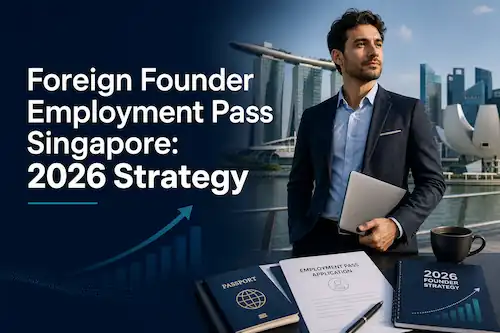
The 2026 Foreign Founder's Guide to Singapore Employment Pass: Pathways, COMPASS & Approval Strategy
The Strategic Reality: Foreign founders cannot self-sponsor a Singapore Employment Pass. The proven pathway requires incorporating a Singapore Pte. Ltd. (leveraging the jurisdiction's statutory allowance for 100% foreign company ownership), appointing a professional Nominee Director to satisfy ACRA's resident director mandate, building a credible business case for MOM, and then having the company sponsor the founder's EP. Once approved, the founder transitions to resident director. Most foreign-owned startups benefit from the COMPASS framework's automatic 10 default points for firms with fewer than 25 local PMET employees, significantly easing the path to the required 40 points.
S$5,600 / S$6,200
40 / 80 Points
~10 Business Days
S$22,500+ Fixed
Key Takeaways for Foreign Founders
- Founders Cannot Self-Sponsor: You must incorporate a Singapore Pte. Ltd. and initially use a professional Nominee Director before the company can sponsor your EP.
- Small Foreign-Owned Firms Have COMPASS Advantages: Startups with under 25 PMETs automatically receive 10 default points on Diversity and Local Employment criteria.
- Nationality-Specific Document Hurdles: Chinese nationals must use MOM-approved third-party verification vendors; Indian professionals may benefit from the Tech.Pass; Malaysians can leverage JS-SEZ advantages.
- Foreign Director Compensation Must Align with MOM and IRAS: Structuring salary vs. director fees has implications for both pass approval and tax efficiency.
- EP Is the Primary Bridge to PR: Holding an EP for 2-3 years with stable income and tax contributions is the most common pathway to Singapore Permanent Residence.
Key Facts — 2026 Foreign Founder EP Metrics
Securing a Singapore Employment Pass as a foreign founder requires navigating a complex intersection of corporate structuring, immigration compliance, and tax planning. While the standard EP framework applies to all applicants, foreign entrepreneurs face unique challenges — from the inability to self-sponsor, to nationality-specific document verification requirements, to the strategic implications of how compensation is structured between MOM and IRAS. This guide provides the tactical blueprint for foreign founders to successfully navigate these hurdles and establish a long-term presence in Singapore.
Can a foreign founder sponsor their own Employment Pass in Singapore?
Yes, a foreign founder can own 100% of a Singapore company and sponsor their own Employment Pass (EP). To do this, the founder must first incorporate a Singapore Private Limited (Pte Ltd) company, appoint a local resident director temporarily to satisfy ACRA rules, and then submit an EP application under the new corporate entity. However, because the founder cannot self-sponsor as an individual, the Ministry of Manpower (MOM) requires all applications to be sponsored by the registered Singapore entity — creating a specific sequencing challenge that must be addressed through careful corporate planning.
Step 1: Incorporate with 100% Foreign Ownership
Foreign entrepreneurs can fully leverage Singapore's statutory allowance for 100% foreign company ownership without local equity dilution. However, before any work pass can be sponsored, the founder must navigate the requirements for company incorporation, including reserving a compliant company name, appointing at least one locally resident director, and maintaining a registered office address in Singapore.
Step 2: Satisfy ACRA with a Professional Nominee Director
The Companies Act imposes a strict residency requirement on company directors. As stated by the Accounting and Corporate Regulatory Authority:
To satisfy this mandate while the founder remains overseas, foreign entrepreneurs typically engage a professional nominee director service. This arrangement allows the founder to retain 100% shareholding and operational control while legally establishing the entity that will later sponsor the Employment Pass.
Step 3: Build the Economic Business Case for MOM
MOM scrutinizes founder EP applications more rigorously than standard employee applications. A freshly incorporated shell company with no operational substance will not provide a sufficiently convincing basis for approval. Founders must demonstrate:
- A corporate bank account with meaningful capitalization
- A signed office lease or virtual office agreement
- A detailed business plan showing economic contribution to Singapore
- Impeccable accounting and financial records to substantiate business viability
- Compliant financial statements for ACRA proving operational substance beyond a mere shell entity
For founders exploring alternative structuring pathways, understanding the full range of foreign structuring options is critical to selecting the right vehicle for both immigration and operational objectives.
Step 4: The Seamless Transition to Resident Director
Once the Employment Pass is approved and the founder has relocated to Singapore, the legal status changes fundamentally. As MOM clarifies:
This means the founder can formally resign the Nominee Director and appoint themselves as the resident director, completing the transition. Throughout this process, strict adherence to the foundational Employment Pass eligibility and COMPASS requirements mandated by the Ministry of Manpower is essential.
What COMPASS advantages do foreign-owned startups have?
The Complementarity Assessment Framework (COMPASS) is often perceived as a barrier for foreign founders, but it actually contains structural advantages for small, foreign-owned startups that larger firms do not enjoy.
The "<25 PMET" Automatic 10-Point Default
Under the COMPASS framework, companies with fewer than 25 local PMET employees automatically score 10 default points for both C3 (Nationality Diversity) and C4 (Local Employment Support). This MOM default rule makes it significantly easier for newly formed foreign-owned startups to reach the required 40-point threshold, as they only need to accumulate 20 additional points from Salary (C1) and Qualifications (C2) to pass the assessment. As MOM states:
| COMPASS Criterion | Standard Scoring | Small Firm Advantage (<25 PMETs) |
|---|---|---|
| C1: Salary | 0-20 points based on percentile | 0-20 points (no advantage) |
| C2: Qualifications | 0-20 points based on institution tier | 0-20 points (no advantage) |
| C3: Diversity | 0-20 points based on nationality % | Automatic 10 default points |
| C4: Local Employment | 0-20 points based on local PMET ratio | Automatic 10 default points |
| C5: Skills Bonus | 0-20 points (Shortage Occupation List) | 0-20 points (no advantage) |
| C6: Economic Priorities | 0-10 points (government programs) | 0-10 points (no advantage) |
Avoiding the C1 Salary Trap for Senior Foreigners
The most common mistake foreign founders make is offering the absolute minimum salary. COMPASS C1 is age-adjusted, meaning a 45-year-old foreign founder cannot simply take the S$5,600 minimum. To score meaningful points on C1, their salary must reflect the top percentiles of local peers in their specific industry and age group — often requiring S$10,700 or more for senior founders.
The Scaling Trap: What Happens When You Hit 25 Employees
As a foreign-owned startup scales past 25 employees, the automatic 10-point default disappears. If the founder has hired predominantly foreign staff during rapid growth, the company may suddenly find itself scoring zero on C3 (Diversity) and struggling on C4 (Local Employment). Strategic local hiring — potentially through the S Pass for mid-skilled roles — becomes critical to maintaining COMPASS compliance. Understanding the current S Pass minimum salary thresholds helps founders plan their local hiring budget effectively.
How do Intra-Corporate Transferees (ICT) bypass COMPASS?
For multinational companies relocating senior talent from overseas offices, the Intra-Corporate Transferee (ICT) pathway offers a significant advantage: complete exemption from the COMPASS points assessment.
The 3 Strict Criteria for ICT Exemption
- Continuous Employment: At least one year of continuous employment with the overseas entity prior to transfer
- Role Classification: The position must be classified as managerial, executive, or specialist
- Corporate Relationship: The transfer must be within the same corporate group (parent, subsidiary, or affiliate)
Required Documentation for ICT Applications
- Employment contracts showing continuous tenure with the overseas entity
- Organizational charts demonstrating the corporate group structure
- Proof of related entity status (shareholding agreements, group registration documents)
- Detailed job descriptions confirming managerial, executive, or specialist classification
What are the unique document hurdles for specific foreign nationalities?
While the EP framework is standardized, certain nationalities face specific document verification requirements that can significantly impact processing timelines if not addressed proactively.
China: The Strict Third-Party Verification Rule
For candidates from China, MOM strictly enforces third-party degree verification through approved vendors such as DataFlow or Avvanz. MOM explicitly states:
Due to the high volume of applications from Chinese nationals, ensuring these documents are authenticated before submission is critical to avoiding typical 8-week processing delays.
India: When to Choose Tech.Pass Over a Standard EP
Indian professionals make up a significant portion of Singapore's tech workforce. For senior leaders earning above S$22,500, the Tech.Pass offers greater flexibility than a standard EP, allowing for multiple directorships and entrepreneurial activities across different entities. This makes it particularly attractive for experienced tech founders and executives who want to maintain involvement in multiple ventures.
Malaysia: Leveraging the JS-SEZ for Cross-Border Talent
Malaysians represent the largest group of foreign EP holders in Singapore. With the upcoming Johor Bahru–Singapore Rapid Transit System (RTS) and the newly launched Johor-Singapore Special Economic Zone (JS-SEZ), many companies are adopting a "Singapore HQ + Johor Operations" model. Malaysian talent can capitalize on the unique cross-border commuting and hiring advantages of the Johor-Singapore Special Economic Zone, creating significant operational cost efficiencies while maintaining Singapore's legal and tax benefits.
How does an Employment Pass impact a foreigner's corporate tax obligations?
Foreign EP holders must navigate a complex intersection of immigration compliance and tax planning. How compensation is structured has significant implications for both MOM approval and fiscal efficiency.
Director Fees vs. Employment Salary
MOM and IRAS view compensation differently. MOM focuses on fixed monthly salary for EP eligibility, while IRAS considers the full spectrum of income for tax residency determination. Structuring a foreign founder's compensation requires careful alignment with MOM's salary benchmarks and IRAS's corporate tax regulations to ensure both pass approval and long-term fiscal efficiency.
Withholding Tax Risks on Overseas Payments
Foreign founders often have complex cross-border financial arrangements. Payments such as management fees, intellectual property royalties, or service fees remitted to overseas entities may trigger specific withholding tax obligations that must be declared to IRAS. Failure to properly account for these obligations can result in significant penalties and complicate future EP renewals.
Structuring Compensation for MOM Approval and Tax Efficiency
The optimal compensation structure balances MOM's requirements for a credible salary (to support the EP application) with IRAS's framework for tax efficiency. For newly incorporated foreign-owned companies, qualifying entities can immediately leverage the Start-Up Tax Exemption (SUTE) to optimize early-stage operational cash flow while maintaining compliance with both immigration and tax authorities.
What happens after Employment Pass approval for foreign founders?
EP approval is not the end of the journey — it is the beginning of a long-term commitment to Singapore that includes family relocation, permanent residence planning, and ongoing compliance obligations.
Sponsoring Your Family: Dependant's Pass Requirements
Once the founder's EP is approved and the fixed monthly salary reaches at least S$6,000, the founder can sponsor their legally married spouse and unmarried children under 21 for Dependant's Passes. This facilitates the seamless relocation of key personnel by securing Dependant's Passes for their immediate family members, allowing the family to establish roots in Singapore.
The 2 to 3-Year EP to PR Timeline
Holding an Employment Pass is the most common pathway to Singapore Permanent Residence. While there is no official minimum waiting period, successful applicants typically apply after 2 to 3 years of continuous employment, demonstrating stable income, consistent tax contributions, and long-term commitment to Singapore. This establishes a clear, multi-year trajectory toward Singapore Permanent Residence through sustained economic contribution.
Ongoing Compliance to Maintain EP Eligibility
EP holders must maintain strict compliance with both MOM and ACRA requirements throughout their tenure. This includes timely filing of annual returns, accurate financial reporting, and adherence to director obligations. Managing post-incorporation compliance obligations proactively prevents complications during EP renewal. Furthermore, as your company scales and approaches 2027, planning for the upcoming 2027 Employment Pass salary and policy changes is critical to ensure your founder's compensation remains above the new qualifying thresholds for seamless renewals.
What alternatives exist if the Employment Pass is not the right fit?
The Employment Pass is not the only pathway for foreign talent. Depending on the founder's profile, business model, and compensation structure, alternative passes may offer better alignment with specific circumstances.
The EntrePass for Innovative Founders
For founders with proprietary technology, venture capital backing, or a track record of innovation, the EntrePass is designed specifically for entrepreneurial talent. Unlike the EP, the EntrePass does not require the company to be established first and does not have a fixed minimum salary requirement. Founders should evaluate the innovation-focused criteria of the EntrePass framework to determine if this pathway better suits their profile than the standard Employment Pass.
The S Pass for Mid-Skilled Foreign Hires
For roles that do not meet the EP's senior professional threshold, the S Pass provides a pathway for mid-skilled foreign workers. While the S Pass is subject to quota and levy requirements that do not apply to the EP, it may be the appropriate choice when the specific role and compensation better align with mid-skilled thresholds rather than executive-level positions.
Don't Risk a Rejection That Flags Your Company's MOM Profile.
Whether you are a foreign founder needing a Nominee Director transition strategy, a COMPASS audit, or guidance on nationality-specific document requirements, our specialists will structure your application before you submit.
Incorporating or restructuring your business requires more than automated forms. We provide a highly personal, tailored approach—no generic packages, just dedicated expert guidance.
- • Your Peace of Mind Comes First: We don't just explain—we ensure you truly understand and are comfortable before proceeding.
- • Personalized & Honest Pricing: Once we understand your needs, we provide a clear, custom quote—no hidden fees or unnecessary extras.
- • Expert Immigration Support: Direct, one-on-one advisory from seasoned professionals with 20+ years of experience.
- • Cross-Border Expertise: Local advisory for smooth business expansion between Singapore and Malaysia.
Your vision, your pace, our expertise.
Important Disclaimer: The information provided on this website is for general informational purposes only and does not constitute formal legal, tax, financial, or corporate advisory advice. While Terra Advisory Services Pte. Ltd. endeavors to keep the content accurate and current, Singapore and Malaysian government policies, regulations, fees, and procedures change frequently and without prior notice. Readers should verify details directly with official government authorities (such as ACRA, MOM, SSM, and LHDN) before taking action. For advice tailored to your specific business circumstances, please contact Terra Advisory Services.
Licensed Malaysian Division — MIA Registered Firm (NF3281)
Official Sources & Latest Updates (August 2026):
- Ministry of Manpower (MOM) — Employment Pass Official Guidelines
- MOM — COMPASS Framework & Eligibility Criteria
- MOM — How to Appeal a Rejected Employment Pass
- Accounting and Corporate Regulatory Authority (ACRA) — Business Registration
- Inland Revenue Authority of Singapore (IRAS) — Corporate Tax & NOA
- Economic Development Board (EDB) — Global Investor Programme