

Quick Answer: Malaysia vs Singapore Incorporation
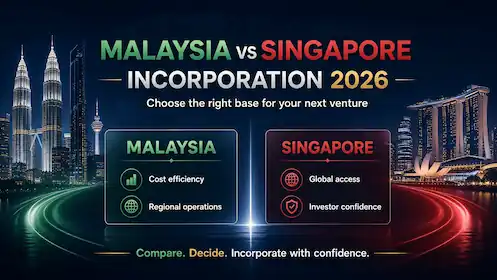
The choice between Malaysia (Sdn Bhd) and Singapore (Pte Ltd) depends on your target market, capital requirements, and tax strategy. Singapore is the global standard for ease of doing business, IP protection, and tax efficiency (17% flat rate). Malaysia offers a lower cost of operations, access to a 34-million-person domestic market, and strategic incentives for manufacturing and regional trade.
You target global markets, need VC funding, prioritize IP protection, or require a prestigious holding structure.
Your primary market is ASEAN domestic, you need manufacturing scale, or you want to minimize setup/operational costs.
Many founders use a Singapore HQ for funding/IP and a Malaysia Sdn Bhd for operations/sales.
Key Takeaways for Founders
- Tax Efficiency vs. Market Access: Singapore offers a 17% corporate tax and extensive treaty network. Malaysia offers a 24% rate but provides aggressive incentives (Pioneer Status, Investment Tax Allowance) that can reduce effective tax to near zero for qualifying industries.
- Compliance Burden: Singapore's ACRA compliance is streamlined and digital-first. Malaysia's SSM and LHDN compliance requires more rigorous documentation, particularly regarding audited financial statements for larger Sdn Bhd companies.
- Banking & Capital: Singapore accounts are easier to open for foreigners but require higher minimum balances. Malaysia accounts are accessible but may require physical presence for initial verification depending on the bank.
- Work Passes: Singapore's EP system is points-based (COMPASS) and highly competitive. Malaysia's Employment Pass is tied to paid-up capital thresholds, making it more predictable for well-capitalized founders.
Fast Facts: Singapore vs Malaysia
Table of Contents
Malaysia vs Singapore Incorporation: The Strategic Decision
Choosing between Malaysia and Singapore is not just a geographic decision; it is a strategic structuring decision that impacts your tax liability, fundraising ability, and operational agility.
While Singapore is the undisputed leader in Southeast Asia for ease of doing business, Malaysia offers compelling advantages for specific business models. The "best" jurisdiction depends entirely on your business DNA. Below is a forensic comparison based on 2026 regulations from both the Companies Commission of Malaysia (SSM) and the Accounting and Corporate Regulatory Authority (ACRA).
Cost Comparison: Setup & Maintenance
Many founders assume Singapore is prohibitively expensive and Malaysia is "cheap." The reality is nuanced. Singapore has higher upfront costs but lower compliance friction. Malaysia has lower setup costs but higher recurring compliance burdens.
| Cost Factor | Singapore (Pte Ltd) | Malaysia (Sdn Bhd) |
|---|---|---|
| Govt Registration Fee | S$300 - S$315 | RM1,000 - RM2,000 (SSM) |
| Minimum Capital | S$1 (S$50k for EP) | RM1 (RM500k for EP) |
| Company Secretary | Mandatory (S$300-S$800/yr) | Mandatory (RM1,500-RM3,000/yr) |
| Audit Requirement | Exempt if small (Revenue | Exempt if meets 2/3: ≤RM2m revenue, ≤RM2m assets, ≤20 employees (SSM 2026) |
|
| Annual Return Filing | Digital, streamlined via ACRA | Requires audited accounts submission to SSM |
| Tax Filing Complexity | Form C-S (Simplified) available | Form C (Detailed) with stricter LHDN scrutiny |
Hidden Cost Alert: Malaysia Audits
Malaysia's audit exemption framework has been updated under SSM Practice Directive No. 10/2024. For 2026 (Phase 2), a private Sdn Bhd is exempt from audit if it meets any 2 of these criteria: (1) annual revenue ≤ RM2 million, (2) total assets ≤ RM2 million, or (3) ≤ 20 employees. This threshold scales to RM3 million in 2027. Companies exceeding these limits must appoint an auditor, adding RM5,000–RM15,000 annually to compliance costs.
Foreign Ownership & Director Rules
Both jurisdictions are foreigner-friendly, but the nuances matter.
Singapore (Pte Ltd)
Singapore allows 100% foreign ownership for almost all sectors. However, you must appoint at least one local resident director (Singapore Citizen, PR, or EntrePass holder). This is a non-negotiable ACRA requirement. Foreign founders often use a Nominee Director service to satisfy this while retaining full operational control.
Malaysia (Sdn Bhd)
Malaysia also allows 100% foreign ownership for most sectors under the Companies Act 2016. However, certain regulated sectors (e.g., education, tourism, oil & gas) have equity restrictions requiring a Bumiputera partner. Under the Companies Act 2016, a private Sdn Bhd requires only one director who ordinarily resides in Malaysia (by having a principal place of residence there). This director can be a foreigner holding a valid local residential address, though many foreign founders appoint a local resident nominee director for compliance simplicity. Single director/shareholder structures are fully permitted. The company must also appoint a Company Secretary who is a Malaysian resident.
Tax Efficiency & Incentives
This is where the decision often pivots.
Singapore: The headline rate is 17%. New startups enjoy tax exemptions on the first S$200,000 of chargeable income. Singapore has no capital gains tax and no dividend tax, making it ideal for holding companies and profit repatriation. For detailed tax planning, see our Singapore Tax Incentives guide.
Malaysia: The standard rate is 24%. However, Malaysia offers Pioneer Status and Investment Tax Allowances that can reduce the effective tax rate significantly for manufacturing, technology, and tourism businesses. For SMEs with paid-up capital below RM2.5 million, the tax rate is 15% on the first RM150,000 of income. Learn more about cross-border taxation strategies.
Banking & Ease of Operations
Corporate bank account opening is often the biggest bottleneck.
- Singapore: Banks like DBS, OCBC, and UOB are efficient but have strict KYC. Foreign-owned companies may be asked for proof of business activities in Singapore. Digital banks like Aspire and Airwallex offer fast alternatives. See our Corporate Bank Account Guide for Foreigners.
- Malaysia: Banks like Maybank, CIMB, and Public Bank are relationship-driven. Foreign directors may be required to visit a branch in Malaysia for identity verification. The process can take 2-4 weeks compared to Singapore's 1-2 weeks.
Work Passes for Foreign Founders
If you plan to relocate to run the business, the visa framework is critical.
| Feature | Singapore (Employment Pass) | Malaysia (Employment Pass) |
|---|---|---|
| System | COMPASS Framework (Points-based) | ESD System (Capital-based) |
| Minimum Salary | S$5,000 (Increases with age) | RM5,000 - RM10,000 (Category dependent) |
| Capital Requirement | None (But S$50k paid-up helps) | RM500,000 paid-up capital required |
| Quota | No quota, but strict criteria | Subject to industry quotas |
The Verdict: Singapore's EP is merit-based but competitive. Malaysia's EP is capital-based but more predictable if you have the funds. For comprehensive work pass guidance, review our Singapore Employment Pass guide or Malaysia-to-Singapore work visa options.
Final Verdict: Which Jurisdiction Is Right?
There is no universal winner. Your choice should align with your business model:
- Incorporate in Singapore if: You are a tech startup seeking VC funding, you operate a high-margin service business, you need strong IP protection, or you plan to list on SGX/NASDAQ. See Singapore Incorporation Requirements.
- Incorporate in Malaysia if: You are in manufacturing, e-commerce targeting ASEAN, or services requiring local presence. The lower operational costs and domestic market size make Malaysia attractive for scaling operations. Learn more about Malaysia Company Registration.
- The Hybrid Approach: Many sophisticated founders incorporate a Singapore Pte Ltd as the holding company (for IP and fundraising) and establish a Malaysia Sdn Bhd as a wholly-owned subsidiary for operations. This maximizes tax efficiency and operational leverage. Explore our Singapore Holding Company structure for Malaysian businesses.
Confused About Jurisdiction?
Choosing the wrong jurisdiction can cost you thousands in taxes and compliance headaches. Terra Advisory Services provides expert cross-border structuring advice. We analyze your business model, tax residency, and growth plans to recommend the optimal setup.
ACRA & SSM Registered Filing Agents. Dual-jurisdiction expertise.
Frequently Asked Questions
Opening a corporate bank account as a foreign founder involves complex compliance requirements. We provide practical Singapore-side support from company setup to ongoing annual filings.
If you do not fully understand the banking or documentation requirements, we will explain the relevant compliance steps before proceeding.
We quote and recommend only the services relevant to your company's actual requirements.
Pin Terra Advisory Services as your Preferred Source on Google (Click link and check the box) →
Note: Terra Advisory Services is a Registered Filing Agent under the ACRA Act. Under the Corporate Service Providers Act 2024, we are treated as a registered Corporate Service Provider (CSP) and meet all new compliance requirements.
Important Notice: While Terra Advisory Services Pte. Ltd. endeavours to keep content accurate and current, Singapore and Malaysia government policies, regulations, fees, and procedures may change at any time without prior notice. For the most up-to-date and authoritative information, please refer directly to official government sources (ACRA, SSM, IRAS, LHDN). For the latest compliance and advice tailored to your specific circumstances, please contact Terra Advisory Services.
Licensed Malaysian Division — MIA Registered Firm (NF3281)
Official sources used in this 2026 update:
- MAS — Digital Banking Framework & License Types
- ABS — Singapore Banking Industry Statistics March 2026
- ACRA — Business Registration & SSIC Code Requirements