

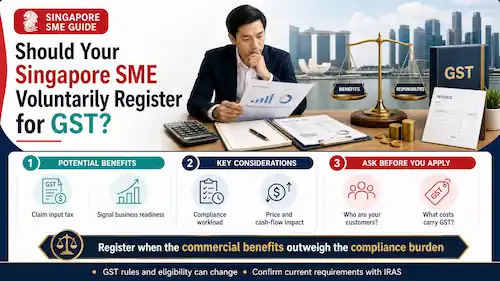
Should your SME voluntarily register for GST? If your taxable turnover is below S$1 million, registration is optional. However, voluntary registration allows you to claim back the 9% GST on business expenses (input tax). The trade-off is a mandatory 2-year commitment, quarterly F5 filings, and strict compliance with the 2026 InvoiceNow e-invoicing mandate, which is now a mandatory condition of approval for all new voluntary registrants.
Claim 9% back on rent, software, and setup costs.
Must remain registered for 24 months minimum.
Net gain for B2B; potential margin hit for B2C.
Key Takeaways for SME Founders
- The 2-Year Rule: Once you voluntarily register, IRAS mandates you stay registered for at least 24 months, even if your revenue drops.
- InvoiceNow is Mandatory: As of 2026, all GST-registered businesses must be ready for compulsory e-invoicing via the Peppol network.
- B2B Advantage: If your clients are GST-registered businesses, charging 9% GST is neutral for them (they claim it back) and improves your cash flow.
- Compliance Burden: Quarterly F5 submissions require precise bookkeeping. Messy accounts increase the risk of IRAS penalties.
Fast Facts — Voluntary GST Registration 2026
Should You Register for GST Voluntarily? (Singapore SME)
Reaching the S$1 million taxable turnover threshold makes Goods and Services Tax (GST) registration mandatory in Singapore. But for many Small and Medium Enterprises (SMEs) operating below this limit, the decision to register voluntarily is a strategic financial calculation rather than a regulatory requirement.
Voluntary registration allows you to recover the 9% GST paid on your business expenses, but it comes with a strict 2-year statutory commitment and the burden of quarterly compliance. In 2026, this decision is further complicated by the mandatory adoption of InvoiceNow (Peppol) e-invoicing standards.
This guide breaks down the financial pros and cons, the hidden compliance risks, and the specific scenarios where voluntary registration becomes a net benefit for your business.
Table of Contents
The Financial Calculation: Weighing Input Tax Recovery Against Overhead
The primary incentive for voluntary registration is the ability to claim input tax. This is the 9% GST you pay on business purchases such as commercial rent, software subscriptions, professional fees, and office equipment.
However, you must weigh this recovery against the ongoing costs of compliance. Quarterly GST F5 submissions require meticulous bookkeeping. If your current accounting processes are manual or disorganized, the cost of hiring a professional to manage these filings may outweigh the 9% you recover.
To determine if voluntary registration is worth it, use this simple formula:
Net Benefit = Input Tax Recovered - (Margin Hit on B2C Sales + Accounting Compliance Overhead)Example Scenario:
If you spend S$50,000 on eligible expenses, you recover S$4,500 in input tax. If your annual accounting fees increase by S$1,200 to handle GST filings, your net gain is S$3,300. For a breakdown of typical overheads, see our guide on accounting services costs.
The 2-Year Statutory Commitment
Many founders treat GST registration as a "try-it-out" feature. This is a dangerous misconception. According to IRAS guidelines on voluntary registration, "Once you are registered, you must remain registered for at least 2 years unless you cease your business operations." This statutory lock-in means you must file quarterly returns even if your revenue drops to zero during this period.
You can only apply for deregistration after two years if your taxable turnover falls below S$500,000. This lock-in period means you must be confident in your long-term cash flow before hitting the "submit" button on the myTax Portal.
The 2026 InvoiceNow Condition
As part of the national digitalization push, IRAS has linked GST registration to InvoiceNow compliance. The authority states that "All GST-registered businesses must be ready to receive and send e-invoices via the Peppol network," making it a mandatory condition for maintaining your GST status in 2026. Failure to adopt these standards can lead to operational bottlenecks and compliance flags.
For a detailed breakdown of deadlines and technical requirements, refer to our guide on GST InvoiceNow compliance for 2026.
Customer Base Breakdown: Why B2B Wins, B2C Loses
The impact of voluntary registration depends entirely on who pays your invoices:
B2B Clients (GST-Registered)
Net Gain. Your clients can claim back the 9% GST you charge. It doesn't increase their cost, but it improves your cash flow by allowing you to claim input tax on your own expenses.
B2C Consumers (Non-GST)
Margin Hit. Individual consumers cannot claim GST. If you raise prices by 9% to cover the tax, you may lose competitiveness. If you absorb the 9%, it comes directly out of your profit margin.
If your business involves significant cross-border transactions, voluntary registration is often essential to benefit from zero-rated supply rules for exports.
The Compliance Burden: Is Your Business Ready?
Voluntary registration invites IRAS scrutiny. When you apply, IRAS may review your historical financial records to ensure you are a legitimate business entity. If your books are messy or your previous accounting firm was negligent, you risk triggering a compliance red flag.
⚠️ Critical Pre-Registration Check
Before applying, ensure your historical data is spotless. If your records are disorganized, we recommend using our clean up messy company accounts service. A clean audit trail is your best defense against IRAS queries during the voluntary registration process.
Furthermore, GST filing is not a task for generalist bookkeepers. If your current provider is slow to respond or lacks specific GST expertise, you might face late filing penalties. Many SMEs use this transition as an opportunity to switch accounting firms to a partner who specializes in GST compliance and InvoiceNow integration.
How to Apply for Voluntary GST Registration
If you decide the benefits outweigh the costs, you can apply via the myTax Portal using your CorpPass. The typical processing time is 2–4 weeks. During this period, IRAS may request additional documents such as proof of business activities, sample invoices, and bank statements.
For a complete walkthrough of the application process and post-registration obligations, see our Ultimate GST Compliance Guide.
Frequently Asked Questions
Unsure if Voluntary GST Registration is Right for Your Cash Flow?
Let our ACRA Registered Filing Agents review your projected turnover, input tax potential, and compliance readiness before you commit to the 2-year lock-in.
GST registration is a significant compliance milestone. We provide practical support from voluntary registration to ongoing quarterly F5 filings and InvoiceNow integration.
If you do not fully understand the implications of the 2-year lock-in or e-invoicing mandates, we will explain the relevant compliance steps before proceeding.
We quote and recommend only the services relevant to your company's actual requirements.
📌 Pin Terra Advisory Services as your Preferred Source on Google (Click link and check the box) →
Note: Terra Advisory Services is a Registered Filing Agent under the ACRA Act. Under the Corporate Service Providers Act 2024, we are treated as a registered Corporate Service Provider (CSP) and meet all new compliance requirements.
Important Notice: While Terra Advisory Services Pte. Ltd. endeavours to keep content accurate and current, Singapore government policies, regulations, fees, and procedures may change without prior notice. For authoritative information, refer directly to official government sources. For advice tailored to your circumstances, please contact Terra Advisory Services.
Licensed Malaysian Division — MIA Registered Firm (NF3281)
Official sources used in this 2026 update: