

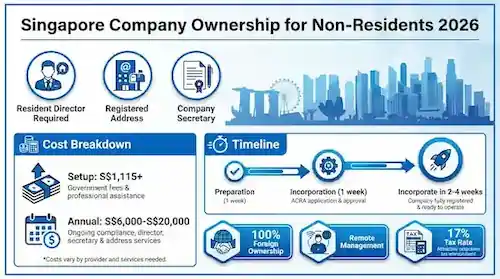
Can a non-resident own 100% of a Singapore company? Yes. Non-residents can own 100% of a Singapore private limited company with no local partner required. Singapore imposes no foreign ownership restrictions for most industries.
However, every Singapore company must have at least one director who is ordinarily resident in Singapore. Non-residents who do not plan to relocate typically appoint a professional nominee director to meet this requirement while retaining full ownership and control.
Most non-resident founders get this wrong. They assume that because they own 100% of the company, they can be the sole director. This is incorrect under Section 145 of the Companies Act. The consequence? Your company cannot be registered, your bank account application will be rejected, and you risk losing the S$125,000 startup tax exemption.
100% allowed
Required (nominee available)
S$2,000–S$4,000/year
Fully possible
Key Takeaways
- 100% Foreign Ownership: Non-residents can own 100% of a Singapore private limited company — no local partner required.
- Resident Director Requirement: Every Singapore company must have at least one director who is ordinarily resident in Singapore. Non-residents can appoint a professional nominee director to meet this requirement.
- Remote Management: You can run your Singapore company entirely from overseas. The entire incorporation process is digital and does not require you to visit Singapore.
- Banking Access: Opening a corporate bank account is one of the biggest hurdles for non-residents. Banks require proper KYC documentation and often a physical visit or video call.
- Tax Exemptions: The Start-Up Tax Exemption (SUTE) can save your company up to S$125,000 in its first three years — but only if structured correctly. Corporate shareholding can disqualify you.
Fast Facts — Non-Resident Company Ownership 2026
Our Approach to Pricing
We know one size doesn't fit all. A SaaS startup with 50 employees has very different compliance needs than a solo consultant. That's why we start with a discovery call to really understand your business model, transaction volume, and growth plans. From there, we tailor a service scope that fits you—no cookie-cutter packages here.
You only pay for what you actually need. If your business has low transaction volume and no employees, we won't charge you for full-service payroll or CFO advisory. We focus on what keeps you compliant, nothing more.
Pricing is always personalized after we review your specific needs. You'll receive a clear, upfront quote for only the services you require—no hidden fees, no surprises.
Table of Contents
- What Does "Non-Resident Ownership" Mean?
- Can a Non-Resident Own 100% of a Singapore Company?
- The One Requirement Non-Residents Must Meet
- How to Set Up a Singapore Company as a Non-Resident
- How to Manage a Singapore Company Remotely
- How to Open a Corporate Bank Account as a Non-Resident
- Annual Compliance Obligations for Non-Resident Owners
- Tax Obligations for Non-Resident Owners
- Non-Resident Ownership vs. Relocating to Singapore
- Costs of Non-Resident Company Ownership (2026)
- What Happens If You Don't Structure Properly?
- Common Mistakes Non-Resident Founders Make
- Why Terra Advisory Services Does Not Make These Mistakes
- Frequently Asked Questions
What Does "Non-Resident Ownership" Mean in Singapore?
Singapore company ownership for non-residents is straightforward. As a non-resident, you can own every share in a Singapore private limited company. You do not need a local partner. You do not need to live in Singapore. You do not need to visit Singapore to incorporate your company. The entire process is managed digitally through ACRA's Bizfile portal.
What you do need, however, is at least one director who is ordinarily resident in Singapore. This is the only statutory requirement that distinguishes a non-resident owner from a Singapore-based owner. Everything else — ownership, control, profits, and decision-making — belongs entirely to you.
This guide explains exactly how non-resident ownership works in 2026, what it costs, how to manage your company remotely, and what compliance obligations apply once your company is incorporated.
Can a Non-Resident Own 100% of a Singapore Company?
Yes — and this is one of Singapore's most significant advantages for foreign investors.
Unlike many Asian jurisdictions, Singapore imposes no equity restrictions on foreign ownership. A non-resident individual or a foreign corporation can hold 100% of the shares in a Singapore Pte Ltd. There is no mandatory local shareholding, no minimum local equity percentage, and no requirement for a Singaporean business partner.
This open ownership policy applies to most industries. Consequently, Singapore consistently attracts foreign entrepreneurs, regional holding companies, and international investors who want a stable, tax-efficient base in Asia.
There are, however, limited exceptions. Certain regulated sectors — including media, legal services, and specific financial services — impose ownership restrictions. For most commercial activities, though, 100% non-resident ownership is fully permitted and legally protected under Singapore law.
The One Requirement Non-Residents Must Meet
Every Singapore company must have at least one director who is ordinarily resident in Singapore. This is the single most important requirement for non-resident owners to understand.
Who Qualifies as a Resident Director?
Under the Singapore Companies Act, a resident director must be one of the following:
- A Singapore Citizen
- A Singapore Permanent Resident (PR)
- An Employment Pass (EP) holder — minimum salary S$5,600/month in 2026 (S$6,200 for financial services)
- An EntrePass holder — for foreign entrepreneurs starting innovative businesses in Singapore
As a non-resident living abroad, you will not qualify as a resident director unless you hold one of these statuses. Therefore, you have two practical options: appoint a professional nominee director, or apply for an Employment Pass and relocate to Singapore.
Option 1: Appoint a Nominee Director (Most Common for Non-Residents)
A nominee director is a Singapore-resident professional who serves as your company's statutory director on paper. Critically, a nominee director does not manage your business, access your bank accounts, or make commercial decisions. Their role is strictly limited to compliance matters.
With a proper service agreement, Power of Attorney, and Deed of Indemnity in place, you retain full operational control. The nominee director simply fulfils the residency requirement on your behalf. This arrangement is standard practice for non-resident owners and is fully recognised under Singapore law.
| Provider Type | Annual Fee (SGD) | Legal Risk Level | Essential Protection Documents |
|---|---|---|---|
| Freelance Individual | S$1,000 – S$1,500 | High | Rarely provided; personal liability exposure |
| Budget Corporate Firm | S$1,500 – S$2,000 | Medium | Standard terms; limited customization |
| Professional CSP / Advisory | S$2,500 – S$4,000 | Low | Deed of Indemnity, Undated Resignation, Service Agreement |
Option 2: Apply for an Employment Pass and Relocate
If you plan to move to Singapore and manage your company in person, you can apply for an Employment Pass (EP) as a director of your own company. Once approved, you become a resident director and no longer need a nominee.
However, the EP requires a minimum monthly salary of S$5,600 in 2026, and your company must demonstrate genuine business activity. This option suits entrepreneurs who intend to build a Singapore-based operation rather than manage remotely.
How to Set Up a Singapore Company as a Non-Resident (Step-by-Step)
Setting up a Singapore company as a non-resident is entirely possible without visiting Singapore. The process is digital, fast, and straightforward when you work with an ACRA Registered Corporate Service Provider.
Step 1: Choose Your Company Name
First, select a unique company name and check availability on ACRA's Bizfile portal. Your name must not be identical or confusingly similar to existing entities. Additionally, avoid restricted words such as "Bank," "Insurance," or "School," which require prior approval from the relevant regulatory authority.
Step 2: Decide How to Meet the Resident Director Requirement
Next, determine how you will satisfy the resident director requirement. Most non-residents appoint a professional nominee director at this stage. Alternatively, if you plan to relocate, begin your Employment Pass application in parallel with incorporation.
Step 3: Prepare Your Documents
- Passport copy and proof of residential address for all shareholders and directors
- Proposed company name and business activity description
- SSIC code for your business activity
- Decision on paid-up capital amount
- Company Constitution (Model Constitution is acceptable for most companies)
Step 4: Engage an ACRA Registered Corporate Service Provider
Non-residents cannot submit incorporation applications directly through Bizfile. Therefore, you must use an ACRA Registered Corporate Service Provider. Terra Advisory Services submits the application on your behalf, typically within one to two business days of receiving complete documents.
Step 5: Receive Your UEN and Certificate of Incorporation
Once ACRA approves your application — usually within one to three business days — you receive a digital Certificate of Incorporation and your Unique Entity Number (UEN). Your company is now legally incorporated.
Step 6: Set Up Compliance and Accounting
Finally, establish your compliance framework from day one. Appoint a company secretary within six months of incorporation. Set your financial year-end. Arrange bookkeeping and accounting services. Understanding your ongoing obligations from the start prevents costly penalties later.
How to Manage a Singapore Company Remotely as a Non-Resident
One of the most common questions from non-resident owners is: "Can I run my Singapore company from overseas?" The answer is yes — and many thousands of non-residents do exactly this.
What You Can Do Remotely
- Sign board resolutions and shareholder resolutions electronically
- Instruct your nominee director on compliance matters via written communication
- Access company bank accounts as the sole authorised signatory
- File corporate tax returns through IRAS myTax Portal (via your corporate secretary)
- Update company information on Bizfile through your ACRA Registered Corporate Service Provider
- Invoice clients and receive payments in Singapore dollars or foreign currencies
What Requires Local Presence
- Bank account opening at traditional banks — often requires a video call or in-person meeting for KYC
- Government grant applications — some Enterprise Singapore grants require a local representative
- Regulated licences — financial, healthcare, and food licences may require a local responsible person
For most commercial activities, though, remote management is entirely practical. Singapore's digital infrastructure is designed to support online management.
How to Open a Corporate Bank Account as a Non-Resident
Opening a corporate bank account is one of the biggest hurdles for non-resident founders. Banks are increasingly cautious about non-resident applicants, and the wrong structure can lead to automatic rejection.
Common rejection reasons include:
- No local resident director on the company — traditional banks often require this to be in place before they open an account
- Lack of operational substance — no clear business link to Singapore
- Incomplete KYC documentation — bank policies require full identity verification of all directors and shareholders
- Business model that doesn't align with Singapore operations — banks want to see genuine business activity in Singapore
How to avoid rejection: Work with a professional filing agent who understands bank KYC requirements. Ensure your resident director is appointed before you apply. Prepare your business description, proof of funds, and source of wealth documentation in advance.
Banking Channel Comparison
| Account Type | Preferred Choice For | Physical Visit Required? | Average Approval Time |
|---|---|---|---|
| Digital Institutions / Neobanks (e.g., Airwallex, Anext) |
E-commerce, Cross-border SaaS, Immediate Launch | ❌ No (100% Digital / Video) | 1 – 3 Business Days |
| Traditional Local Banks (e.g., DBS, OCBC, UOB) |
Physical Operations, Local Contracts, Credit Lines | ⚠️ May require video call or branch visit | 2 – 4 Weeks |
Complete guide to opening a Singapore corporate bank account →
Annual Compliance Obligations for Non-Resident Owners
Owning a Singapore company comes with ongoing compliance obligations. These obligations begin immediately after incorporation — not at year-end. Understanding them upfront prevents penalties and keeps your company in good standing.
| Obligation | Deadline | Penalty for Default |
|---|---|---|
| Company Secretary appointment | Within 6 months of incorporation | Offence under Companies Act |
| Annual General Meeting (AGM) | Within 6 months of financial year-end | Up to S$5,000 per director |
| Annual Return filing (ACRA) | Within 7 months of financial year-end | S$300–S$600 |
| Estimated Chargeable Income (ECI) | Within 3 months of financial year-end | IRAS estimated assessment |
| Corporate Income Tax Return | 30 November each year | Penalty + estimated assessment |
Tax Obligations for Non-Resident Owners
Singapore's corporate tax system, administered by IRAS, is one of the most competitive in Asia. The flat corporate tax rate is 17%. However, new companies benefit from significant startup tax exemptions under the Start-Up Tax Exemption (SUTE) scheme:
- 75% exemption on the first S$100,000 of chargeable income (first three years)
- 50% exemption on the next S$100,000 of chargeable income (first three years)
- 40% Corporate Income Tax (CIT) rebate capped at S$30,000 for Year of Assessment 2026
Importantly, Singapore operates a territorial tax system. This means your Singapore company is taxed only on income sourced in Singapore or remitted to Singapore. Foreign-sourced income that remains offshore is generally not taxable in Singapore, subject to conditions. Additionally, Singapore has no corporate withholding tax on dividends paid to shareholders.
Furthermore, Singapore has no capital gains tax. As a non-resident owner, you can receive dividends from your Singapore company tax-free under the single-tier dividend system.
Non-Resident Ownership vs. Relocating to Singapore
Many non-residents eventually consider whether to relocate to Singapore and manage their company in person. The table below compares both approaches to help you decide.
| Factor | Non-Resident Ownership | Relocating with Employment Pass |
|---|---|---|
| Residency required | No | Yes |
| Nominee director needed | Yes (annual cost: S$2,000–S$4,000) | No |
| Operational control | Full (via service agreement) | Full (direct) |
| EP salary requirement | Not applicable | S$5,600/month minimum (2026) |
| Bank account opening | Possible remotely | Straightforward in person |
| Government grants | Limited access | Full access |
| Best suited for | Remote entrepreneurs, holding companies | Founders building a Singapore-based team |
Neither approach is inherently better. The right choice depends on your business model, whether you need to hire locally, and whether you plan to live in Singapore long-term.
Costs of Non-Resident Company Ownership in Singapore (2026)
Understanding the full cost of non-resident ownership helps you budget accurately from the start. Beyond incorporation and nominee director fees, you'll also need to budget for accounting services and compliance costs.
One-Time Setup Costs:
| Item | Cost (SGD) |
|---|---|
| ACRA name reservation | S$15 |
| ACRA incorporation fee | S$300 |
| Professional filing fee | S$500–S$1,500 |
| Total government + filing | S$815–S$1,815 |
Annual Recurring Costs:
| Item | Cost (SGD/year) |
|---|---|
| Nominee director service | S$2,000–S$4,000 |
| Company secretary + registered address | S$500–S$1,200 |
| Accounting and bookkeeping | S$1,200–S$3,600 |
| Corporate tax filing | S$500–S$1,500 |
| Total annual (estimated) | S$4,200–S$10,300 |
These costs are significantly lower than maintaining a physical office or hiring local staff. Moreover, the tax savings from Singapore's startup exemptions typically offset the compliance costs within the first year of operation.
What Happens If You Don't Structure Properly?
Most non-resident founders focus on getting the company registered. They don't think about the consequences of getting the structure wrong — until they hit a brick wall.
Bank Account Rejection
Traditional banks in Singapore are increasingly cautious about non-resident applicants. Without a proper resident director and complete KYC documentation, your application will be rejected. Digital banks may be an option, but they have their own eligibility criteria — and the wrong setup can cause delays regardless of provider.
Loss of Tax Exemptions
If you hold shares through a foreign corporate parent without at least one individual holding 10% of ordinary shares, your company loses the SUTE relief worth up to S$125,000 over three years. This is a mistake most corporate-owned Singapore companies make.
Director Personal Liability
Under the Companies Act, directors bear personal liability for compliance failures. If you are a director who is not ordinarily resident in Singapore and your company fails to comply, penalties can reach S$5,000 per director for missed filings.
No Banking Access = No Business Operations
You cannot receive payments, pay suppliers, or demonstrate financial credibility without a bank account. Delays in opening a bank account can stall your business operations entirely.
Common Mistakes Non-Resident Founders Make
Mistake 1: Assuming You Don't Need a Resident Director
Most founders believe that owning 100% of the company means they can be the sole director. This is incorrect. Under Section 145 of the Companies Act, every company must have at least one director who is ordinarily resident in Singapore — regardless of who owns the shares.
Consequence: Your company cannot be registered. Your bank account application will be rejected. Your business stalls before it starts.
Mistake 2: Waiting Until Incorporation to Think About Banking
Most founders wait until after incorporation to think about bank accounts. Banks require a valid resident director, complete KYC documents, and often a physical visit or video call. Planning banking at the same time as incorporation avoids delays.
Consequence: You incorporate your company but cannot open a bank account for weeks or months. You cannot receive payments, pay suppliers, or demonstrate financial credibility.
Mistake 3: Choosing the Wrong Shareholding Structure
Most founders don't realize that holding shares through a foreign parent can cost them the start-up tax exemption. If a corporate shareholder owns 100% and no individual holds at least 10% of ordinary shares, the company loses SUTE relief worth up to $125,000 over three years.
Consequence: You lose up to S$125,000 in tax savings over your first three years.
Mistake 4: Assuming Remote Incorporation Means Remote Banking
Most founders assume that because they incorporated remotely, they can bank remotely. Traditional banks often require physical presence or video KYC, and digital banks have their own eligibility criteria.
Consequence: You are forced to delay operations or fly to Singapore at short notice to complete KYC verification.
Why Terra Advisory Services Does Not Make These Mistakes
The common mistakes above are exactly why so many non-resident founders struggle with compliance, banking, and tax planning. Terra Advisory Services does not make these mistakes.
1. Resident Director Requirement — We get it right from day one.
We appoint a professional nominee director with full legal safeguards — Deed of Indemnity, Service Agreement, and Undated Resignation Letter. Your assets stay protected.
2. Banking Strategy — We plan banking at the same time as incorporation.
We help you choose the right provider — traditional or digital — based on your business model, not after the fact. We prepare your KYC documentation in advance so you don't face rejection.
3. Shareholding Structure — We protect your tax exemptions.
We ensure at least one individual holds 10% of ordinary shares so you don't lose SUTE relief worth up to S$125,000 over three years.
4. COMPASS & EP Planning — We align your structure with immigration goals.
If you plan to relocate, we help you apply for Employment Pass at the right time to replace the nominee director.
Frequently Asked Questions
🔒 A Note on Compliance:
To ensure a secure, smooth incorporation, all ACRA-registered Corporate Service Providers (CSPs) are required to complete identity verification and due diligence checks before setting up a company. This is a standard statutory requirement under Singapore's Corporate Service Providers Act 2024, and applies to every provider in the industry.
Ready to incorporate your Singapore company as a non-resident?
We handle the entire process remotely — ACRA filing, nominee director, and ongoing compliance. Let's make sure your structure is right from day one.
- ✅ 100% foreign-owned company setup
- ✅ Nominee director with full legal protection
- ✅ Bank account strategy and KYC preparation
- ✅ Tax exemption planning
- ✅ Ongoing compliance and accounting
Incorporating or restructuring your business requires more than automated forms. We provide a highly personal, tailored approach—no generic packages, just dedicated expert guidance.
- • Your Peace of Mind Comes First: We don't just explain—we ensure you truly understand and are comfortable before proceeding.
- • Personalized & Honest Pricing: Once we understand your needs, we provide a clear, custom quote—no hidden fees or unnecessary extras.
- • Expert Immigration Support: Direct, one-on-one advisory from seasoned professionals with 14+ years of experience.
- • Cross-Border Expertise: Local advisory for smooth business expansion between Singapore and Malaysia.
Your vision, your pace, our expertise.
Important Notice: While Terra Advisory Services Pte. Ltd. endeavours to keep the content accurate and current, Singapore and Malaysian government policies, regulations, fees, and procedures may change at any time without prior notice. For the most up-to-date and authoritative information, please refer directly to official government sources. For advice tailored to your specific circumstances, please contact Terra Advisory Services.
Licensed Malaysian Division — MIA Registered Firm (NF3281)
Official sources used in this 2026 update:
- ACRA — Singapore Accounting and Corporate Regulatory Authority
- IRAS — Inland Revenue Authority of Singapore
- Bizfile — ACRA's online filing portal
- MOM — Ministry of Manpower (Employment Pass)
- Singapore Companies Act 1967
This page is a general guide and should not be treated as legal or compliance advice for a specific case. For advice tailored to your specific situation, contact Terra Advisory Services.