

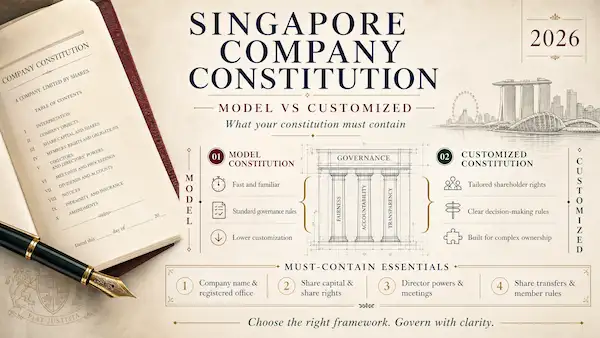
A company constitution is a mandatory legal rulebook required by the Accounting and Corporate Regulatory Authority (ACRA) under the Singapore Companies Act 1967. It governs the internal management of the company, defining the relationship between the company, its directors, and its shareholders. During incorporation on BizFile+, founders must choose between adopting ACRA’s standardized Model Constitution or lodging a tailored, customized constitution.
Free & Instant (via BizFile+)
3 to 7 Days (Professional fees apply)
100% Required for all Pte. Ltd.
Key Takeaways for Founders
- The Constitution is your statutory contract: Once lodged, it acts as a legally binding contract between the company and its members, and among the members themselves.
- Model vs. Custom is a strategic choice: The free ACRA Model is fine for solo founders, but multi-founder startups and venture-backed companies require a Custom Constitution to handle vesting, preference shares, and investor protections.
- Shareholders' Agreements (SHA) must align: If your SHA conflicts with your public Constitution, the Constitution generally prevails in the eyes of third parties. Both documents must be drafted in tandem.
- Upgrade triggers are predictable: You will likely need to amend your constitution when bringing on co-founders, issuing ESOPs, or raising institutional capital.
- Professional drafting prevents costly disputes: Standardizing share transfer restrictions and director powers early prevents operational paralysis later.
Fast Facts: Singapore Company Constitution
1. What Is a Singapore Company Constitution?
Under current Singapore company law, the constitution replaces the older "Memorandum and Articles of Association" (M&A). It is the foundational document for your corporate governance, working hand-in-hand with your corporate secretarial compliance framework.
Statutory Contractual Effect
Once lodged with ACRA, it acts as a binding contract between the company and its members, as well as among the members themselves. Breaching it can lead to direct legal action.
Public Record Status
Because it is lodged publicly on BizFile+, anyone—including prospective clients, banks, and future investors—can purchase a copy. It is not a private, internal document.
2. Model Constitution vs. Customized Constitution
Choosing the right format during company incorporation sets the baseline for your startup's future governance and investor readiness.
| Feature / Consideration | ACRA Model Constitution | Customized Constitution |
|---|---|---|
| Setup & Cost | Free and instant selection inside BizFile+. | Requires professional drafting and legal filing fees. |
| Ideal For | Single founders, simple holding companies, or standard ordinary share structures. | Multi-founder setups, venture-backed startups, or complex capital tables. |
| Share Classes | Usually restricted or rigid; typically assumes a single class of ordinary shares. | Fully flexible; accommodates preference shares, vesting schedules, and multiple voting tiers. |
| Transfer Restrictions | Directors have absolute discretion to refuse any transfer without reason, creating deadlock risks. | Tailored drag-along, tag-along, and right of first refusal mechanisms. |
| Investor Readiness | Low; often requires an amendment or complete overhaul prior to institutional fundraising. | High; built from day one to match shareholder agreements and term sheets. |
3. Mandatory Statutory Clauses vs. Custom Provisions
Every constitution filed in Singapore must incorporate baseline statutory requirements, but customized documents expand heavily on operational rules to protect your specific business interests.
Mandatory Clauses (Required by ACRA)
- Name Clause: The exact approved corporate name.
- Registered Office Clause: Acknowledging the office is in Singapore.
- Liability Clause: Stating member liability is limited.
- Subscriber Clause: Identifying initial founders and pledged shares.
Critical Custom Provisions
- Share Capital & Multi-Class: Rules for preference shares, warrants, or ESOPs.
- Transfer of Shares: Pre-emption rights and rights of first refusal.
- Director Powers: Quorum, casting votes, and remote meeting protocols.
- Reserved Matters: Supermajority votes for major capital changes.
4. When Should You Upgrade from the Model Constitution?
Many early-stage founders select the default ACRA template to save time, only to encounter severe operational roadblocks or ACRA incorporation delays later. You should upgrade or customize your constitution if:
Bringing on Co-Founders
The model constitution does not inherently handle unvested founder shares, good/bad leaver provisions, or forced buybacks upon a founder's departure.
Raising Institutional Capital
VC and angel investors require specific protection clauses, liquidation preferences, and protective provisions that standard models completely omit.
Issuing Complex Share Classes
If certain shares carry different voting weights, dividend priorities, or conversion rights, custom drafting is legally mandatory.
You Need to Amend an Existing Constitution
Learning how to amend a company constitution in Singapore requires a Special Resolution (75% shareholder vote) and ACRA lodgment. Doing this post-incorporation incurs higher professional drafting and filing fees than getting it right on day one.
Need Help Structuring Your Company Constitution?
Choosing between the ACRA Model template and a custom governance structure impacts everything from future fundraising to day-to-day board control. Let our corporate secretarial team review your ownership layout and draft a constitution that protects your interests.
Note on Advisory Fees: Adopting the standard ACRA Model Constitution is free. However, professional drafting for a customized constitution or complex amendments typically ranges from SGD 800 to 2,500+, depending on the complexity of your share classes and shareholder agreements. We provide transparent, fixed-fee proposals before any work begins.
Frequently Asked Questions
Incorporating or restructuring a business in Singapore is a major legal and financial decision. We provide dedicated, personal service from our first conversation to your ongoing annual filings.
If you do not fully understand any aspect of the process, we will pause and will not move forward until you are ready.
We quote and design only the specific services your business actually requires.
Official sources used in this 2026 update:
This page is a general guide and should not be treated as legal advice. ACRA policies and the Companies Act are subject to change. For advice tailored to your specific corporate governance scenario, contact Terra Advisory Services.