
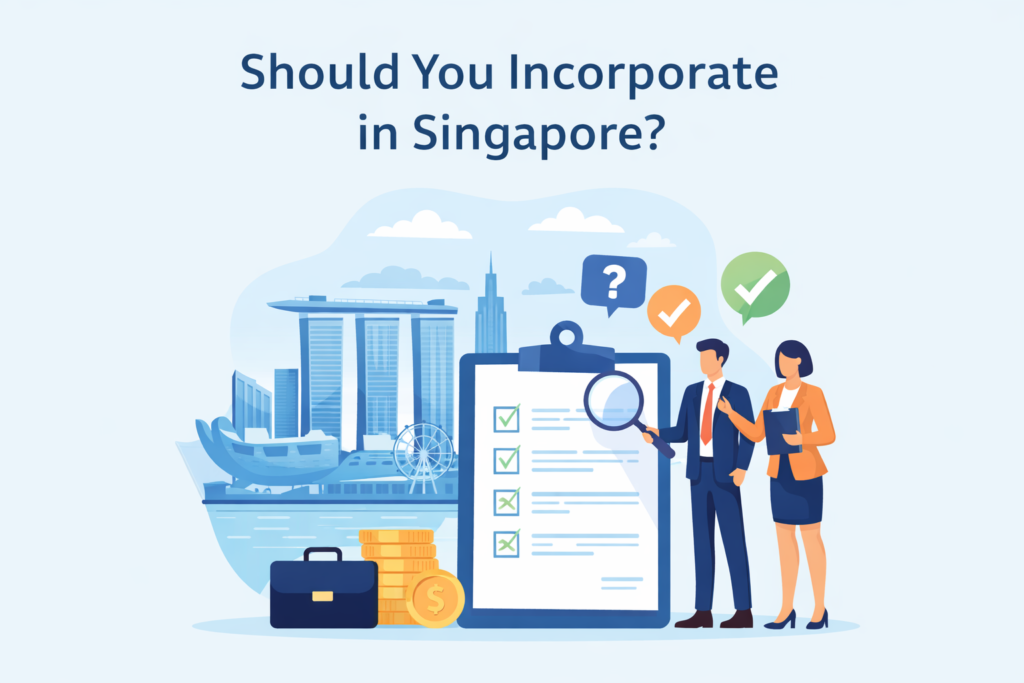
Should You Incorporate a Company in Singapore? (SME Decision Guide 2026)
If you are a Singapore citizen or permanent resident running a business, one of the most important structural decisions you will make is whether to continue as a sole proprietor or incorporate a private limited company. This is not just an administrative step. It affects your personal liability, tax treatment, business credibility, growth options, and long-term risk.
Many local founders wait too long to incorporate because the business still feels “small”. Others incorporate too early without understanding the ongoing compliance burden. The right timing depends less on emotion and more on revenue stability, commercial risk, hiring plans, and whether you are building a real business rather than testing an idea.
You should usually incorporate a company in Singapore if:
- your business revenue is becoming stable;
- you are taking on business risk, contracts, or liabilities;
- you plan to hire staff, bring in co-founders, or scale operations; or
- you want stronger credibility with clients, banks, and partners.
You may not need to incorporate yet if:
- you are still testing a low-risk idea;
- your income is inconsistent or very small; or
- you are running a simple side activity with little exposure.
UEN: 201207025E | Established 2012 | 14+ Years of Experience
Who this guide is for
This article is mainly for:
- Singapore citizens starting a business;
- Singapore PRs deciding whether to formalise their SME through incorporation;
- sole proprietors thinking about converting into a company; and
- local founders who want a practical answer, not just a generic “Pte. Ltd. is better” opinion.
Pte. Ltd. vs Sole Proprietorship: the real decision
For most local founders, the real choice is not between all possible Singapore business structures. It is between staying as a sole proprietor or moving into a private limited company.
| Factor | Private Limited Company | Sole Proprietorship |
|---|---|---|
| Legal status | Separate legal entity | Not separate from the owner |
| Liability | Generally limited to the company | Unlimited personal liability |
| Credibility | Stronger with banks, vendors, and clients | Usually lower |
| Scalability | Better for growth, hiring, and investors | Limited |
| Ownership structure | Can issue shares and add owners | Single-owner structure |
| Compliance | Higher ongoing requirements | Lower ongoing requirements |
If you need a broader comparison of business forms before deciding, see our guide to the best business structure for startups in Singapore and our Singapore company structure comparison page.
Tax comparison: why this matters to SMEs
Tax is not the only factor, but it is often one of the reasons SMEs eventually incorporate.
| Factor | Private Limited Company | Sole Proprietorship |
|---|---|---|
| Tax treatment | Corporate income tax applies | Taxed as part of personal income |
| Headline tax rate | 17% corporate tax rate | Personal income tax rates apply |
| Tax planning flexibility | Usually stronger | Usually more limited |
| Eligibility for some schemes / structuring | Generally better positioned | More limited |
Official tax rules depend on your exact facts, and you should always refer to IRAS for the applicable position. If you are already thinking beyond survival and into tax efficiency, that is often one sign your business may be ready for a company structure.
For official references, see IRAS. For a practical local-founder setup guide, see our Singapore citizen / PR incorporation guide.
Revenue thresholds: when many SMEs start considering incorporation
There is no official ACRA or IRAS revenue threshold that forces you to incorporate. However, from a practical SME decision standpoint, many businesses start reviewing incorporation at certain revenue and growth stages.
| Monthly Revenue Range | Typical Business Stage | Practical Incorporation View |
|---|---|---|
| Below S$3,000 | Testing / side income | Usually remain a sole proprietor unless risk is already high |
| S$3,000 – S$8,000 | Early traction | Optional. Review your contracts, liability exposure, and growth plans |
| S$8,000 – S$15,000 | Stable operating business | Strong point to seriously consider incorporation |
| Above S$15,000 | Scaling SME | Incorporation is often the more suitable long-term structure |
When you should usually incorporate
1. You are signing larger contracts
Once you are taking on obligations to clients, suppliers, or landlords, unlimited personal liability becomes a more serious issue.
2. Your revenue is becoming predictable
Stable monthly revenue is often the point where a founder shifts from “testing” to “operating a real business”.
3. You want cleaner separation
A company makes it easier to separate personal money, business records, tax reporting, and ownership.
4. You plan to hire staff
If you are building a team, formal company structure becomes much more useful for payroll, governance, and scale.
When you may not need to incorporate yet
Not every business should incorporate immediately. You may be better off waiting if:
- you are still validating the business idea;
- your income is irregular and small;
- your activity is low-risk and not contract-heavy; or
- you want to minimise compliance while you test the market.
The point is not to stay simple forever. It is to incorporate at the right time, not blindly or too late.
How much does incorporation cost?
The official ACRA government fees are straightforward:
| Item | Cost | Notes |
|---|---|---|
| Name reservation | S$15 | Official ACRA fee |
| Company incorporation | S$300 | Official ACRA fee |
| Total government cost | S$315 | Excludes advisory / support services |
Official reference: ACRA.
If you are a Singapore citizen or PR acting as your own resident director, you also avoid one of the main extra costs many foreign founders face: a nominee director arrangement. For background, see our nominee director guide.
Common mistakes local founders make when deciding to incorporate
1. Waiting too long
Some SMEs continue operating as sole proprietors long after the business has become commercially significant. That leaves the owner personally exposed to liabilities that should already sit inside a company structure.
2. Focusing only on the S$315 fee
The real question is not whether incorporation costs S$315. The real question is whether your current structure is still suitable for your actual business risk and growth stage.
3. Ignoring post-incorporation compliance
Some founders think incorporation is the finish line. It is not. Once the company is incorporated, there are ongoing obligations involving annual returns, company secretary support, tax filing, and proper record keeping.
4. Choosing structure emotionally, not strategically
Some founders incorporate too early just because a company “sounds more serious”. Others refuse to incorporate because they fear compliance. Both mistakes come from making the decision emotionally rather than structurally.
For the full filing side of the picture, see our post-incorporation compliance guide and our Singapore corporate compliance 2026 guide.
What happens after you decide to incorporate?
If your answer is yes, the next step is not just filing a form. You need to incorporate properly from the start.
- Choose and reserve your company name
- Prepare the company details and shareholding structure
- Submit the incorporation application via BizFile+
- Appoint your company secretary within 6 months
- Set up accounting, tax, and compliance properly
To see the practical step-by-step process, read our guide to registering a company in Singapore and our main incorporation pillar guide.
Final decision framework
You should usually incorporate if:
- your business has become stable and commercially real;
- you want limited liability protection;
- you are hiring, expanding, or taking on contracts;
- you want stronger credibility and cleaner business structure.
You may delay incorporation if:
- you are still testing a low-risk idea;
- your income is very early-stage and inconsistent; or
- you genuinely do not yet need the extra structure.
Need help deciding or incorporating properly?
Terra Advisory Services supports Singapore citizens and PRs with company incorporation, corporate secretarial support, and ongoing compliance setup.
Frequently asked questions
When should I incorporate my business in Singapore?
There is no official legal revenue threshold. In practice, many SMEs start seriously considering incorporation once revenue becomes stable, risk increases, or hiring begins.
Is a private limited company better than a sole proprietorship?
For many growth-focused SMEs, yes. A private limited company offers limited liability, stronger credibility, and better long-term scalability, although it also comes with higher compliance obligations.
Do Singapore citizens or PRs need a nominee director?
Usually no. Singapore citizens and PRs can normally act as their own resident director, which is one of the main reasons local incorporation is simpler than foreign-founder incorporation.
How much does it cost to incorporate a company in Singapore?
The official ACRA government fees are S$15 for name reservation and S$300 for company incorporation, for a total of S$315.
Can I convert from a sole proprietorship to a company later?
Yes. Many SMEs start as sole proprietors and incorporate later once revenue stabilises or business risk becomes more significant.
What happens after incorporation?
After incorporation, the company must appoint a company secretary, maintain proper records, and comply with annual filing, tax, and statutory obligations.