

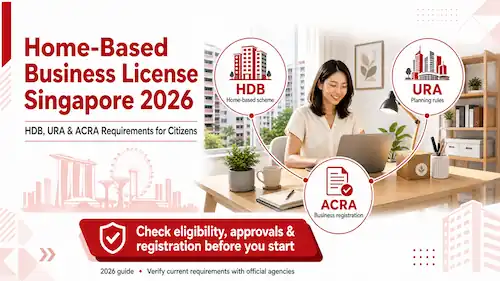
Do you need a licence to run a home business in Singapore? Most home-based businesses do not require special approval from HDB or URA — if they are small-scale, non-disruptive, and comply with the rules.
✅ Yes — ACRA registration is mandatory if you trade under a business name
S$15 name + S$100 sole prop
❌ Not for most small businesses
HBB Scheme = no prior approval needed
❌ No SFA retail licence required
But food safety rules still apply
Key Takeaways
- Most home businesses do not need HDB/URA approval. Under the Home-Based Business Scheme, you can operate small-scale activities without seeking prior permission.
- ACRA registration is mandatory. If you operate under a business name or sell products/services regularly, you must register with ACRA.
- Your SSIC code matters. Choose the wrong one and you risk grant ineligibility, licence delays, or incorrect tax treatment. Our SSIC guide explains how to choose correctly.
- Home bakers have it easy. No SFA food retail licence is required — but you must follow food safety rules and sell directly to consumers, not to retailers.
- Structure matters. A sole prop exposes you to personal liability. As your revenue grows, switching to a Pte Ltd protects your personal assets.
Fast Facts — Home Business Singapore 2026
Starting a business from home in Singapore? Smart move. No expensive office rent, no long commutes. But getting your structure, SSIC code, and registration wrong can expose you to personal liability and cost you thousands down the road.
This guide covers exactly what you need to know about starting a home-based business in 2026: HDB/URA schemes, ACRA registration, SSIC codes, and requirements for popular activities like baking or tuition.
Not sure where to start? Terra Advisory is an ACRA‑registered filing agent that helps Singapore citizens and PRs register their home businesses correctly — no mistakes, no delays, no personal liability surprises. Our complete guide for local founders walks you through every step with Singpass.
Table of Contents
Understanding the Two Main Schemes: HBB and HO
Singapore has two different schemes for running a business from home. Which one applies to you depends entirely on the type of work you plan to do.
The Home-Based Business Scheme (HBB) is for small-scale, hands-on activities. Think of things like baking and selling cakes from your kitchen, offering hairdressing or nail services to neighbours, or making crafts to sell online. These are businesses that involve physical activity, stock, or direct service at your home.
For the HBB scheme, you generally do not need to seek prior approval from HDB or URA. You can carry out these activities as long as they remain small-scale and do not cause any nuisance to your neighbours — no strong smells, noise, or heavy foot traffic.
The Home Office Scheme (HO) is for administrative or office-type work. If you run a consultancy, provide accounting or IT services, do graphic design, or run an e-commerce store where all your stock is stored elsewhere, this is likely your scheme. You are using your home as your office to handle the paperwork and communications of your business.
Under the HO scheme, you can register your residential property with HDB (for HDB flats) or URA (for private property). You are allowed to hire up to two non-resident employees to work from your home. However, all activities must be strictly administrative in nature.
Under the Home Office Scheme, clients and customers are strictly prohibited from visiting the residential property. The scheme is designed exclusively for back-office and administrative work. If your business model requires face-to-face meetings with clients at your home address, you cannot use the HO scheme and may need to consider alternative arrangements.
Do You Even Need to Register a Home Business?
You need to register your business with ACRA if you are operating under a business name, selling products, or providing services with the intention of making a profit. If you are casually selling a few homemade cookies to friends once in a while, you might not need to register. But once you start using a brand name, advertising online, or regularly selling to people you do not know, registration is required.
For most small-scale home-based businesses, you do not need to get any special approval from HDB. The HDB Home-Based Business Scheme allows you to operate certain small-scale activities from your flat without applying for a permit first. As long as your business stays small and does not disrupt your neighbours, you are generally in the clear.
If you live in private property — a condo or landed house — the rules are similar. You can run a small-scale business under the URA Home Office Scheme without seeking prior approval for most administrative activities.
When you register with ACRA, you must select an SSIC code that classifies your business activity. Picking the wrong code can affect your eligibility for grants, licences, or even your tax treatment. Our SSIC 2025 guide explains the new codes in plain English — and Terra can help you choose the right one from the start.
One question many home-based founders ask at this stage is whether to register as a sole proprietorship or incorporate a private limited company. If you are not sure which structure suits your situation, our guide on registering a company as a local founder walks through the key decision points before you register.
The Step-by-Step Guide to Registering Your Home Business
Once you are confident your business idea fits within the allowed activities, the registration process is straightforward.
Step 1: Check if your business activity is allowed.
Confirm that what you want to do is permitted under the HBB or HO scheme. Most common small businesses are fine. However, you cannot operate a medical clinic, a spa, a tuition centre with many students coming and going, or any activity that creates significant noise or pollution from home.
Step 2: Register your business with ACRA.
Go to the ACRA BizFile+ portal and register your business using your Singpass. You will need to choose a business name, pay the registration fee (S$15 for name application + S$100 for sole proprietorship registration), and provide your home address as your business address. Within a few hours or days, you will receive your Business Profile.
If you are a Singapore citizen or PR considering a private limited company instead of a sole proprietorship, the process is different. See our complete guide to incorporating a company as a Singapore citizen or PR for the full step-by-step breakdown, costs, and post-incorporation obligations.
⚠️ Critical Risk Warning for High-Revenue Home Businesses
Registering as a Sole Proprietorship is the cheapest option for a small home hobby, but it carries immense risk. In Singapore, a Sole Proprietorship means you and your business are the exact same legal entity. If your home-based e-commerce store, digital agency, or consulting business faces a lawsuit or debt, your personal savings, your car, and your home can be seized to pay it off.
If your business projects more than S$50,000 in revenue, you should skip the sole proprietorship entirely and incorporate a Private Limited (Pte Ltd) company from day one to protect your personal assets.
Discuss Pte Ltd Protection →💡 Doing it yourself? While you can register on your own, a single mistake in your SSIC code or business structure can cost you thousands in tax, grants, or personal liability.
Terra Advisory handles the entire registration process for you — so you get it right the first time, with no compliance surprises down the road.
Get Terra to Handle It →Step 3: Inform HDB or URA (if needed).
For most home-based businesses, you do not need to separately inform HDB or URA. However, if your business falls under the Home Office Scheme, you may need to register your home address with the relevant authority. For HDB flats, this is done online through the HDB Home Office Scheme page. For private property, you register with URA. This step is free and quick.
Step 4: Handle any additional licences.
Some home businesses need extra licences from other government agencies. Home bakers do not need an SFA food shop licence, but must follow food safety rules. If you are providing tuition, you cannot turn your home into a full-fledged tuition centre with many students coming daily. Always check the specific requirements for your industry on GoBusiness.
Home-Based Business vs. Private Limited Company
| Feature | Home-Based (Sole Prop) | Private Limited Company |
|---|---|---|
| Setup Cost | S$115 (ACRA fees) | S$315 + professional fees |
| Liability | Personal (unlimited) — your home and savings are at risk | Limited to company assets |
| Tax Benefits | Personal tax rates (up to 24%) | 75% exemption on first S$100K + 17% corporate rate |
| Credibility | Lower (sole prop) | Higher (Pte Ltd) |
| Compliance | Simple (annual declaration) | More complex (annual returns, AGM, filings) |
| Best For | Testing ideas, side income, low-risk activities | Scaling, hiring, investors, grant applications |
Still deciding? Our best Singapore business structure guide for startups helps you choose the right path for your goals.
⚡ Are You Outgrowing the Home-Based Sole Proprietorship Structure?
If you are setting up an online business or a consultancy from home, registering as a Sole Proprietorship is simple — but it leaves you personally exposed.
You should skip the sole prop and incorporate a Private Limited (Pte Ltd) company from day one if you meet any of these criteria:
- Your projected annual revenue is over S$100,000 — allowing you to leverage Singapore's 75% tax exemption for new start-ups.
- You operate in e-commerce, software, or digital marketing — where legal liability protection is critical.
- You intend to apply for Singapore enterprise grants — most grants require Pte Ltd status.
- You plan to hire employees or raise investment — investors and talent prefer incorporated entities.
What About Food Businesses? The Special Case of Home Bakers
Home-based food businesses — baking and selling cakes, cookies, or other treats — are incredibly popular in Singapore. The Singapore Food Agency (SFA) has made it easier for small home bakers.
As of 2026, home-based food businesses generally do not require an SFA food retail licence because they are considered small-scale and low-risk. This is great news for aspiring home bakers.
However, there are important conditions. You cannot provide catering services, and you should not sell your food to other retail businesses like cafes or restaurants. Your food must be sold directly to individual consumers. You must still comply with basic food safety laws — a clean kitchen, properly stored ingredients, and no risk to consumers.
Even without a licence, it is a good idea to follow good food hygiene practices. Some home bakers take the WSQ Food Safety Course Level 1 to build confidence and credibility with customers.
As your home baking business grows and you start earning consistent income, proper bookkeeping becomes essential. Our guide on affordable accounting services for Singapore SMEs explains how to keep your records clean from day one without overspending on compliance.
Fire Safety and Other Practical Considerations
Even for a small home business, you have a responsibility to keep your home safe. The Singapore Civil Defence Force (SCDF) has general fire safety regulations that all businesses must follow. For a home-based business, this means having a working fire extinguisher, keeping escape routes clear, and not storing large quantities of flammable materials at home.
You should also think about your neighbours. No excessive noise, no strong odours drifting into neighbouring flats, and no heavy foot traffic from customers or delivery vehicles. If your neighbours complain to HDB or URA, you could be asked to stop your business activities or move to a commercial space.
If you are running an online business, consider whether you need additional insurance. Your standard home insurance policy might not cover business-related activities, especially if customers visit your home or you store valuable stock. A small business insurance policy can protect you if something goes wrong.
As your business grows, understanding your Singapore accounting requirements becomes critical for tax compliance and financial planning.
When to Upgrade from Home Business to Private Limited Company
Starting small is smart. But when your home-based business starts gaining traction, you may want to consider incorporating a private limited company. Here are key signals it's time to upgrade:
- Annual revenue exceeds S$50,000–S$100,000 — you can now claim the 75% tax exemption on first S$100K income for new companies (see full tax incentives guide)
- You want liability protection — a Pte Ltd separates your personal assets from business risks
- You plan to hire employees or seek investors — investors prefer the credibility of a Pte Ltd structure
- You want to build business credit or apply for grants — many Singapore grants require Pte Ltd status
- You're ready to scale beyond home-based limits — HBB/HO schemes have activity and employee restrictions
Making the switch? Our guide on switching from sole proprietorship to Pte Ltd shows you exactly when and how to make the move — including the tax benefits, liability protection, and compliance changes you need to know.
Real Talk: Can You Really Run a Business from Your HDB Flat?
Yes, absolutely. Many successful Singaporean entrepreneurs started from their HDB flats. One home baker started selling cakes online from her kitchen and now runs her own commercial bakery. Another ran a digital marketing consultancy from his living room for two years before moving to a proper office.
The key is to start small, follow the rules, and be a good neighbour. Do not take on more than you can handle, and do not create problems for the people living around you. Running a business from your HDB flat is a fantastic way to test your idea, build a customer base, and save on rent.
Once your business grows and you are ready to formalise your structure, understanding Singapore's tax benefits and incentives for new companies can help you plan your next move — especially if you are considering incorporation.
Starting a home business in Singapore involves important legal and tax decisions. We provide dedicated, personal service from our first conversation to your ongoing annual filings.
If you do not fully understand any aspect of the process, we will pause and will not move forward until you are ready.
We quote and design only the specific services your business actually requires.
Key Takeaways for Singapore Citizens Starting a Home Business in 2026
- Most home-based businesses do not need special approval from HDB or URA, as long as they are small-scale and non-disruptive.
- You must register your business with ACRA if you are operating under a business name or selling products and services regularly.
- Choose your SSIC code carefully — it affects grants, licences, and tax. Read our SSIC guide before you register.
- Home-based food businesses like baking generally do not require an SFA food retail licence but must follow basic food safety rules.
- The Home Office Scheme allows you to hire up to two non-resident employees for administrative work only.
- Always be considerate of your neighbours and avoid causing noise, smells, or heavy foot traffic.
- Consider getting basic business insurance and a fire extinguisher for safety.
- As your business grows, review your business structure and compliance obligations to ensure you are set up correctly for the long term.
- When revenue exceeds S$50,000–S$100,000 or you need liability protection, consider upgrading to a private limited company — our guide shows you how.
Need help setting up your home business?
Skip the SSIC code guesswork and avoid personal liability traps. Terra Advisory handles your ACRA filing cleanly from start to finish.
ACRA‑Registered Filing Agent | Transparent Pricing | 100+ Clients
Frequently Asked Questions
Official sources used in this 2026 update: