

Complete Eligibility Guide & Application Strategy
What are the exact Singapore Employment Pass requirements for 2026, and how do you qualify?
The Singapore Employment Pass (EP) is one of the most sought-after work visas for foreign professionals, managers, and executives. To qualify for an Employment Pass in 2026, applicants must meet three key requirements: a minimum qualifying salary (tiered by age and sector), acceptable qualifications, and a minimum score of 40 points under the COMPASS framework. In 2026, the requirements have become more transparent yet more rigorous with the full implementation of COMPASS (Complementarity Assessment). This guide explains each requirement, how COMPASS scoring works, and what you need to do to improve your approval chances.
📌 Quick Answer — Singapore Employment Pass Requirements 2026
To qualify for a Singapore Employment Pass (EP) in 2026, you must earn at least S$5,000 per month (higher for older applicants), have acceptable qualifications, and score at least 40 points under the COMPASS framework.
Singapore Employment Pass Requirements 2026 (Summary)
| Requirement | Criteria |
|---|---|
| Minimum Salary | From S$5,000 (higher with age) |
| COMPASS Score | Minimum 40 points |
| Qualifications | Degree or relevant experience |
| Processing Time | 4–8 weeks |
If you are planning to relocate for employment or start a business, you should also understand Singapore company incorporation requirements and how work passes align with business setup strategies.
If you do not meet the Employment Pass criteria, you may consider the Singapore S Pass, which has lower salary requirements and is suitable for mid-level professionals.
Employment Pass vs Other Singapore Work Passes (2026)
| Pass Type | Minimum Salary | Best For |
|---|---|---|
| Employment Pass (EP) | From S$5,000+ | Professionals, managers, executives |
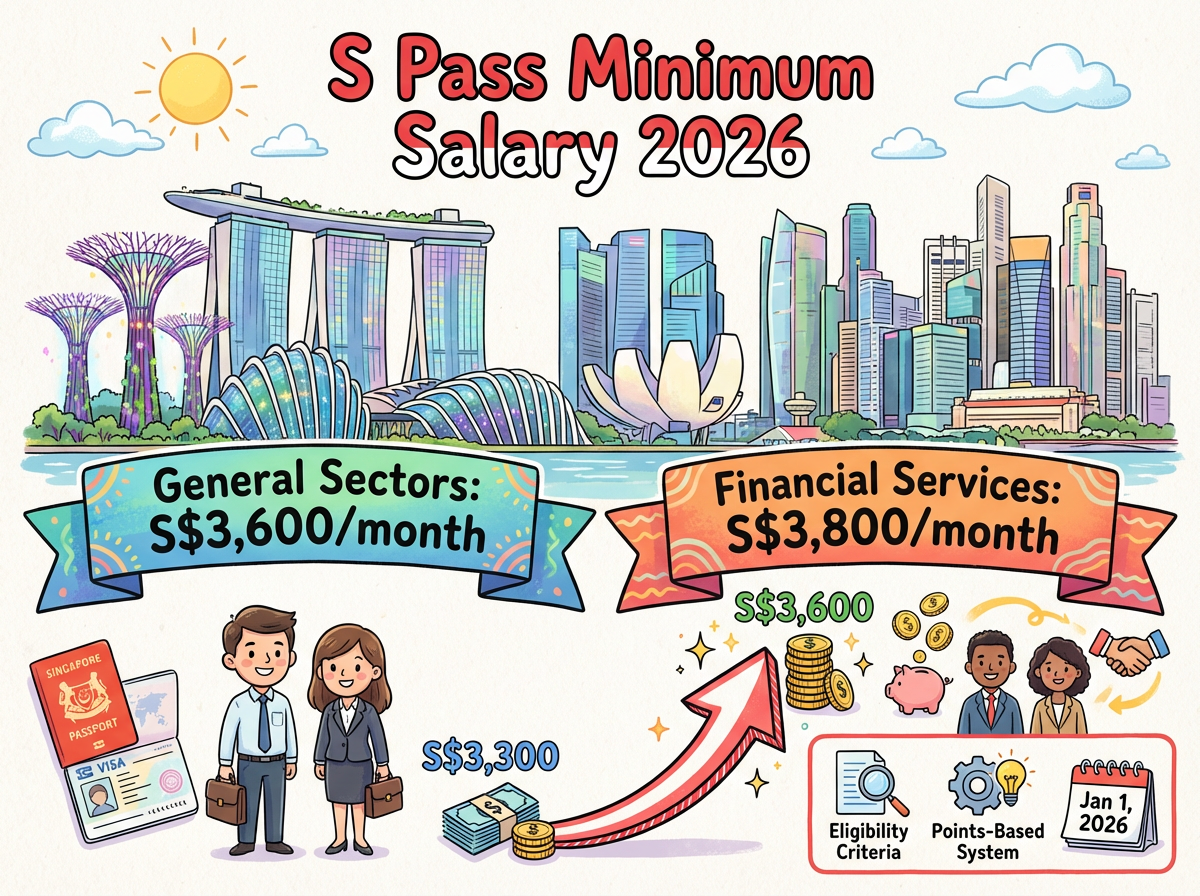
| S Pass | From S$3,300+ | Mid-level skilled workers |
| Work Permit | No fixed minimum | Semi-skilled workers |
Can Foreigners Qualify for an Employment Pass in Singapore?
Yes, foreigners can qualify for an Employment Pass if they meet the minimum salary, qualifications, and COMPASS score requirements. Singapore allows foreign professionals to work legally under the EP scheme, provided the employer meets all regulatory requirements.
If you are planning to work or relocate to Singapore, explore our complete guide to Singapore company incorporation to understand how business setup, employment passes, and compliance work together.
Terra Advisory Services
Your Trusted Corporate Partner
- ACRA-Registered Filing Agent
- 14+ Years of Industry Experience
- 100% Transparent Pricing
- Comprehensive Corporate Solutions
Our Visa Affiliate Partner
Mr. Bill (UEN: 200514682K)
- MOM EA License No. 04C4555
- 20+ Years Immigration Experience
- Exceptionally High Success Rate
- Specialized in Complex EP Applications
Ready to secure your Employment Pass?
Email: accounts@terraadvisoryservices.com | WhatsApp: +65 8961 8383
Understanding Salary Requirements: The Foundation of EP Eligibility
The minimum qualifying salary is the first hurdle every Employment Pass applicant must clear. It is not a flat figure but a tiered system that increases with age and varies by sector. Understanding these tiers is critical because they directly impact your eligibility and your COMPASS score. For context on how employment visas compare across the region, see our guide on Singapore company incorporation versus other Asia countries.
The Age-Based Salary Tiers for 2026
Singapore's Ministry of Manpower (MOM) recognizes that professionals gain experience and command higher salaries as they age. The salary requirements reflect this reality, with younger candidates facing lower minimums and older candidates requiring higher salaries to demonstrate their continued market value.
| Age Group | General Sectors (Minimum Salary) | Financial Services Sector (Minimum Salary) | Rationale |
|---|---|---|---|
| Under 30 years | S$5,000 | S$5,500 | Entry-level professionals with specialized qualifications |
| 30–40 years | S$6,500–S$8,000 | S$7,000–S$8,500 | Mid-career professionals with proven experience |
| 40–50 years | S$8,500–S$10,500 | S$9,000–S$11,500 | Senior professionals with extensive expertise |
| 50+ years | S$10,500+ | S$11,500+ | Highly specialized roles or executive positions |
What "minimum qualifying salary" means: This is the fixed monthly salary that your employer must commit to paying you. It excludes bonuses, stock options, and performance-based incentives. The salary must be guaranteed in your employment contract and paid consistently. MOM verifies this through your employment contract, payslips, and tax declarations.
Why Salary Alone Isn't Enough
Many applicants mistakenly believe that meeting the minimum salary requirement guarantees EP approval. This is incorrect. The salary requirement is merely the baseline; your application is then evaluated through the COMPASS framework, which considers multiple factors beyond compensation. An applicant earning S$15,000 per month might still be rejected if their COMPASS score falls below 40 points, while another earning S$5,500 might be approved if they score well across other criteria.
This is why understanding the full COMPASS system is essential. Your salary contributes to your score, but it is only one component of a more comprehensive evaluation. If you are planning to relocate to Singapore for employment, you should also understand Singapore incorporation requirements for your business or your employer's operations.
Qualifying Credentials: What Education and Experience MOM Accepts
The second foundational requirement for an Employment Pass is acceptable qualifications. MOM evaluates the quality and relevance of your credentials against global standards, considering institutional rankings and professional certifications. For more information on professional requirements in Singapore, review our Singapore accounting requirements 2026 guide, which outlines similar credential standards.
University Degrees and Institutional Rankings
MOM maintains a list of recognized universities worldwide. Degrees from top-tier institutions (typically those ranked in the top 500 globally or top 100 in their respective countries) are more favorably evaluated. However, this does not mean degrees from lower-ranked institutions are automatically rejected. MOM considers the overall context: the institution's reputation in your home country, the relevance of your degree to the role, and your professional experience.
Examples of accepted qualifications:
- Bachelor's degree from a recognized university
- Master's degree or higher
- Professional certifications (e.g., CPA, CFA, PMP, CISSP)
- Specialized diplomas from accredited institutions
Experience as a Substitute for Formal Qualifications
If you do not possess a traditional university degree, you may still qualify for an Employment Pass if you can demonstrate exceptional professional experience and specialized skills. MOM evaluates this on a case-by-case basis, but generally requires:
- A minimum of 10–15 years of relevant professional experience
- Evidence of expertise in a specialized field
- A salary significantly above the minimum threshold
- A role that genuinely requires your specific expertise
For example, a software architect with 20 years of experience in cloud infrastructure might qualify without a formal degree, provided they are earning well above the minimum and their employer can justify why their specialized skills are essential.
Credential Verification and Fraud Prevention
MOM has increasingly stringent verification processes for credentials. If you claim to hold a degree from a particular university, MOM will verify this directly with the institution. Fraudulent or misrepresented credentials are grounds for immediate rejection and potential legal consequences. Ensure all credentials listed in your application are accurate and verifiable.
The COMPASS Framework: Decoding the Points-Based System
The COMPASS (Complementarity Assessment) framework is the most significant change to Singapore's Employment Pass system in recent years. To be approved for an EP in 2026, you must score a minimum of 40 points across six criteria. Learn more about Singapore's broader immigration and visa services to understand how the EP fits into Singapore's overall visa landscape.
How COMPASS Scoring Works
The COMPASS framework evaluates both individual attributes (your qualifications, salary, skills) and firm-level attributes (how your employer treats local workers, their diversity initiatives). Points are awarded across four foundational criteria and two bonus criteria.
| Criterion | Type | Maximum Points | What It Measures |
|---|---|---|---|
| Salary | Foundational (Individual) | 20 | How your salary compares to local PMET salaries in your sector |
| Qualifications | Foundational (Individual) | 15 | Quality and relevance of your educational credentials and professional certifications |
| Experience | Foundational (Individual) | 10 | Years of relevant professional experience in your field |
| Skills & Specialization | Foundational (Individual) | 5 | Specialized skills, certifications, or expertise in shortage occupations |
| Local Salary Benchmarking | Bonus (Firm-level) | 10 | Employer's commitment to paying local employees competitively |
| Diversity & Inclusion | Bonus (Firm-level) | 5 | Employer's diversity initiatives and proportion of local management |
Total possible points: 65 | Minimum required: 40
Breaking Down Each COMPASS Criterion
1. Salary (0–20 points): Your salary is benchmarked against the median salary for your role and sector in Singapore. If you earn at the 50th percentile for your sector, you receive approximately 10 points. Earning at the 75th percentile yields around 15 points, and the 90th percentile or above yields 20 points. This criterion directly rewards professionals who command higher market value.
2. Qualifications (0–15 points): Degrees from top-tier universities (QS top 500 or equivalent) receive maximum points. Degrees from recognized but lower-ranked institutions receive proportionally fewer points. Professional certifications (CPA, CFA, etc.) can boost this score. A Master's degree typically yields more points than a Bachelor's degree.
3. Experience (0–10 points): Generally, 5+ years of relevant experience yields 5 points, 10+ years yields 8 points, and 15+ years yields 10 points. The experience must be directly relevant to the role you are applying for.
4. Skills & Specialization (0–5 points): If your role falls within Singapore's Shortage Occupation List (SOL)—such as specialized engineers, data scientists, or senior financial professionals—you receive bonus points. Additionally, rare or highly sought-after certifications (e.g., AWS Solutions Architect, Kubernetes Administrator) can earn you points in this category.
5. Local Salary Benchmarking (0–10 bonus points): This criterion evaluates your employer's commitment to fair compensation. If the employer pays local employees in similar roles at least 80% of what they pay foreign employees, the employer receives bonus points that apply to your application. This incentivizes companies to maintain equitable pay structures.
6. Diversity & Inclusion (0–5 bonus points): Employers with strong diversity initiatives and a significant proportion of local management staff receive bonus points. This criterion encourages companies to develop local talent and maintain diverse leadership.
Real-World COMPASS Scoring Examples
Example 1: Mid-Career Professional (Age 35)
- Salary: S$10,000/month (75th percentile for role) = 15 points
- Qualifications: Master's degree from top-100 university = 12 points
- Experience: 12 years in field = 8 points
- Skills: CFA charterholder (bonus) = 5 points
- Employer local pay benchmark: Yes = 5 bonus points
- Total: 45 points (APPROVED)
Example 2: Senior Executive (Age 48)
- Salary: S$18,000/month (90th percentile) = 20 points
- Qualifications: MBA from top-50 university = 15 points
- Experience: 22 years in finance = 10 points
- Skills: Specialized in M&A (shortage occupation) = 5 points
- Employer diversity initiatives: Strong = 5 bonus points
- Total: 55 points (STRONG APPROVAL)
The Application Process: Step-by-Step Timeline and Requirements
Understanding the Employment Pass application process is crucial for managing expectations. The process typically takes 4–8 weeks from submission to approval, depending on the completeness of your application and the complexity of your case.
Step 1: Pre-Application Preparation (Week 1–2)
Before your employer submits your application, you and your employer must gather and prepare all required documents:
- Personal documents: Passport, birth certificate, educational certificates (original and certified copies)
- Employment contract: Clearly stating your job title, responsibilities, salary, and start date
- Employer documents: Company registration certificate, financial statements, organizational chart
- Medical examination: Completed by an approved clinic (chest X-ray and blood tests)
- Police clearance: From your home country or countries where you've lived for more than 6 months
This preparation phase is critical. Missing or incomplete documents are the leading cause of application delays. Work with your employer's HR department or an employment agent (like our affiliate Mr. Bill) to ensure everything is in order.
Step 2: Application Submission (Week 2–3)
Your employer submits your application through the MOM online portal. The application includes your personal information, employment details, COMPASS scoring, and all supporting documents. Your employer receives a submission reference number and can track the application status online.
Step 3: Initial Review and Requests for Additional Information (Week 3–5)
MOM reviews your application and may request additional information or clarification. Common requests include:
- Verification of educational credentials directly from your university
- Additional documentation on your work experience
- Clarification on your job scope and how it benefits Singapore
- Additional financial documentation from your employer
If MOM requests additional information, your employer typically has 5–7 days to respond. Delays in responding can extend the overall timeline significantly.
Step 4: Final Approval or Rejection (Week 6–8)
Once MOM completes its review, you receive a decision. If approved, you receive an In-Principle Approval (IPA) letter, which your employer must acknowledge. You then proceed to collect your Employment Pass from the ICA (Immigration & Checkpoints Authority). If rejected, MOM provides reasons for the rejection, and you can appeal or reapply after addressing the issues.
Timeline Comparison: EP vs. Other Work Visas
| Visa Type | Typical Processing Time | Salary Requirement | Best For |
|---|---|---|---|
| S Pass | 4–6 weeks | S$3,300–S$4,500 | Mid-level skilled professionals |
| Employment Pass (EP) | 4–8 weeks | S$5,000–S$11,500+ | Senior professionals and managers |
| Dependent Pass | 2–4 weeks | N/A (dependent on EP holder) | Family members of EP/S Pass holders |
| Work Permit | 1–3 weeks | N/A (no fixed minimum) | Semi-skilled and unskilled workers |
Common Rejection Reasons and How to Avoid Them
Understanding why applications are rejected helps you avoid costly mistakes. The most frequent reasons include COMPASS score below 40, fraudulent credentials, employer non‑compliance, incomplete documentation, and job scope misalignment.
1. COMPASS Score Below 40 Points
This is the most frequent reason for rejection. If your combined score across all criteria falls below 40, your application is automatically rejected. To avoid this, ensure your salary, qualifications, and experience are accurately documented and competitive for your sector.
2. Fraudulent or Misrepresented Credentials
If MOM discovers that your educational credentials are false or misrepresented, your application is rejected and you may face legal consequences. Always provide accurate, verifiable information.
3. Employer Non-Compliance
If your employer fails to meet MOM's requirements (e.g., not paying local employees fairly, inadequate company financial records), your application may be rejected. Ensure your employer is compliant with all MOM guidelines.
4. Incomplete or Missing Documentation
Missing medical reports, police clearance, or educational certificates can cause delays or rejection. Submit all required documents upfront to avoid this issue.
5. Job Scope Not Aligned with Your Qualifications
If your job title and responsibilities don't align with your qualifications and experience, MOM may question the legitimacy of the role. Ensure your employment contract clearly describes duties that match your expertise.
6. Fair Consideration Framework Concerns
MOM evaluates whether hiring a foreign professional is justified given the availability of local talent. If your role can reasonably be filled by a qualified local candidate, your application may be rejected. Your employer should demonstrate why your specific expertise is necessary.
Family Considerations: Bringing Your Spouse and Children
If you are approved for an Employment Pass, your immediate family members can apply for Dependent Passes, which allow them to live and study in Singapore.
Dependent Pass Eligibility
- Spouse: Your legally married spouse can apply for a Dependent Pass
- Children: Unmarried children under age 21 (or up to 22 if in full-time education) can apply
- Dependents: In some cases, elderly parents or other dependents may qualify, but this is evaluated case-by-case
Processing and Costs
Dependent Pass applications are typically processed faster than EP applications (2–4 weeks) and are usually approved if your EP is approved. There is no separate salary requirement for dependents, but you must demonstrate that you can financially support them. For more information on family relocation and related services, see our guide on Singapore permanent residence options.
Working with Employment Agents: Finding the Right Partner
Many applicants choose to work with licensed employment agents to navigate the EP application process. An experienced agent can significantly increase your approval chances and reduce stress.
What to Look for in an Employment Agent
- MOM EA License: Verify they hold a valid Employment Agent license from MOM
- Track Record: Ask for their approval rate and client testimonials
- Transparency: They should clearly explain fees, timelines, and what they can and cannot guarantee
- Experience: Prefer agents with 10+ years of experience and specialization in EP applications
- Communication: They should be responsive and keep you updated throughout the process
Our affiliate partner, Mr. Bill (UEN: 200514682K, EA License No. 04C4555), has over 20 years of experience and an exceptionally high success rate in complex EP applications. He works closely with Terra Advisory Services to provide comprehensive support for both immigration and corporate needs.
Renewal and Long-Term Planning: What Happens After Approval
Your Employment Pass is typically valid for 1–2 years, depending on your employment contract. Before it expires, you and your employer must apply for renewal.
Renewal Process
- Timing: Apply 1–2 months before your current EP expires
- Requirements: Similar to the initial application, with updated employment contract and financial documents
- Processing time: Usually 2–4 weeks for renewals (faster than initial applications)
- Cost: Renewal fees are similar to initial application fees
Long-Term Residency Options
If you plan to stay in Singapore long-term, you may eventually be eligible for Singapore Permanent Residence (PR). PR eligibility typically requires 2+ years of continuous EP employment and strong ties to Singapore. For professionals considering long-term relocation and business opportunities, explore our comprehensive guide on best Singapore business structures for startups 2026.
Frequently Asked Questions
What is the minimum salary for an Employment Pass in 2026?
The minimum EP salary starts from S$5,000 and increases with age and sector. For applicants under 30, it is S$5,000 (general) or S$5,500 (financial services).
How many points do I need to pass the COMPASS framework?
You need at least 40 points out of a possible 65. Points are awarded based on salary, qualifications, experience, skills, and your employer's local hiring practices.
Can I apply for an Employment Pass without a degree?
Yes, but you must demonstrate exceptional professional experience. Typically, 10–15 years of relevant experience, a salary well above the minimum, and a specialized skill set can compensate for the lack of a formal degree.
How long does the EP application process take?
Most applications are processed within 4–8 weeks. Complex cases or those requiring additional information may take longer.
Can my spouse work in Singapore on a Dependent Pass?
No, a Dependent Pass does not grant work rights. Your spouse would need to obtain their own Employment Pass, S Pass, or a Letter of Consent (LOC) if they are a director of a company that meets specific criteria.
What happens if my EP application is rejected?
You can appeal or reapply after addressing the reasons for rejection. MOM provides a reason for rejection, and you should work with your employer or an agent to correct the issues before reapplying.
What is the difference between an Employment Pass and an EntrePass?
An Employment Pass is for employees hired by a Singapore company, while an EntrePass is for entrepreneurs starting an innovative business. The EntrePass has no minimum salary but requires a business plan and proof of innovation.
Conclusion: Your Path to Employment Pass Success
Securing a Singapore Employment Pass in 2026 requires careful preparation, accurate documentation, and a clear understanding of the COMPASS framework. By meeting the salary requirements, presenting strong qualifications, and scoring well across all COMPASS criteria, you can significantly increase your approval chances.
Key takeaways:
- Ensure your salary meets the age-based minimum for your sector
- Gather and verify all educational credentials before applying
- Understand how COMPASS scoring works and aim for a score well above 40 points
- Prepare complete documentation to avoid delays
- Work with a licensed employment agent if you need guidance
- Plan for family relocation if applicable
- Consider long-term residency options like PR or Singapore incorporation if you plan to start a business
Ready to begin your Employment Pass journey? Contact Terra Advisory Services and our affiliate Mr. Bill today for a free consultation. We'll guide you through every step of the process and help you achieve your Singapore career goals.
📧 Email: accounts@terraadvisoryservices.com | 💬 WhatsApp: +65 8961 8383
Important Notice
The information provided on this page is for general informational purposes only and should not be relied upon as legal, immigration, financial, or professional advice. While Terra Advisory Services Pte. Ltd. endeavours to keep the content accurate and current, Singapore government policies, regulations, fees, and procedures may change at any time without prior notice.
For the most up-to-date and authoritative information, please refer directly to official government sources, including the Immigration and Checkpoints Authority (ICA), Ministry of Manpower (MOM), and other relevant agencies.
Any reliance you place on the information on this website is strictly at your own risk. Terra Advisory Services Pte. Ltd. shall not be held liable for any loss, damage, or inconvenience arising from the use of this content. For advice tailored to your specific circumstances, please contact a Terra Advisory Services professional.