

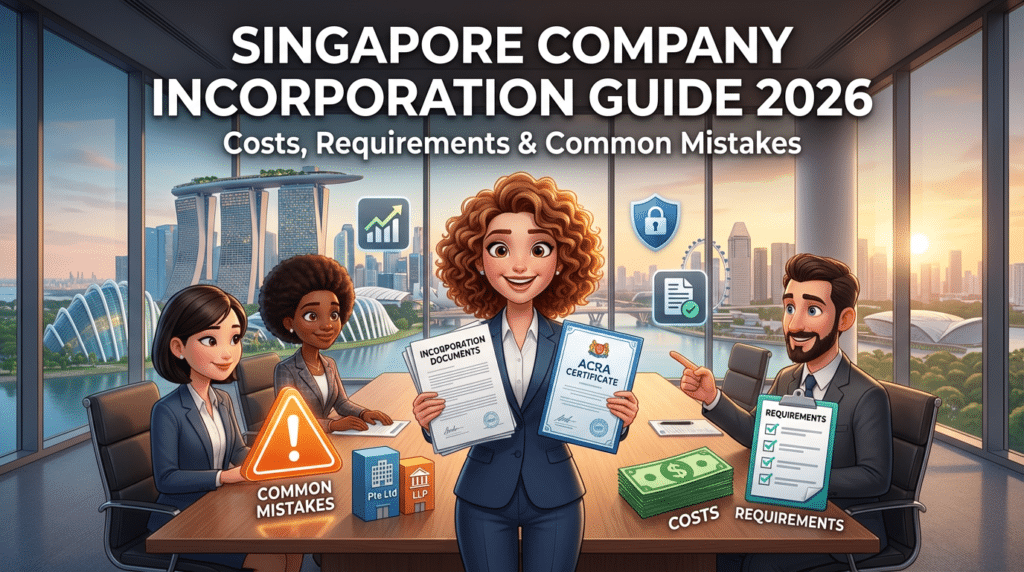
1. Why Incorporate a Company in Singapore in 2026
Singapore continues to rank among the world’s most business-friendly jurisdictions. In 2026, it remains a preferred destination for entrepreneurs, startups, and multinational companies looking to establish a presence in Asia.
Key reasons businesses choose Singapore include:
A transparent and stable legal system
Competitive corporate tax rates
Strong international reputation and investor confidence
Extensive network of double taxation agreements
Efficient regulatory and incorporation processes
For foreign founders and growing businesses, company incorporation in Singapore provides credibility, access to regional markets, and long-term regulatory certainty.
Table of Contents
2. Who This Guide Is For
This guide is designed for:
Foreign entrepreneurs planning to set up a Singapore company
Business owners expanding operations into Singapore
Startups seeking a compliant incorporation structure
SMEs and holding companies managing regional operations
Investors evaluating Singapore as a business base in 2026
If you are deciding how to register a company in Singapore, understanding the requirements and avoiding common pitfalls will save time, cost, and compliance risk.
3. Types of Business Entities in Singapore
Before incorporation, it is important to choose the right business structure.
Private Limited Company (Pte. Ltd.)
The most common structure for both local and foreign businesses. It offers limited liability, scalability, and tax efficiency.
Branch Office
An extension of a foreign company. The parent company remains fully liable for debts and obligations.
Subsidiary Company
A locally incorporated company owned by a foreign parent. Often preferred for risk management and operational independence.
Representative Office
Used for market research only. It cannot engage in revenue-generating activities.
Most businesses choose a Private Limited Company, which aligns well with Singapore’s regulatory framework and investor expectations.
If you are planning company incorporation in Singapore in 2026, it is important to choose the right structure and prepare for post-incorporation compliance from the outset. Our Singapore incorporation services support businesses from initial setup through ongoing regulatory compliance.
4. Key Requirements for Company Incorporation
To incorporate a company in Singapore, you must meet the following statutory requirements:
Company Director
At least one director must be ordinarily resident in Singapore
The director must be at least 18 years old and not disqualified
Shareholders
Minimum of one shareholder (individual or corporate)
100% foreign ownership is permitted
Company Secretary
Must be appointed within six months of incorporation
Responsible for statutory filings and compliance
Registered Address
A local Singapore address is required
Paid-Up Capital
Minimum paid-up capital can be as low as SGD 1
These requirements apply regardless of business size and must be maintained throughout the company’s lifecycle.
5. Step-by-Step Company Incorporation Process
Step 1: Company Name Reservation
The proposed company name is submitted for approval. Names that are misleading, identical, or regulated may be rejected.
Step 2: Document Preparation
Key documents include:
Identification documents of directors and shareholders
Company constitution
Registered address details
Step 3: Filing with ACRA
Once documents are ready, the application is submitted to the Accounting and Corporate Regulatory Authority (ACRA).
Step 4: Company Registration
Upon approval, ACRA issues a Certificate of Incorporation and Unique Entity Number (UEN).
Step 5: Post-Incorporation Setup
This includes opening a corporate bank account, appointing officers, and preparing for compliance.
Businesses often benefit from professional support during this process to ensure regulatory accuracy from day one.
👉 See also: Company Incorporation Singapore
6. Cost Breakdown for Company Incorporation in Singapore
While Singapore is cost-efficient compared to many jurisdictions, incorporation involves both government and professional fees.
Typical Cost Components
ACRA filing fees
Company secretary services
Registered address services
Nominee director (if required)
Corporate bank account setup
Accounting and tax setup
Costs vary depending on structure, ownership, and compliance needs. Importantly, businesses should budget not only for incorporation but also for ongoing statutory obligations.
Reduce Incorporation and Compliance Risk
Many foreign businesses encounter delays due to incomplete documentation, missed filings, or misaligned tax and immigration planning. Terra Advisory Services provides integrated support covering corporate secretarial , tax compliance , and regulatory advisory.
7. Post-Incorporation Compliance Obligations
Incorporation is only the first step. Companies must remain compliant to avoid penalties.
Annual Filings
Annual Return with ACRA
Financial statements preparation
Tax Compliance
Corporate income tax filings with IRAS
GST registration (if applicable)
Corporate Governance
Maintaining statutory registers
Director and shareholder resolutions
Failure to meet these requirements can result in fines, late penalties, or enforcement actions.
👉 Related reading: post-incorporation compliance and annual filings
8. Common Mistakes Foreign Businesses Make
Despite Singapore’s efficiency, many foreign businesses encounter avoidable issues:
Choosing the Wrong Business Structure
Selecting an entity that does not align with business objectives can create tax or liability issues.
Ignoring Ongoing Compliance
Some founders focus only on incorporation and overlook ongoing obligations such as filings and tax reporting.
Inadequate Documentation
Incomplete or inconsistent records may cause regulatory delays or audits.
Misalignment with Immigration Planning
Foreign directors and employees often require work passes. Incorporation should be aligned with Singapore immigration and visa services to avoid operational disruption.
9. How Professional Support Simplifies Incorporation
Professional advisory services help businesses:
Select the right entity structure
Ensure accurate and timely filings
Coordinate accounting, tax, and immigration requirements
Maintain compliance as regulations evolve
An integrated approach reduces administrative burden and allows business owners to focus on growth rather than paperwork.
10. Final Thoughts: Setting Up for Long-Term Success
Company incorporation in Singapore remains highly attractive in 2026—but success depends on proper planning and compliance. Understanding the process, costs, and common mistakes helps businesses establish a strong foundation.
For foreign entrepreneurs and expanding companies, early professional guidance ensures regulatory alignment, operational efficiency, and long-term confidence in one of Asia’s most trusted business hubs.
Ready to Incorporate a Company in Singapore?
Terra Advisory Services supports local and foreign businesses with company incorporation, accounting, tax, and immigration solutions. Our integrated approach ensures full compliance from day one.
Speak with an incorporation advisor