
Table of Contents
- S Pass Minimum Salary Requirements 2026
- Age-Progressive Salary Table
- Employer Verification Process
- Consequences of Underpayment
- Common Rejection Reasons
- S Pass vs Employment Pass Comparison
- How to Calculate Eligibility
- Professional Services
- Frequently Asked Questions
- Bringing Family to Singapore
- Switching Employers
- Appeal Process Guide
- Renewal Requirements 2026
- Industry Salary Benchmarks
As Singapore continues to tighten its foreign workforce policies in 2026, the Singapore S Pass minimum salary has become a critical focal point for employers and mid-skilled professionals. The Ministry of Manpower (MOM) has implemented a series of strategic increases designed to ensure that foreign workers complement, rather than compete with, Singapore's local workforce. For detailed insights on Singapore's business landscape, refer to our State of Singapore Company Incorporation 2026 Report.
The landscape has shifted dramatically since the COVID-19 pandemic, with Singapore adopting a more selective approach to foreign talent acquisition. The Singapore company incorporation boom of 2025, which saw 58,077 new companies registered (Singapore Department of Statistics, 2026), has intensified competition for skilled workers while simultaneously raising compliance expectations for employers.
Key Statistic: 58,077 companies were incorporated in Singapore in 2025, according to ACRA annual report data.
With significant salary hikes scheduled for July 2026, understanding the age-progressive wage ladder, quota calculations, and documentation requirements is no longer optional—it is essential for compliance. Employers who fail to adapt to these changes risk not only application rejections but also substantial financial penalties and potential debarment from hiring foreign workers.
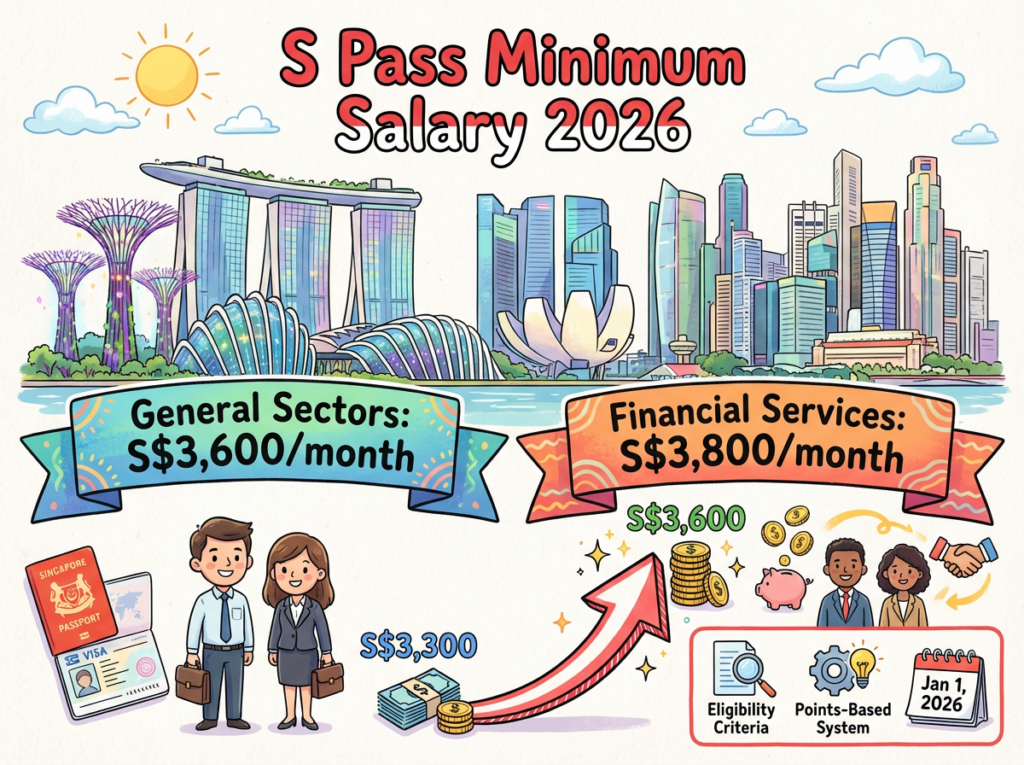
Effective July 1, 2026, the S Pass minimum qualifying salary will increase from S$3,300 to S$3,600 for new applications. Financial services sector requirements will rise from S$3,800 to S$4,000 (MOM S Pass Qualifying Criteria, 2026). Employers must plan their budgets now to avoid rejected applications or renewal issues.
1. What is the S Pass Minimum Salary Requirement? (2026 Update)
The Ministry of Manpower (MOM) sets the S Pass minimum salary to ensure foreign professionals are of comparable quality to local Associate Professionals and Technicians (APTs) (MOM S Pass Overview, 2026). Unlike a flat minimum wage, this threshold is dynamically benchmarked against the top one-third of local APT salaries, creating a moving target that rises with Singapore's economic growth.
The policy rationale behind this approach is multifaceted. First, it ensures wage parity between foreign and local workers in similar roles, preventing salary depression in the mid-skilled job market. Second, it creates a natural filter that prioritizes higher-value foreign workers who can contribute meaningfully to Singapore's economy. Third, it provides a revenue mechanism through the S Pass levy system, which funds local workforce development programs.
Current vs. Upcoming Requirements
The 2026 salary structure reflects MOM's commitment to gradual, predictable increases that allow employers time to adjust their compensation frameworks. For the first half of 2026, the baseline remains at S$3,300, providing a transition period for existing pass holders and applications in the pipeline.
Key Update: The S Pass levy has been harmonized to S$650 per month (Tier 1) across all sectors since September 2025 (MOM Levy and Quota Guide, 2026).
- Current (Early 2026): S$3,300 (General Sectors) | S$3,800 (Financial Services)
- From July 1, 2026: S$3,600 (General Sectors) | S$4,000 (Financial Services)
- Levy Rate 2026: The S Pass levy has been harmonized to S$650 (Tier 1) across all sectors since September 2025, simplifying administrative burden for employers.
The financial services sector maintains higher thresholds due to the specialized nature of roles and Singapore's position as a regional financial hub. This premium reflects the higher local salary benchmarks in banking, insurance, and asset management sectors.
2. S Pass Salary Requirements by Age (2026-2027)
One of the most common misconceptions among employers is that paying the minimum S$3,600 is sufficient for all candidates. This is fundamentally incorrect. The S Pass qualifying salary increases progressively with age, reflecting the expectation that older, more experienced candidates should command higher compensation packages.
This age-progressive structure serves multiple purposes: it prevents the exploitation of experienced foreign workers at below-market rates, ensures that senior foreign professionals contribute meaningfully to Singapore's economy, and maintains competitive salary levels that protect local workers in similar age groups.
Key Insight: A 23-year-old software developer may qualify at S$3,600, but a 35-year-old with equivalent qualifications will require approximately S$5,000 to meet eligibility criteria. A 40-year-old candidate typically needs S$5,200-5,500 to qualify.
| Age Group | Current (Jan - Jun 2026) | From July 1, 2026 | From Jan 1, 2027 (Projected) |
|---|---|---|---|
| All Sectors (Except Financial Services) | |||
| Age 23 (Entry Level) | S$3,300 | S$3,600 | S$3,600+ |
| Age 25 | ~S$3,600 | ~S$3,900 | ~S$4,100 |
| Age 27 | ~S$3,900 | ~S$4,200 | ~S$4,400 |
| Age 30 | ~S$4,300 | ~S$4,600 | ~S$4,800 |
| Age 35 (Mid-Career) | ~S$4,600 | ~S$5,000 | ~S$5,200 |
| Age 40 | ~S$4,900 | ~S$5,300 | ~S$5,500 |
| Age 45+ (Senior) | ~S$5,200 | ~S$5,600 | ~S$5,800 |
| Financial Services Sector | |||
| Age 23 (Entry Level) | S$3,800 | S$4,000 | S$4,200 |
| Age 30 | ~S$4,800 | ~S$5,100 | ~S$5,300 |
| Age 35 (Mid-Career) | ~S$5,200 | ~S$5,500 | ~S$5,800 |
| Age 40+ | ~S$5,600 | ~S$6,000 | ~S$6,300 |
Note: Salary figures for specific age groups are estimates based on MOM's progressive wage curve and historical patterns. For precise requirements, always use the MOM Self-Assessment Tool (SAT) with the candidate's exact age and sector details.
3. How Employers Verify S Pass Salary Compliance
MOM employs a multi-layered verification system to ensure that declared salaries match actual compensation received by S Pass holders (MOM Salary Guidelines, 2026). This rigorous approach has been strengthened significantly since 2024, with digital monitoring systems and cross-referencing capabilities that make salary fraud increasingly difficult to conceal.
The verification process begins during the application stage but continues throughout the employment period. MOM can conduct spot checks, require additional documentation, and cross-reference salary declarations with bank transfer records, CPF contributions, and IRAS tax filings.
The Definition of "Fixed Monthly Salary"
To meet the S Pass minimum salary requirement, compensation must qualify as "Fixed Monthly Salary" under MOM's strict definition. This distinction is crucial because it prevents employers from inflating apparent compensation through variable or one-time payments.
- Basic Monthly Salary: The core monthly wage stated in the employment contract
- Fixed Monthly Allowances: Regular allowances paid every month regardless of performance, attendance, or business results (e.g., fixed transport allowance of S$200/month, fixed meal allowance of S$300/month)
- Guaranteed Monthly Supplements: Contractually guaranteed additions to base salary that are paid monthly without conditions
- Variable Bonuses or Commissions: Performance-based payments, annual bonuses, sales commissions
- Overtime Pay: Additional compensation for hours worked beyond regular schedule
- Reimbursements: Expense reimbursements, travel allowances, phone bill reimbursements
- Employer CPF Contributions: Mandatory provident fund contributions (applicable only to citizens/PRs)
- In-kind Benefits: Housing provided by employer, company car usage, meals provided at workplace
- One-time Payments: Signing bonuses, retention payments, project completion bonuses
Documentation and Record-Keeping Requirements
Employers must maintain comprehensive records that demonstrate salary compliance. For guidance on maintaining proper corporate records, see our Singapore Corporate Compliance 2026 Guide. MOM can request these documents at any time during the employment period, and failure to provide adequate documentation can result in pass cancellation and penalties.
Required Documentation includes:
- Signed employment contract clearly stating salary breakdown
- Monthly payslips showing consistent salary payments
- Bank statements proving direct salary transfers to employee accounts
- Board resolutions or salary revision letters for any salary changes
- Audit trails for payroll processing systems
Cash salary payments are heavily scrutinized and generally discouraged for S Pass holders. MOM prefers electronic transfers that create clear audit trails and prevent under-the-table arrangements that could undermine the salary verification system.
4. Consequences of Paying Below S Pass Minimum Salary
Underpaying an S Pass holder or making false salary declarations to circumvent quota requirements constitutes a serious offense under the Employment of Foreign Manpower Act (EFMA) . The penalties have been substantially increased in recent years as part of Singapore's broader effort to maintain integrity in its foreign worker management system.
Legal Penalties and Enforcement Actions
- Financial Penalties: Fines up to S$20,000 per offense, with penalties scaling based on the severity and duration of violations
- Criminal Charges: Imprisonment of up to 2 years for willful misrepresentation or systematic underpayment
- Administrative Sanctions: Immediate revocation of existing work passes for affected employees
- Debarment from Foreign Worker Programs: Companies may be permanently or temporarily banned from hiring any category of foreign workers (Work Permits, S Pass, Employment Pass)
- Reputational Damage: MOM publishes lists of violating companies, creating long-term business reputation risks
Real-World Enforcement Examples
MOM's Enhanced Enforcement Capabilities: Since 2024, MOM has significantly upgraded its monitoring and enforcement systems. The ministry regularly conducts both scheduled and surprise audits, with a particular focus on companies that show unusual patterns in their salary declarations or quota utilization (MOM Press Releases, 2026).
Recent enforcement actions have targeted sophisticated "clawback" schemes where employers pay the required salary through official bank transfers but force employees to return portions in cash. These arrangements are now easily detected through cross-referencing bank records, employee interviews, and digital monitoring systems.
MOM Enforcement Actions: Recent enforcement actions have resulted in substantial fines, imprisonment, and company debarments. Companies found violating salary requirements face both criminal and administrative penalties, with violations published publicly by MOM.
5. Common Reasons for S Pass Salary-Related Rejections
Even legitimate employers with genuine business needs face S Pass application rejections. Understanding the most common pitfalls can significantly improve approval chances and reduce costly delays in hiring processes.
Processing Time: Average application processing takes 10-15 business days .
Top Salary-Related Rejection Scenarios
-
Age-Salary Mismatch (Most Common):
Offering the baseline minimum to candidates significantly older than 23. Example: A 32-year-old IT support specialist offered S$3,600. While this meets the absolute minimum threshold, it fails the age-progressive requirement that typically demands S$4,500+ for this age group.
-
Quota Capacity Exceeded:
S Pass holders are subject to strict quota limits: 10% of total workforce for the Services sector and 15% for Manufacturing/Construction/Marine sectors. Many employers miscalculate their available quota or fail to account for recent changes in local employee counts.
-
Weak Business Profile vs. High Salary Claims:
Companies with low paid-up capital, declining revenue, or minimal business activity declaring high salaries raise red flags. For guidance on proper business structuring, refer to our Singapore Company Incorporation Guide 2026. MOM cross-references salary claims with company financial health indicators.
-
Fair Consideration Framework Violations:
Failure to demonstrate genuine efforts to recruit local candidates before resorting to foreign hires. This includes inadequate job advertising periods or discriminatory job requirements that effectively exclude local candidates.
-
Inconsistent Salary Documentation:
Discrepancies between employment contract salary, payroll systems, and bank transfer amounts. Even small inconsistencies can trigger detailed reviews and potential rejections.
Use MOM's Self-Assessment Tool multiple times with slightly different salary figures to identify the exact threshold for your candidate. This prevents the costly rejection-reapplication cycle that can delay hiring by 4-6 weeks.
If your application has been rejected, our comprehensive S Pass guide provides detailed appeal strategies and professional assistance options.
6. S Pass vs Employment Pass Salary Comparison
Choosing between an S Pass and Employment Pass (EP) application often comes down to salary thresholds, candidate qualifications, and long-term career objectives. Both pass categories have experienced significant requirement increases, but they serve different segments of Singapore's foreign talent ecosystem.
The EP has evolved into Singapore's premium work pass category, targeting highly skilled professionals and managers with the introduction of the COMPASS framework. Meanwhile, the S Pass continues to serve the critical mid-skilled segment, though with increasingly stringent salary requirements that push it closer to EP territory.
| Feature | S Pass (Mid-Skilled) | Employment Pass (Professionals) | Work Permit (Basic-Skilled) |
|---|---|---|---|
| Minimum Salary (2026) | S$3,300 (S$3,600 from July) | S$5,600 (S$6,000 projected 2027) | No minimum (sector rates apply) |
| Age-Progressive Requirements | Yes (increases with age) | Yes (COMPASS scoring) | No |
| Quota Limitations | Yes (10% Services, 15% Others) | No quota limit | Yes (sector-specific ratios) |
| Monthly Levy | S$650 (harmonized rate) | No levy | S$300-950 (tier-dependent) |
| Assessment Framework | Salary + Age + Quota | COMPASS (40 points minimum) | Basic eligibility check |
| Dependant Pass Eligibility | S$6,000 salary threshold | S$6,000 salary threshold | Not eligible |
| Pass Duration | Up to 2 years (renewable) | Up to 2 years (renewable) | Up to 2 years (renewable) |
| Path to Permanent Residence | Possible (competitive) | More favorable consideration | Generally not eligible |
Strategic Considerations for Employers
When to Choose S Pass:
- Candidate salary falls in the S$3,600-5,500 range
- Mid-skilled technical roles (technicians, supervisors, specialized operators)
- Company has available S Pass quota
- Candidate may not meet COMPASS scoring requirements for EP
When to Choose Employment Pass:
- Salary exceeds S$5,600 and candidate can achieve 40+ COMPASS points
- Professional or managerial roles requiring degree-level qualifications
- No quota restrictions needed
- Long-term retention and potential PR pathway important
For detailed EP requirements and COMPASS scoring guidance, refer to our comprehensive Employment Pass guide. For entrepreneurs considering work passes, also see our Singapore Work Visas Guide for Entrepreneurs.
7. How to Calculate If Your Salary Meets S Pass Requirements
Accurate salary calculation is critical for S Pass application success. Many employers underestimate the complexity of this process, leading to rejections that could have been avoided with proper preparation and calculation methodology.
Step-by-Step Calculation Process
-
Identify the Correct Sector Classification:
Determine if your company operates in the Financial Services sector, which has higher salary thresholds. This classification is based on your company's primary SSIC (Singapore Standard Industrial Classification) code, not the specific role being filled. For assistance with company registration and classification, see our Singapore Incorporation services.
Financial Services Examples: Banks, insurance companies, asset management firms, financial advisory companies, securities dealers
General Sectors Examples: IT services, manufacturing, retail, F&B, logistics, healthcare
-
Apply Age-Progressive Multiplier:
Calculate the age-specific requirement using the candidate's exact age at time of application. As a general rule, add approximately S$150-200 for each year above age 23, but this varies by sector and current wage inflation.
Example Calculation:
28-year-old Marketing Executive (General Sector):
Base requirement (July 2026): S$3,600
Age adjustment: (28-23) x S$180 = S$900
Estimated minimum: S$4,500
-
Verify Fixed Salary Components:
Calculate only qualifying "Fixed Monthly Salary" components. Remove all variable elements, bonuses, reimbursements, and in-kind benefits from your calculation.
-
Use Official MOM Self-Assessment Tool:
The MOM Self-Assessment Tool (SAT) provides the definitive assessment of eligibility. Input the candidate's exact details including age, nationality, education, experience, and proposed salary.
-
Account for Quota Availability:
Even if salary requirements are met, applications will fail if the employer lacks available S Pass quota. Verify your quota calculation before proceeding.
The Self-Assessment Tool provides a preliminary assessment only. Final approval depends on comprehensive document review, quota verification, and MOM's overall assessment of the application. A "Yes" result from SAT does not guarantee approval.
Common Calculation Errors to Avoid
- Including CPF contributions in salary calculation: Only the employee's cash salary counts, not employer CPF contributions
- Using gross salary including reimbursements: Only fixed monthly salary components qualify
- Assuming flat minimum applies to all ages: Age-progressive requirements often catch employers off-guard
- Sector misclassification: Incorrectly applying general sector rates to financial services companies
8. Professional Services for S Pass Applications
Navigating the 2026 salary hikes, quota calculations, age-progressive requirements, and complex documentation can be overwhelming for employers, particularly those new to Singapore's foreign worker regulatory framework. Professional immigration and corporate services can significantly improve approval rates while reducing administrative burden.
When Professional Assistance Becomes Essential
High-Risk Application Scenarios:
- Company approaching or at S Pass quota limits
- Candidate's salary borderline for age requirements
- Previous S Pass or EP application rejections
- Complex salary structures involving multiple allowances
- First-time foreign worker hire for the company
- Urgent hiring needs with tight deadlines
- Companies undergoing restructuring or ownership changes. For guidance on corporate governance, see our Nominee Director Services in Singapore.
Professional Service Value Proposition
Pre-Application Services:
- Comprehensive eligibility assessment using latest MOM criteria
- Quota calculation and optimization strategies
- Salary benchmarking and age-progressive requirement analysis
- Document preparation and compliance review. For ongoing compliance needs, explore our Corporate Secretarial Services.
- Risk assessment and mitigation planning
Application Management:
- BizFile+ portal management and submission
- Real-time application tracking and status updates
- MOM query response and additional document coordination
- Expedited processing where possible
Post-Application Support:
- Pass collection and activation assistance
- Renewal reminder systems and advance planning
- Compliance monitoring and reporting
- Appeal services if applications are rejected
Typical Professional Service Costs (2026):
- Basic S Pass Application: S$800 - S$1,200
- Complex/High-Risk Applications: S$1,200 - S$2,000
- Appeal Services: S$1,500 - S$2,500
- Annual Compliance Management: S$1,200 - S$2,400
Expert S Pass Application Support
Terra Advisory Services specializes in Singapore corporate immigration and compliance. Our team ensures your salary structure meets 2026 MOM standards while maximizing approval chances through strategic application preparation. For comprehensive immigration solutions, visit our Singapore Immigration and Visa Services page.
Key Benefits:
- 95%+ approval rate for properly structured applications
- Comprehensive quota and salary optimization
- Direct MOM liaison and query management
- Ongoing compliance monitoring and renewal support
9. Frequently Asked Questions (FAQ)
What is the minimum salary requirement for an S Pass in Singapore?
As of early 2026, the minimum qualifying salary is S$3,300 per month for general sectors and S$3,800 for financial services. However, this will increase to S$3,600 (general) and S$4,000 (financial services) starting July 1, 2026, for new applications. Remember that these are age-progressive requirements—older candidates require significantly higher salaries.
How much does an S Pass holder need to earn to bring their family to Singapore?
S Pass holders need a minimum fixed monthly salary of S$6,000 to sponsor Dependant's Passes for their spouse and unmarried children under 21. This threshold is significantly higher than the S Pass minimum salary itself and applies to both general and financial services sectors.
What is the current minimum salary for an S Pass?
Currently (early 2026), the minimum is S$3,300 for general sectors and S$3,800 for the financial services sector. However, candidates in their 30s typically need salaries ranging from S$4,500 to S$5,500 to qualify, while those in their 40s may need S$5,200 to S$6,000 depending on the specific sector and role.
How do employers verify the S Pass minimum salary criteria?
Employers must declare the fixed monthly salary in the S Pass application and ensure it matches the employment contract, monthly payslips, and bank transfer records. MOM cross-references these documents and may conduct audits. Only "fixed monthly salary" components count—bonuses, overtime, reimbursements, and CPF contributions are excluded.
How does the S Pass salary requirement affect application approval?
Meeting the age-progressive salary threshold is a mandatory eligibility criterion. Applications with salaries below the age-benchmarked requirement are automatically rejected without further consideration. The salary requirement acts as the primary filter in MOM's approval process, followed by quota availability and other compliance factors.
How to calculate if my job salary meets the S Pass minimum threshold?
Use MOM's with the candidate's exact age, qualifications, and proposed salary. Remember to include only "fixed monthly salary" components (basic salary plus guaranteed monthly allowances) and exclude bonuses, overtime pay, and reimbursements. The tool provides preliminary assessment, but final approval depends on comprehensive document review.
What documentation is needed to prove S Pass salary compliance?
Key documents include a detailed employment contract specifying salary breakdown, monthly payslips showing consistent payments, bank statements proving direct salary transfers, and any salary revision letters or board resolutions. All documents must demonstrate that declared salary matches actual payments received by the employee (MOM Salary Guidelines, 2026).
What are the consequences if an employer pays below the S Pass minimum salary?
Employers face severe penalties under the Employment of Foreign Manpower Act: fines up to S$20,000 per violation, imprisonment up to 2 years, immediate pass revocation, and potential debarment from hiring any category of foreign workers. MOM also publishes violating companies' names, creating reputational damage.
Can S Pass holders switch employers in Singapore?
Yes, but the process requires a completely new S Pass application by the new employer—passes cannot be transferred. The new application is assessed against current salary requirements and quota availability. There must be no employment gap between pass cancellation and new pass approval to avoid immigration violations.
What happens if an S Pass renewal is rejected due to salary requirements?
If renewal is rejected because the current salary no longer meets updated requirements (e.g., the July 2026 increase), the employee must leave Singapore unless they can secure an alternative pass type or the employer successfully appeals by increasing the salary to meet current thresholds.
Which professional services assist with S Pass applications?
Licensed corporate service providers like Terra Advisory Services offer comprehensive S Pass support including eligibility assessment, application preparation, quota optimization, MOM liaison, and appeal services. For permanent residence pathways after S Pass employment, see our Singapore Permanent Residence Guide. Professional assistance is particularly valuable for complex cases or companies new to foreign worker hiring.
10. Can S Pass Holders Bring Family to Singapore?
Yes, S Pass holders can bring their family members to Singapore, but this privilege is subject to strict salary thresholds that are significantly higher than the basic S Pass requirements. The ability to sponsor dependants reflects Singapore's policy of ensuring foreign workers can financially support their families without relying on public assistance or social services.
Important: S Pass holders need a minimum fixed monthly salary of S$6,000 to sponsor Dependant's Passes for family members.
Dependant's Pass (DP) Eligibility and Requirements
S Pass holders earning at least S$6,000 per month in fixed monthly salary can apply for Dependant's Passes for:
- Legal spouse (marriage certificate must be recognized under Singapore law)
- Unmarried children under 21 years old (including step-children with proper legal documentation)
- Legally adopted children under 21 years old (with valid adoption papers)
Key DP Requirements and Considerations:
Salary Verification: The S$6,000 threshold applies to "fixed monthly salary" only, following the same definition used for S Pass eligibility. Variable bonuses, overtime pay, and allowances do not count toward this requirement.
Employment Stability: MOM typically requires the sponsor to have been employed for at least 6 months with the current employer and have a continuing employment contract extending at least 6 months beyond the DP application date.
Relationship Documentation: Extensive documentation is required to prove family relationships, including marriage certificates, birth certificates, and potentially translated documents if issued in languages other than English.
Long-Term Visit Pass (LTVP) Alternative
For S Pass holders earning below S$6,000, the Long-Term Visit Pass offers an alternative pathway for family members, particularly spouses:
- Extended Stay Rights: LTVP allows residence in Singapore for up to 3 years, renewable based on the sponsor's continued employment
- Work Authorization Potential: LTVP holders can apply for Letter of Consent (LOC) to work in Singapore, though this requires separate approval and is not automatically granted
- Lower Salary Threshold: LTVP applications may be considered for sponsors earning S$4,000-6,000, though approval rates vary significantly
Financial and Practical Considerations
Estimated Annual Costs for Dependant Pass Holders:
| Expense Category | Annual Cost (S$) | Notes |
|---|---|---|
| Healthcare/Medical Insurance | 3,000 - 8,000 | Private insurance essential; no subsidized healthcare |
| Education (per child) | 5,000 - 15,000 | MOE school fees higher than citizen/PR rates |
| Housing (family accommodation) | 18,000 - 48,000 | Larger housing typically required |
| Daily living expenses | 12,000 - 24,000 | Food, transport, utilities increase |
Critical DP Restrictions and Renewal Requirements:
- Pass Dependency: DP validity is directly tied to the sponsor's S Pass. If the S Pass is cancelled, expires, or renewal is rejected, all associated DPs are automatically revoked
- Salary Maintenance: The sponsor must maintain the S$6,000 salary threshold throughout the DP validity period. Salary reductions can result in DP cancellation
- Employment Changes: If the S Pass holder changes employers, DP holders may need to leave Singapore temporarily until the new S Pass is approved
- Education Continuity Risks: Children's schooling can be disrupted if pass renewals are delayed or rejected
For comprehensive guidance on family immigration options and strategies, consult our immigration services team who can assess your specific situation and provide tailored advice.
11. Can S Pass Holders Switch Employers in Singapore?
Yes, S Pass holders can change employers, but the process is neither automatic nor guaranteed. Unlike some countries where work permits can be transferred between employers, Singapore's S Pass system requires a completely new application process that treats the candidate as a first-time applicant under current regulations and requirements.
The Complete Employer Change Process
Step-by-Step Employer Change Timeline:
-
New Employer Assessment (Week 1):
The prospective employer must verify their S Pass quota availability and assess whether they can meet the current salary requirements for the candidate's age and sector. This includes using MOM's Self-Assessment Tool to confirm preliminary eligibility.
-
Employment Agreement and Documentation (Week 1-2):
New employment contract must be prepared with salary meeting current age-progressive requirements. Remember that salary thresholds may have increased since the original S Pass was issued.
-
New S Pass Application Submission (Week 2):
The new employer submits a fresh S Pass application through BizFile+. This is assessed as a completely new application—previous approval history provides no guarantee of success.
-
Current Employment Notice Period (Week 2-6):
The employee serves notice period with current employer while new application is processed. Timing coordination is critical to avoid employment gaps.
-
Current S Pass Cancellation (Week 6):
Current employer cancels the existing S Pass, typically effective from the employee's last working day. This must not occur before the new pass is approved.
-
New S Pass Activation (Week 6+):
If approved, the new S Pass becomes effective, allowing legal employment with the new company.
Critical Risks and Compliance Requirements
Working in Singapore without a valid pass, even for a single day, constitutes a criminal offense under the Immigration Act. If there is any gap between S Pass cancellation and new pass approval, the individual must either leave Singapore or obtain a Short-Term Visit Pass.
Common Failure Points in Employer Changes:
- Quota Limitations: New employer lacks available S Pass quota despite initial assessment
- Salary Inadequacy: Current salary insufficient for updated age-progressive requirements
- Business Profile Issues: New employer's financial profile doesn't support declared salary levels. For guidance on proper business structuring, see our Company Incorporation Guide.
- Timing Miscalculation: Current pass cancelled before new pass approval, creating illegal employment gap
- Documentation Deficiencies: Incomplete or inconsistent application materials leading to rejection
Strategic Recommendations for Successful Employer Changes
For Employees:
- Verify new employer's S Pass quota availability before accepting job offers
- Ensure new salary package meets current age-progressive requirements, not historical thresholds
- Negotiate flexible start dates to accommodate application processing delays
- Maintain valid travel documents and be prepared for potential temporary exit if applications are rejected
For New Employers:
- Complete quota calculations and Self-Assessment Tool verification before making job offers
- Engage professional immigration services for complex cases or tight timelines
- Prepare comprehensive documentation packages to minimize processing delays
- Consider temporary employment arrangements or consulting contracts if timing becomes critical
The average processing time for new S Pass applications is 10-15 business days, but complex cases or additional document requests can extend this significantly. Professional guidance becomes particularly valuable when coordinating employer changes to ensure legal compliance and minimize business disruption.
12. How to Appeal a Rejected S Pass Application
S Pass application rejections, while disappointing, are not necessarily final. MOM provides an appeal mechanism that can be successful if the underlying rejection reasons are properly addressed with supporting evidence and documentation. However, appeals require strategic preparation and realistic assessment of success probability.
Understanding Common Rejection Reasons
MOM rejection letters typically provide brief explanations, but understanding the underlying causes is essential for crafting effective appeals:
-
Salary Below Age-Progressive Threshold (60% of rejections):
The most common reason, though MOM rarely specifies the exact required salary. The rejection indicates that while the offered salary might meet the sector minimum, it fails the age-specific benchmark for the candidate.
-
Quota Capacity Exceeded (25% of rejections):
The employer has reached the maximum S Pass quota for their workforce size and sector. This can occur due to miscalculation or changes in local employee counts between application submission and processing.
-
Weak Job Role Justification (10% of rejections):
MOM determines that the position could reasonably be filled by a local candidate, or that the employer has not demonstrated adequate efforts to recruit locally through the Fair Consideration Framework.
-
Employer Business Profile Concerns (5% of rejections):
Issues with the company's financial stability, compliance history, or ability to sustain the declared salary levels based on business performance and financial statements. For assistance with maintaining proper corporate compliance, see our guide.
The S Pass Appeal Process: Step-by-Step Guide
Phase 1: Assessment and Preparation (Week 1)
- Analyze the Rejection Letter: Identify the specific rejection reason and gather evidence to address it directly
- Root Cause Analysis: Determine what changes can realistically be made to overcome the rejection reason
- Evidence Compilation: Gather supporting documents, updated information, or revised offers that address the identified issues
Phase 2: Appeal Preparation (Week 1-2)
- Document Revision: Update employment contracts, salary structures, or job descriptions as needed
- Additional Evidence: Compile supplementary materials such as recruitment efforts documentation, company financial updates, or industry salary benchmarks
- Appeal Letter Drafting: Prepare comprehensive appeal submission addressing each rejection point with specific evidence
Phase 3: Submission and Follow-up (Week 2-6)
- Appeal Submission: Submit through MOM's online portal with all supporting documentation
- Additional Document Requests: Respond promptly to any MOM queries or requests for clarification
- Decision and Next Steps: Receive appeal decision and plan subsequent actions
Appeal Success Strategies by Rejection Type
| Rejection Reason | Appeal Strategy | Success Rate |
|---|---|---|
| Salary Below Age Requirement | Increase offered salary to meet age-progressive threshold + provide salary benchmarking evidence | 70-80% |
| Quota Exceeded | Hire additional local employees to increase quota capacity + provide updated workforce calculation | 60-70% |
| Weak Job Justification | Enhanced job description + evidence of local recruitment efforts + skills gap documentation | 40-50% |
| Business Profile Issues | Updated financial statements + business expansion plans + salary sustainability analysis | 30-40% |
When NOT to Appeal: Realistic Success Assessment
Appeals are unlikely to succeed in the following scenarios:
- No substantive changes made to address the rejection reasons
- Employer has a history of compliance violations or previous debarments
- Candidate's qualifications clearly don't match the job requirements or salary level
- Company's financial position cannot credibly support the declared salary
- Multiple previous appeals for similar applications have been rejected
Professional Appeal Assistance
Immigration consultants and corporate service providers can significantly improve appeal success rates through:
- Expert analysis of rejection letters and identification of addressable issues
- Strategic appeal preparation with comprehensive supporting evidence
- Professional presentation of company strengths and mitigation of weaknesses
- Direct communication channels with MOM for clarification and follow-up
Professional appeal services typically cost S$1,500-2,500 but can save months of delays and increase success probability by 40-60% for properly structured cases. For appeals assistance, contact our immigration services team.
13. S Pass Renewal Salary Rules 2026
S Pass renewal is fundamentally a re-assessment process, not an automatic extension . This distinction becomes critical in 2026 as salary thresholds increase mid-year, potentially affecting thousands of existing S Pass holders whose passes expire after July 1, 2026. MOM applies current salary requirements at the time of renewal, not the requirements that were in effect when the pass was originally issued.
Key Renewal Assessment Criteria
| Renewal Factor | Assessment Criteria | 2026 Changes |
|---|---|---|
| Salary Threshold Compliance | Must meet current age-progressive salary requirement at time of renewal | July 2026 increase from S$3,300 to S$3,600 affects all renewals thereafter |
| Employer Quota Availability | Company must maintain available S Pass quota based on current workforce | LQS increase to S$1,800 (July 2026) may affect quota calculations |
| Employment Contract Validity | Valid employment contract extending beyond renewal period | Must reflect updated salary levels if increased for renewal |
| Compliance History | No violations of employment or immigration laws during pass period | Enhanced monitoring systems may flag previously undetected issues |
| Business Profile Stability | Employer's financial capacity to sustain employment and salary | Post-pandemic business recovery assessment may be more stringent |
Critical Impact of July 2026 Salary Increases
High-Risk Renewal Scenarios:
Existing Pass Holders at Risk: S Pass holders initially approved at the previous minimum thresholds (S$3,150 or S$3,300) whose passes expire after July 1, 2026, face automatic renewal rejection unless their salaries are increased to meet new requirements.
Example Risk Assessment:
25-year-old IT Support Specialist approved in 2024 at S$3,300
Current age (2026): 27 years old
Required salary for renewal (July 2026): ~S$4,200
Salary gap: S$900 increase needed
Risk Level: HIGH - Renewal likely to be rejected without salary adjustment
S Pass holders originally approved at S$3,150-3,300 who are now 25+ years old will require salary increases of S$600-1,200+ to meet July 2026 renewal requirements. Employers must proactively address this or risk losing valuable employees due to renewal rejections.
Renewal Timeline and Strategic Planning
Recommended Renewal Schedule:
- 6 Months Before Expiry: Initial renewal assessment and salary gap analysis
- 4 Months Before Expiry: Salary adjustment negotiations and contract revisions
- 3 Months Before Expiry: Renewal application submission (earliest allowed)
- 2 Months Before Expiry: Follow-up on application status and respond to any MOM queries
- 1 Month Before Expiry: Contingency planning if renewal is delayed or rejected
Consequences of Renewal Rejection
Unlike initial applications, renewal rejections create immediate compliance and business continuity issues:
- Immediate Employment Termination: The individual must stop working immediately upon pass expiry
- Departure Requirements: Must leave Singapore within 7-30 days (depending on MOM's specific notice)
- Dependant Pass Impact: Any associated Dependant Passes are automatically cancelled
- Business Disruption: Loss of trained employees and knowledge, recruitment costs, operational delays
- Limited Appeal Options: Appeals must be submitted before pass expiry and success rates are generally lower for renewals
Renewal vs. New Application Strategy
In some cases, it may be strategically advantageous to cancel an existing S Pass and submit a fresh application rather than pursuing renewal, particularly when:
- Significant salary increases are needed that substantially change the employment terms
- The employee's qualifications or experience have improved significantly
- Company's business profile or financial position has strengthened considerably
- Switching to Employment Pass becomes viable due to salary increases. See our Employment Pass guide for eligibility criteria.
This strategy requires careful timing and professional guidance to avoid creating employment gaps or visa violations during the transition process.
14. Industry-Specific Salary Benchmarks for S Pass 2026
Understanding sector-specific salary expectations is crucial for both employers and candidates navigating the S Pass application process. While MOM sets universal minimum thresholds, actual market rates vary significantly across industries, affecting both application success rates and competitive positioning in Singapore's talent market. For comprehensive business setup guidance, refer to our Singapore Company Incorporation Guide 2026 and ACRA Essential Guide 2026.
Technology Sector Benchmarks
IT and Software Development Roles:
| Role | Age 23-25 | Age 26-30 | Age 31-35 | Age 36+ |
|---|---|---|---|---|
| Software Developer | S$3,800-4,200 | S$4,500-5,200 | S$5,500-6,500 | S$6,000-7,500 |
| IT Support Specialist | S$3,600-3,900 | S$4,000-4,600 | S$4,800-5,500 | S$5,200-6,200 |
| Data Analyst | S$3,900-4,400 | S$4,600-5,400 | S$5,600-6,800 | S$6,500-8,000 |
| Network Engineer | S$3,700-4,100 | S$4,300-5,000 | S$5,200-6,200 | S$5,800-7,000 |
The technology sector generally offers salaries above MOM minimums due to high demand and competition. S Pass applications in tech roles typically succeed when salaries exceed minimum thresholds by 15-20% (MOM Salary Guidelines, 2026).
Engineering and Manufacturing Sector Benchmarks
Engineering Roles:
| Role | Age 23-25 | Age 26-30 | Age 31-35 | Age 36+ |
|---|---|---|---|---|
| Mechanical Engineer | S$3,500-3,800 | S$4,000-4,600 | S$4,800-5,500 | S$5,300-6,200 |
| Electrical Engineer | S$3,600-3,900 | S$4,100-4,700 | S$4,900-5,600 | S$5,400-6,300 |
| Production Supervisor | S$3,400-3,700 | S$3,900-4,400 | S$4,600-5,200 | S$5,000-5,800 |
| Quality Assurance Engineer | S$3,500-3,800 | S$4,000-4,500 | S$4,700-5,400 | S$5,200-6,000 |
Financial Services Sector Benchmarks
Banking and Finance Roles:
| Role | Age 23-25 | Age 26-30 | Age 31-35 | Age 36+ |
|---|---|---|---|---|
| Financial Analyst | S$4,000-4,500 | S$4,800-5,500 | S$5,800-6,800 | S$6,500-8,000 |
| Credit Analyst | S$3,900-4,300 | S$4,600-5,200 | S$5,500-6,300 | S$6,200-7,500 |
| Compliance Officer | S$4,000-4,400 | S$4,700-5,400 | S$5,600-6,500 | S$6,300-7,800 |
| Customer Relationship Manager | S$3,800-4,200 | S$4,400-5,000 | S$5,200-6,000 | S$5,800-7,000 |
The financial services sector commands premium salaries, with entry-level positions starting above S$4,000 from July 2026. Applications in this sector face higher scrutiny and require robust justification of specialized skills.
Logistics and Supply Chain Benchmarks
Supply Chain Roles:
| Role | Age 23-25 | Age 26-30 | Age 31-35 | Age 36+ |
|---|---|---|---|---|
| Supply Chain Coordinator | S$3,400-3,700 | S$3,900-4,400 | S$4,600-5,200 | S$5,000-5,800 |
| Logistics Supervisor | S$3,500-3,800 | S$4,000-4,500 | S$4,700-5,300 | S$5,200-6,000 |
| Procurement Specialist | S$3,600-3,900 | S$4,100-4,700 | S$4,800-5,500 | S$5,300-6,200 |
Healthcare Sector Benchmarks
Allied Health Roles:
| Role | Age 23-25 | Age 26-30 | Age 31-35 | Age 36+ |
|---|---|---|---|---|
| Registered Nurse | S$3,600-4,000 | S$4,200-4,800 | S$5,000-5,700 | S$5,500-6,500 |
| Physiotherapist | S$3,700-4,100 | S$4,300-4,900 | S$5,100-5,800 | S$5,600-6,600 |
| Medical Laboratory Technician | S$3,500-3,800 | S$4,000-4,500 | S$4,700-5,300 | S$5,200-6,000 |
Healthcare roles, particularly nursing, often receive priority processing due to sector demand, but salary requirements remain strictly enforced.
Hospitality and Retail Sector Benchmarks
Hospitality Roles:
| Role | Age 23-25 | Age 26-30 | Age 31-35 | Age 36+ |
|---|---|---|---|---|
| Restaurant Supervisor | S$3,300-3,600 | S$3,700-4,200 | S$4,300-4,800 | S$4,700-5,400 |
| Hotel Front Office Manager | S$3,400-3,700 | S$3,900-4,400 | S$4,600-5,200 | S$5,000-5,800 |
| Retail Store Manager | S$3,300-3,600 | S$3,800-4,300 | S$4,400-5,000 | S$4,800-5,600 |
Hospitality and retail sectors face the tightest quota restrictions (10% dependency ratio) and require careful quota management. For guidance on business structuring in these sectors, refer to our guide on foreign ownership of Singapore companies.
Regional Salary Variations
While MOM sets national thresholds, actual salaries may vary based on company size, location, and specific role requirements:
- CBD-based roles: Typically command 5-10% premiums due to higher operating costs
- MNCs vs. SMEs: Multinational corporations generally offer 10-20% higher salaries than local SMEs
- Specialized skills: Roles requiring niche technical expertise or language capabilities may command significant premiums
For comprehensive market salary data and benchmarking, consult industry-specific salary guides or engage professional immigration services for application-specific guidance.
Conclusion: Preparing for S Pass Success in 2026
The Singapore S Pass landscape in 2026 is characterized by rising salary thresholds, enhanced compliance enforcement, and increasingly complex eligibility criteria. Employers and foreign professionals must adapt to these changes through strategic planning, accurate documentation, and realistic salary positioning. For ongoing updates and compliance guidance, refer to our ACRA Essential Guide 2026 and Corporate Compliance 2026 resources.
Key Takeaways:
- July 2026 salary increases to S$3,600 (general) and S$4,000 (financial services) affect all new applications and renewals.
- Age-progressive requirements mean older candidates require substantially higher salaries
- Quota management and compliance documentation are critical success factors
- Professional assistance can significantly improve approval rates for complex cases
- Renewal applications face the same rigorous assessment as new applications, with current salary thresholds applied
Strategic Recommendations:
- For Employers: Conduct salary audits for existing S Pass holders to identify renewal risks; maintain robust documentation systems; consider engaging corporate secretarial services for compliance support
- For Employees: Monitor your pass expiry dates and salary competitiveness; discuss renewal timelines with employers at least 6 months in advance; explore permanent residence pathways if eligible (Singapore Permanent Residence Guide)
- For New Applicants: Use MOM's Self-Assessment Tool early in the job search process; ensure your qualifications and experience align with proposed salary levels; work with employers who have clear S Pass quota availability
Need Expert S Pass Guidance?
Terra Advisory Services provides comprehensive S Pass support including eligibility assessment, application preparation, and compliance management. With the July 2026 salary hikes approaching, proactive planning is essential for successful applications and renewals.
Our team of immigration specialists can help you navigate the complex requirements, optimize your application strategy, and ensure compliance with all MOM regulations. For entrepreneurs and business owners, we also offer integrated company incorporation and nominee director services to support your Singapore business journey.
Disclaimer: This article provides general information and does not constitute legal advice. Immigration policies and salary requirements are subject to change. Readers should verify current requirements with the Ministry of Manpower (MOM) or consult qualified professionals for advice specific to their situation. Last updated: January 2026.
Need Help With Your Application?
Our immigration specialists are here to guide you through every step of the process.
Contact Terra Advisory Services