
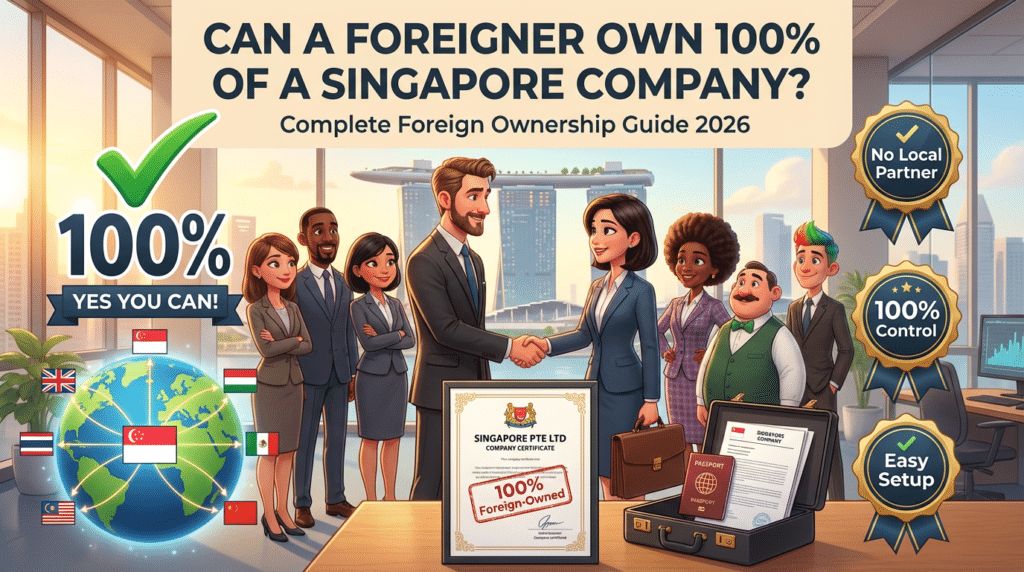
Quick Answer: Yes, foreigners can own 100% of a Singapore private limited company. No local partner or local shareholding is required. No equity restrictions apply. The only requirement is that your company must have at least one director who is an ordinary resident of Singapore.
Singapore welcomes foreign entrepreneurs with open arms. Unlike many Asian countries, Singapore places no restrictions on foreign ownership of companies. You can own every single share and maintain full control. This makes understanding the foreign ownership Singapore company 2026 rules crucial for international investors.
This guide explains exactly how foreign ownership works in Singapore. We cover the requirements, the process, and the costs involved in incorporating a Singapore company.
Table of Contents
- Foreign Ownership Rules in Singapore
- Risks vs. Benefits of Foreign Ownership
- The Resident Director Requirement (2026 Update)
- Foreigner vs. Local Director Comparison
- Nominee Director: Solutions for Non-Residents
- Step-by-Step Incorporation Process
- Detailed Setup Costs
- Key Tax Implications for Foreign Owners
- Expert FAQ (12 Key Questions)
Foreign Ownership Rules in Singapore
Singapore imposes no restrictions on foreign ownership of private limited companies. This applies to most business activities regulated by the Accounting and Corporate Regulatory Authority (ACRA). For a deeper look at entity choices, see our guide on Singapore Company Types & Structures.
What you can do as a foreign owner:
- Own 100% of the shares with zero local equity requirements.
- Appoint yourself as a director (if you satisfy residency via an EP).
- Receive dividends tax-free under the single-tier system.
- Transfer shares freely and hire foreign employees through your entity.
- Expand regionally using our Malaysia Hub for cross-border growth.
Risks vs. Benefits of Foreign Ownership
While 100% foreign ownership is a significant advantage, it's important to weigh the pros and cons. This balanced view helps in making an informed decision, a key aspect for any non-resident owning a Singapore company.
| Benefits (Pros) |
|---|
| Full Control: You retain 100% control over business decisions, strategy, and operations without needing local partner approval. |
| 100% Profit Retention: All profits belong to you as the owner. There is no mandatory profit-sharing with local entities. |
| Access to a Stable Economy: Leverage Singapore's world-class infrastructure, political stability, and strong legal framework. |
| Attractive Tax System: Benefit from low corporate tax rates, tax exemptions for new startups, and no capital gains tax. |
| Risks (Cons) |
| Reliance on Nominee Director: If you don't relocate, you must appoint a nominee director, which involves trust and an annual fee. |
| Higher Compliance Costs: The need for a nominee director and a registered filing agent can increase annual compliance costs compared to a local setup. |
| Navigating Foreign Regulations: As a foreigner, you must stay updated on Singapore's Companies Act and tax laws, a key part of Singapore corporate compliance. |
The Resident Director Requirement
Here is the one requirement you must understand. Every Singapore company needs at least one resident director. This is mandated under the Singapore Companies Act.
Who qualifies as a resident director in 2026?
- Singapore Citizen or Permanent Resident
- Employment Pass holder (2026 Min. Salary: S$5,600)
- EntrePass holder
Foreigner vs. Local Director Comparison
Choosing between relocating as a foreign director or appointing a local nominee is a critical decision. This table breaks down the key differences:
| Feature | Foreign Director (with EP) | Nominee Director |
|---|---|---|
| Role | Active, hands-on management of the company. | Non-executive role to fulfill statutory requirements. |
| Control | Full operational and strategic control. | No operational control; acts only on your instructions. |
| Cost | EP application fees and meeting the minimum salary requirement. | Annual service fee (typically S$2,000 - S$3,500). |
| Residency | Must reside and work in Singapore. | A Singapore resident acting on your behalf. |
| Liability | Full directorial duties and liabilities under the Companies Act. | Liability is limited as defined in the service agreement. |
Nominee Director: The Solution for Non-Residents
What if you do not plan to move to Singapore? You have two options. A nominee director is a professional who serves as your local director on paper. At Terra Advisory, our nominee directors satisfy the resident director requirement while acting strictly according to your instructions through a secure service agreement.
Step-by-Step Incorporation Process (2026 Workflow)
Incorporating a foreign-owned Singapore company takes about 1-2 weeks. Here is the detailed process:
Step 1: Choose Your Company Name
Pick a unique name for your company. Check availability using the ACRA BizFile+ portal. For tips on branding, refer to our guide: How to Select Your Ideal Company Name.
Step 2: Prepare Required Documents
Gather passport copies and proof of address for all officers. You must define your business activities using SSIC codes and prepare the Company Constitution.
Step 3: Arrange Your Resident Director
Decide how you will meet the residency requirement. You can identify a local contact in Singapore, engage our professional Nominee Director Service, or plan your relocation with an Employment Pass once the entity is live.
Step 4: Secure a Registered Address
Every company needs a local physical address (no P.O. Boxes allowed). Most founders use a Virtual Office address provided by their secretary for official correspondence and statutory compliance.
Step 5: Submit Your Application
Foreigners cannot submit directly; you must use an ACRA Registered Filing Agent. Terra Advisory submits the application via BizFile+ on your behalf.
Step 6: Receive Your Certificate & UEN
Approval typically takes 1-24 hours. You receive a digital Certificate of Incorporation and your Unique Entity Number (UEN), which you can verify via official ACRA resources.
Step 7: Open a Corporate Bank Account
With your UEN, you can open a business account. Major banks like DBS, UOB, and OCBC are standard choices.
How Much Does It Cost? (2026 Estimates)
Understanding the Singapore company incorporation cost 2026 is vital for budgeting. Here is a breakdown of typical expenses:
| Item | Cost Range (SGD) |
|---|---|
| ACRA Registration & Name Fees | S$315 |
| Professional Filing Fee | S$500 - S$1,500 |
| Nominee Director (Annual) | S$2,000 - S$3,500 |
| Corporate Secretary & Address | S$500 - S$1,000 |
| Total Setup (Estimated) | S$1,330 - S$6,330 |
Key Tax Implications for Foreign Owners
Singapore's tax system is a major draw for foreign investors. Here are the key points to note:
- Corporate Tax Rate: A flat rate of 17% on chargeable income.
- Tax Exemption for New Start-ups: New companies enjoy a 75% tax exemption on the first S$100,000 of normal chargeable income for the first three consecutive years.
- No Capital Gains Tax: Singapore does not impose a tax on capital gains.
- Single-Tier Dividend System: Dividends paid by a Singapore company are tax-exempt in the hands of shareholders.
- Withholding Tax: Payments made to non-residents (e.g., interest, royalties) may be subject to withholding tax. Our corporate tax services can provide detailed guidance.
Frequently Asked Questions (12 Expert Insights)
1. Can a foreigner own 100% of a Singapore company in 2026?
Yes. Foreigners (individuals or entities) can own 100% of the shares in a Private Limited company with no local partner requirements.
2. Do I need a local partner in Singapore?
No. You do not need a Singaporean shareholder or partner. You only need to fulfill the resident director requirement.
3. What is the 2026 EP salary for a director?
As of Jan 1, 2026, the minimum salary for an EP is S$5,600 (S$6,200 for financial services), which increases for older, more experienced candidates.
4. How much does it cost to set up?
Basic setup is between S$1,330 and S$2,830. Including a Nominee Director, costs typically range from S$3,330 to S$6,330 per year.
5. Can I open a bank account remotely?
Yes, neo-banks allow remote opening. Traditional banks prefer video or physical meetings for KYC (Know Your Customer) verification.
6. What are the tax benefits for foreign owners?
New companies enjoy a 75% exemption on the first S$100,000 of taxable income for the first three consecutive years. See our Corporate Tax Services for more info.
7. How long does the process take?
ACRA approval takes 1-2 days. Total setup through an ACRA Registered Filing Agent usually takes 1-2 weeks.
8. Is a physical office mandatory?
Yes. You must have a registered office address in Singapore (no P.O. Boxes). Many entrepreneurs use our Virtual Office services.
9. Can I be the sole director and shareholder?
Yes, provided you are a Singapore resident. Non-residents can be sole shareholders but must appoint a local resident director.
10. Does the 2026 COMPASS framework apply?
Yes. All new EP applications for directors must score at least 40 points on the COMPASS points-based system. This is a key part of the Singapore S Pass and EP framework.
11. What is the minimum capital required?
The legal minimum is S$1, though we recommend at least S$50,000 for visa applications and bank credibility.
12. Can I run the company from Malaysia?
Absolutely. You can manage your firm remotely from Malaysia while using our Nominee Director service. Explore regional expansion via our Malaysia Registration Guide.
Next Steps
Starting a foreign-owned company in Singapore is straightforward. The process is clear, the costs are reasonable, and the benefits are significant.
If you are ready to proceed, here is what to do:
- Select Your Name: Decide on your company name and business activities (check availability on BizFile+).
- Confirm Residency: Determine how you will meet the resident director requirement.
- Gather Identification: Prepare your passport scans and address proof.
- Consult an Expert: Get in touch with our team for a free consultation.