

Can a non-resident own a Singapore company?
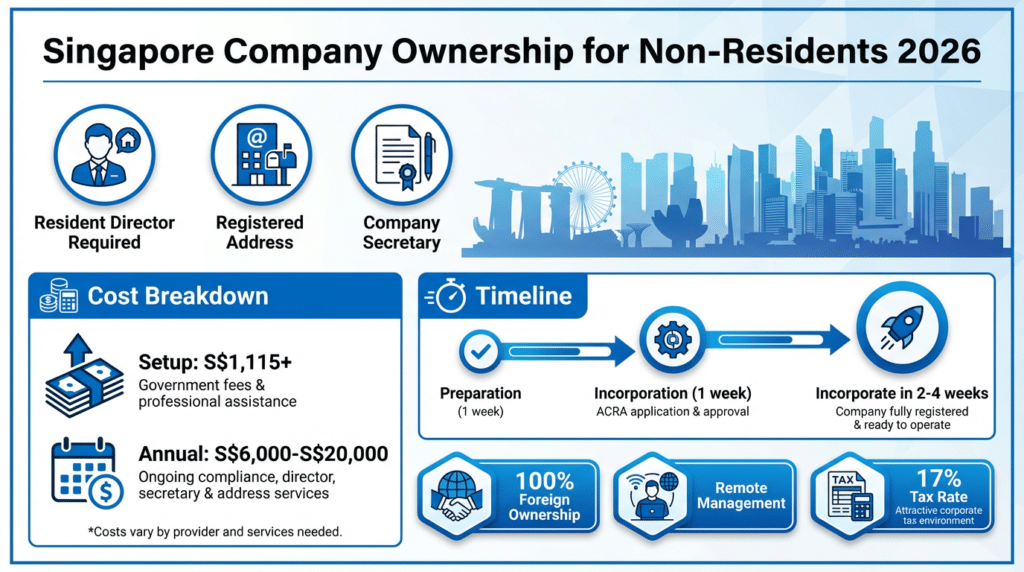
Yes. Non-residents can own 100% of a Singapore private limited company (Pte Ltd) with no local partner required. Singapore imposes no foreign ownership restrictions for most industries. However, every Singapore company must have at least one director who is ordinarily resident in Singapore — a Singapore Citizen, Permanent Resident, Employment Pass holder, or EntrePass holder. Non-residents who do not plan to relocate typically appoint a professional nominee director to meet this requirement while retaining full ownership and control.
Quick Reference — Non-Resident Ownership at a Glance
| Requirement | Rule (2026) | Source |
|---|---|---|
| Foreign ownership | 100% permitted — no local partner needed | ACRA |
| Resident director | At least 1 required (Singapore Citizen, PR, EP, or EntrePass holder) | Companies Act |
| Company secretary | Must appoint within 6 months of incorporation | Companies Act |
| Registered address | Singapore physical address required (no P.O. Boxes) | ACRA |
| Minimum paid-up capital | S$1 (S$10,000+ recommended for bank credibility) | ACRA |
| Nominee director cost | S$2,000–S$3,500/year (professional firm) | Market rate |
| Incorporation timeline | 1–3 business days via BizFile+ | ACRA |
| Annual compliance | AGM/written resolution, annual return, corporate tax return | ACRA, IRAS |
What Does "Non-Resident Ownership" Mean in Singapore?
Singapore company ownership for non-residents is straightforward. As a non-resident, you can own every share in a Singapore private limited company. You do not need a local partner. You do not need to live in Singapore. Furthermore, you do not need to visit Singapore to incorporate your company.
What you do need, however, is at least one director who is ordinarily resident in Singapore. This is the only statutory requirement that distinguishes a non-resident owner from a Singapore-based owner. Everything else — ownership, control, profits, and decision-making — belongs entirely to you.
This guide explains exactly how non-resident ownership works in 2026, what it costs, how to manage your company remotely, and what compliance obligations apply once your company is incorporated.
Can a Non-Resident Own 100% of a Singapore Company?
Yes — and this is one of Singapore's most significant advantages for foreign investors.
Unlike many Asian jurisdictions, Singapore imposes no equity restrictions on foreign ownership. A non-resident individual or a foreign corporation can hold 100% of the shares in a Singapore Pte Ltd. There is no mandatory local shareholding, no minimum local equity percentage, and no requirement for a Singaporean business partner. For more details on ownership rules and tax implications, see our guide on whether a foreigner can own 100% of a Singapore company.
This open ownership policy applies to most industries. Consequently, Singapore consistently attracts foreign entrepreneurs, regional holding companies, and international investors who want a stable, tax-efficient base in Asia. According to ACRA's data, Singapore recorded 58,077 new company incorporations in 2025 — a significant proportion of which were foreign-owned.
There are, however, limited exceptions. Certain regulated sectors — including media, legal services, and specific financial services — impose ownership restrictions. For most commercial activities, though, 100% non-resident ownership is fully permitted and legally protected under Singapore law.
The One Requirement Non-Residents Must Meet
Every Singapore company must have at least one director who is ordinarily resident in Singapore. This is the single most important requirement for non-resident owners to understand.
Who Qualifies as a Resident Director?
Under the Singapore Companies Act, a resident director must be one of the following:
- A Singapore Citizen
- A Singapore Permanent Resident (PR)
- An Employment Pass (EP) holder — minimum salary S$5,600/month in 2026 (S$6,200 for financial services)
- An EntrePass holder — for foreign entrepreneurs starting innovative businesses in Singapore
As a non-resident living abroad, you will not qualify as a resident director unless you hold one of these statuses. Therefore, you have two practical options: appoint a professional nominee director, or apply for an Employment Pass and relocate to Singapore.
Option 1: Appoint a Nominee Director (Most Common for Non-Residents)
A nominee director is a Singapore-resident professional who serves as your company's statutory director on paper. Critically, a nominee director does not manage your business, access your bank accounts, or make commercial decisions. Their role is strictly limited to compliance matters.
With a proper service agreement, Power of Attorney, and Deed of Indemnity in place, you retain full operational control. The nominee director simply fulfils the residency requirement on your behalf. This arrangement is standard practice for non-resident owners and is fully recognised under Singapore law. For a comprehensive understanding of nominee director risks and protections, see our complete guide to nominee directors in Singapore.
2026 Nominee Director Costs:
| Provider Type | Annual Fee (SGD) | Risk Level |
|---|---|---|
| Freelance individual | S$1,000–S$1,500 | High |
| Budget corporate firm | S$1,500–S$2,000 | Medium |
| Professional corporate firm | S$2,500–S$4,000 | Low |
Terra Advisory Services provides a professional nominee director service with full legal protection, including a Deed of Indemnity and undated resignation letter.
Option 2: Apply for an Employment Pass and Relocate
If you plan to move to Singapore and manage your company in person, you can apply for an Employment Pass (EP) as a director of your own company. Once approved, you become a resident director and no longer need a nominee.
However, the EP requires a minimum monthly salary of S$5,600 in 2026, and your company must demonstrate genuine business activity. This option suits entrepreneurs who intend to build a Singapore-based operation rather than manage remotely.
How to Set Up a Singapore Company as a Non-Resident (Step-by-Step)
Setting up a Singapore company as a non-resident is entirely possible without visiting Singapore. The process is digital, fast, and straightforward when you work with an ACRA Registered Filing Agent.
Step 1: Choose Your Company Name
First, select a unique company name and check availability on ACRA's BizFile+ portal. Your name must not be identical or confusingly similar to existing entities. Additionally, avoid restricted words such as "Bank," "Insurance," or "School," which require prior approval from the relevant regulatory authority.
Step 2: Decide How to Meet the Resident Director Requirement
Next, determine how you will satisfy the resident director requirement. Most non-residents appoint a professional nominee director at this stage. Alternatively, if you plan to relocate, begin your Employment Pass application in parallel with incorporation.
Step 3: Prepare Your Documents
Gather the following before filing:
- Passport copy and proof of residential address for all shareholders and directors
- Proposed company name and business activity description
- SSIC code (Singapore Standard Industrial Classification) for your business activity
- Decision on paid-up capital amount
- Company Constitution (Model Constitution is acceptable for most companies)
Step 4: Engage an ACRA Registered Filing Agent
Non-residents cannot submit incorporation applications directly through BizFile+. Therefore, you must use an ACRA Registered Filing Agent. Terra Advisory Services submits the application on your behalf, typically within one to two business days of receiving complete documents.
Step 5: Receive Your UEN and Certificate of Incorporation
Once ACRA approves your application — usually within one to three business days — you receive a digital Certificate of Incorporation and your Unique Entity Number (UEN). Your company is now legally incorporated.
Step 6: Open a Corporate Bank Account
With your UEN, you can open a corporate bank account. Traditional banks such as DBS, UOB, and OCBC require KYC verification, which may involve a video call or physical visit. Digital banks and neo-banks, however, allow fully remote account opening. Terra Advisory assists clients with bank introductions to reduce onboarding friction.
Step 7: Set Up Compliance and Accounting
Finally, establish your compliance framework from day one. Appoint a company secretary within six months of incorporation. Set your financial year-end. Arrange bookkeeping and accounting services. Understanding your ongoing obligations from the start prevents costly penalties later.
How to Manage a Singapore Company Remotely as a Non-Resident
One of the most common questions from non-resident owners is: "Can I run my Singapore company from overseas?" The answer is yes — and many thousands of non-residents do exactly this.
What You Can Do Remotely
As a non-resident owner, you can manage the following entirely from abroad:
- Sign board resolutions and shareholder resolutions electronically
- Instruct your nominee director on compliance matters via written communication
- Access company bank accounts as the sole authorised signatory (banks issue internet banking access regardless of your location)
- File corporate tax returns through IRAS myTax Portal (via your corporate secretary)
- Update company information on BizFile+ through your ACRA Registered Filing Agent
- Invoice clients and receive payments in Singapore dollars or foreign currencies
What Requires Local Presence
Certain activities, however, benefit from or require local presence:
- Bank account opening at traditional banks (DBS, UOB, OCBC) — often requires a video call or in-person meeting for KYC
- Government grant applications — some Enterprise Singapore grants require a local representative
- Regulated licences — financial, healthcare, and food licences may require a local responsible person
For most commercial activities, though, remote management is entirely practical. Singapore's digital infrastructure — including BizFile+, IRAS myTax Portal, and CorpPass — is designed to support online management.
Annual Compliance Obligations for Non-Resident Owners
Owning a Singapore company comes with ongoing compliance obligations. These obligations begin immediately after incorporation — not at year-end. Understanding them upfront prevents penalties and keeps your company in good standing.
Key Annual Deadlines
| Obligation | Deadline | Penalty for Default |
|---|---|---|
| Company Secretary appointment | Within 6 months of incorporation | Offence under Companies Act |
| Annual General Meeting (AGM) or written resolution | Within 6 months of financial year-end | Up to S$5,000 per director |
| Annual Return filing (ACRA) | Within 7 months of financial year-end | S$300–S$600 |
| Estimated Chargeable Income (ECI) | Within 3 months of financial year-end | IRAS estimated assessment |
| Corporate Income Tax Return | 30 November each year | Penalty + estimated assessment |
For a complete compliance calendar and detailed obligations, see our Singapore corporate compliance guide for 2026.
Tax Obligations for Non-Resident Owners
Singapore's corporate tax system is one of the most competitive in Asia. The flat corporate tax rate is 17%. However, new companies benefit from significant startup tax exemptions:
- 75% exemption on the first S$100,000 of chargeable income (first three years)
- 50% exemption on the next S$100,000 of chargeable income (first three years)
- 40% Corporate Income Tax (CIT) rebate capped at S$30,000 for Year of Assessment 2026
Importantly, Singapore operates a territorial tax system. This means your Singapore company is taxed only on income sourced in Singapore or remitted to Singapore. Foreign-sourced income that remains offshore is generally not taxable in Singapore, subject to conditions. Additionally, Singapore has no corporate withholding tax on dividends paid to shareholders.
Furthermore, Singapore has no capital gains tax. As a non-resident owner, you can receive dividends from your Singapore company tax-free under the single-tier dividend system.
Non-Resident Ownership vs. Relocating to Singapore
Many non-residents eventually consider whether to relocate to Singapore and manage their company in person. The table below compares both approaches to help you decide.
| Factor | Non-Resident Ownership | Relocating with Employment Pass |
|---|---|---|
| Residency required | No | Yes |
| Nominee director needed | Yes (annual cost: S$2,000–S$4,000) | No |
| Operational control | Full (via service agreement) | Full (direct) |
| EP salary requirement | Not applicable | S$5,600/month minimum (2026) |
| Bank account opening | Possible remotely (neo-banks) or via video KYC | Straightforward in person |
| Government grants | Limited access | Full access |
| Best suited for | Remote entrepreneurs, holding companies, regional HQs | Founders building a Singapore-based team |
Neither approach is inherently better. The right choice depends on your business model, whether you need to hire locally, and whether you plan to live in Singapore long-term.
Costs of Non-Resident Company Ownership in Singapore (2026)
Understanding the full cost of non-resident ownership helps you budget accurately from the start. Beyond incorporation and nominee director fees, you'll also need to budget for accounting services and compliance costs in 2026.
One-Time Setup Costs
| Item | Cost (SGD) |
|---|---|
| ACRA name reservation | S$15 |
| ACRA incorporation fee | S$300 |
| Professional filing fee | S$500–S$1,500 |
| Total government + filing | S$815–S$1,815 |
Annual Recurring Costs
| Item | Cost (SGD/year) |
|---|---|
| Nominee director service | S$2,000–S$4,000 |
| Company secretary + registered address | S$500–S$1,200 |
| Accounting and bookkeeping | S$1,200–S$3,600 |
| Corporate tax filing | S$500–S$1,500 |
| Total annual (estimated) | S$4,200–S$10,300 |
These costs are significantly lower than maintaining a physical office or hiring local staff. Moreover, the tax savings from Singapore's startup exemptions typically offset the compliance costs within the first year of operation.
Frequently Asked Questions (10 Expert Answers)
1. Can a non-resident own 100% of a Singapore company?
Yes. Non-residents can own 100% of a Singapore private limited company with no local partner or local equity requirement. The only statutory requirement is that the company has at least one director who is ordinarily resident in Singapore.
2. Do I need to visit Singapore to incorporate a company?
No. The entire incorporation process can be completed remotely through an ACRA Registered Filing Agent. You do not need to visit Singapore at any stage of the incorporation process.
3. What is a nominee director and do I need one?
A nominee director is a Singapore-resident professional who serves as your company's statutory director on paper. If you are a non-resident and do not hold an Employment Pass or Singapore PR, you need a nominee director to meet the resident director requirement. The nominee director does not manage your business or access your bank accounts.
4. Can I be the sole shareholder and director as a non-resident?
You can be the sole shareholder. However, you cannot be the sole director unless you are ordinarily resident in Singapore. You must appoint at least one resident director alongside yourself, or use a nominee director service.
5. How do I open a Singapore corporate bank account as a non-resident?
Digital banks and neo-banks allow fully remote account opening for Singapore companies. Traditional banks (DBS, UOB, OCBC) typically require a video call or in-person meeting for KYC verification. Terra Advisory assists clients with bank introductions to simplify this process.
6. Will my Singapore company be taxed on overseas income?
Generally, no. Singapore operates a territorial tax system. Income sourced outside Singapore and not remitted to Singapore is typically not subject to Singapore corporate tax. However, specific rules apply depending on the nature of income and applicable tax treaties.
7. Can I receive dividends from my Singapore company as a non-resident?
Yes. Singapore operates a single-tier dividend system. Dividends paid by a Singapore company are tax-exempt in the hands of shareholders, regardless of their residency. There is no withholding tax on dividends paid to non-resident shareholders.
8. How long does it take to incorporate a Singapore company remotely?
Once all documents are in order, ACRA typically approves incorporation within one to three business days. The total process — from document preparation to receiving your UEN — usually takes one to two weeks when working with a professional filing agent.
9. What happens if my nominee director resigns?
Your service agreement should include an undated resignation letter from the nominee director. If the nominee resigns, you have a defined period to appoint a replacement resident director. Terra Advisory manages this transition as part of our nominee director service.
10. Do I need a physical office in Singapore?
You need a registered office address in Singapore — but not a physical office that you occupy. Most non-resident owners use a registered address service provided by their corporate secretary. This address is used for official correspondence and ACRA registration.
Is Singapore the Right Choice for Non-Resident Owners?
Singapore is one of the few jurisdictions in the world where non-residents can own a company outright, manage it remotely, and benefit from a world-class tax and legal framework — all without relocating. The combination of 100% foreign ownership, a 17% corporate tax rate, no capital gains tax, and a fully digital incorporation process makes Singapore uniquely accessible for international entrepreneurs.
That said, the nominee director requirement and annual compliance obligations add cost and complexity compared to simpler offshore structures. The key question is whether Singapore's strategic advantages — ASEAN market access, banking infrastructure, investor credibility, and tax treaties — justify those costs for your specific business model.
For most non-resident entrepreneurs building a regional business, the answer is yes. For those seeking a pure holding structure with minimal activity, Singapore remains competitive but should be evaluated alongside alternatives such as the British Virgin Islands or Cayman Islands.
Next Steps for Non-Resident Owners
If you are ready to incorporate a Singapore company as a non-resident, here is what to do next:
- Read the complete incorporation guide — Singapore Company Incorporation 2026: Requirements, Costs & Process
- Understand the nominee director requirement — Nominee Director Singapore: Risks, Costs & Protection 2026
- Review post-incorporation obligations — Singapore Corporate Compliance 2026
- Contact Terra Advisory for a free consultation — we handle the entire process remotely, from incorporation to ongoing compliance.
Terra Advisory Services — ACRA Registered Filing Agent (FA20122913) · UEN: 201207025E
Verify our credentials on ACRA BizFile+ →
References
- ACRA — Foreigners Registering a Business in Singapore
- ACRA — Company Registration Fees
- ACRA — Appointing Directors and Secretary
- IRAS — Corporate Income Tax Rate
- IRAS — Tax Exemption Scheme for New Start-Up Companies
- Ministry of Manpower — Employment Pass
- Singapore Companies Act (Cap. 50)
- ACRA — Annual Return Filing
Important Notice
The information provided on this page is for general informational purposes only and should not be relied upon as legal, immigration, financial, or professional advice. While Terra Advisory Services Pte. Ltd. endeavours to keep the content accurate and current, Singapore government policies, regulations, fees, and procedures may change at any time without prior notice.
For the most up-to-date and authoritative information, please refer directly to official government sources, including the Immigration and Checkpoints Authority (ICA), Ministry of Manpower (MOM), and other relevant agencies.
Any reliance you place on the information on this website is strictly at your own risk. Terra Advisory Services Pte. Ltd. shall not be held liable for any loss, damage, or inconvenience arising from the use of this content. For advice tailored to your specific circumstances, please contact a Terra Advisory Services professional.